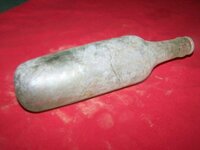
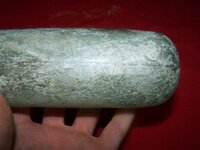
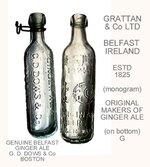
I've got one of those around somewhere. I've looked at it many times but never took the time to research it. Hope to see an ID.
I have heard 2 things. One its called a torpedo bottle and its from 1880 - 1910. And its used for soda. Another person told me it was used for wine and the bottom was rounded so that the bottle wont stand up so the cork in the bottle wouldnt dry out.
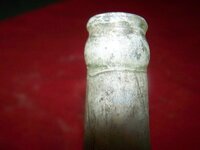
It appears to be an applied-lip, crown-top ginger ale bottle. That would date it to say 1892 to 1910 or so. Crown-tops became universal after the automatic bottling machines took over the industry, but that was a transitional takeover that extended into the WWI era.
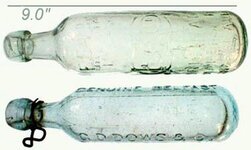
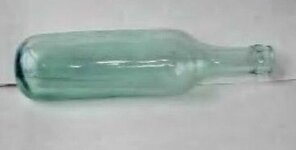
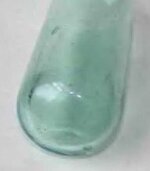
This is just a "round-bottom." A "torpedo" (a.k.a. "hamilton") actually tapers to a pointed bottom.
“A man should keep his little brain attic stocked with all the furniture that he is likely to use, and the rest he can put away in the lumber room of his library, where he can get it if he wants it.”
--Sherlock Holmes (Arthur Conan Doyle) in "The Sign of Four"
Harry is "right on" with his info on that particular bottle. One thing to add is ...Yes, the round bottom and torpedo bottom bottles were designed to lay on their side, but they were not for wine. They held the early carbonated beverage of gingerale (as Harry said).
The contents were under pressure and if the cork dried out, it shrank in size and the cork would blow out, the contents would lose the carbonation or "fizz" effect and it would just be flat tasting. By lying on its' side, the cork remained wet and the bottom of the cork stayed flared out or expanded inside the neck of the bottle and the contents remained fresh and fizzy.
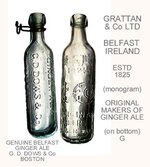
Here's a better image of my two round-bottom ginger ale bottles:
“A man should keep his little brain attic stocked with all the furniture that he is likely to use, and the rest he can put away in the lumber room of his library, where he can get it if he wants it.”
--Sherlock Holmes (Arthur Conan Doyle) in "The Sign of Four"
I realize this topic is several months old, but someone brought it to my attention and asked me to post the following link. The photos are from the link. And please be reminded, as Harry Pristis already said, the "Crown" top closure was not patented until 1892, and that it took several years (early 1900s) before it became widely used.