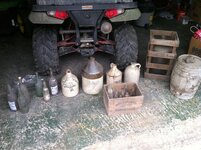
Good score. Those old jugs should be worth something.
Behold, ye despisers, and wonder, and perish: for I work a work in your days, a work which ye shall in no wise believe, though a man declare it unto you. Acts 13:41
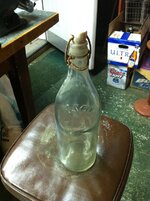
What about the hires water jug? Are they worth anything?
I don't know, but I would think all the old jugs would be worth something. Should be able to find out about them with Google.
Behold, ye despisers, and wonder, and perish: for I work a work in your days, a work which ye shall in no wise believe, though a man declare it unto you. Acts 13:41
lets see some close ups of the crook jugs and soda bottles. that carboy is a nice find in the box. a wild guess with out close ups i would say you have at least 300.00 there maybe a lot more
Great finds! I would be interested in the date of the Hires bottle, and whether or not the bottle itself has any other embossment on it. Look on the underside of the base and there should be a glass makers mark along with some other numbers and letters. Please describe and/or photograph what you find. A closeup of the sodas would be cool too.
Gracias'
SBB
P.S. The High Explosives box is pretty dang cool also. And I know you've heard this one, but I'm gonna share it anyway ...
Carboy or demijohn is what the big bottles are called. not positive of the spelling but I think that is right. any bottle 5gal or larger is a carboy. A demijohn can be as small as a gal
Thanks for the pictures. And while we have you in the hotseat, how'z about a couple of more questions ...
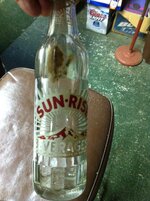
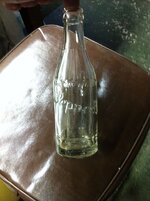
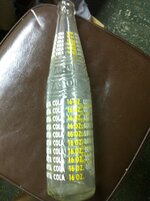
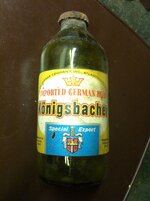
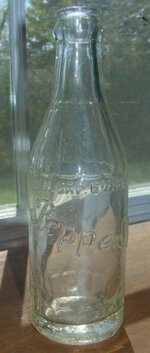
1. Please tell exactly what the deco style soda bottle says. All I can make out is something like ...
wap ... Pepper SS
Plus any info on the base like a makers mark - numbers - etc.
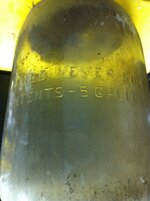
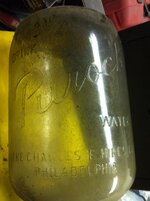
2. Hold on to and take good care of that five gallon Hires bottle. I suspect it may be something extremely rare. Are there any makers marks - numbers - etc on it's base?
I found the following connection between Charles Elmer Hires and "Purock Water." But there were no dates associated with it. However, it reads like it took place while Hires was still alive, which was ... Born 1851 - Died 1937
Charles E. Hires
Rose Hill
Charles E. Hires is best known as the originator of Hires Root Beer, a soft drink which gained great popularity in the 1870s. Hires began his career as a pharmacist and sold a variety of health remedies and flavoring extracts before introducing root beer as a healthful and refreshing alternative to beer.
He also sold ginger ale which was called champanale. While soft drinks were at the heart of his enterprise, he was a pioneer in manufacturing condensed milk and had factories in towns near dairy centers including Malvern, Pennsylvania. His Purock Water Company distributed spring water around the region and Hires water coolers were found in many Philadelphia area buildings. Hires’ sugar plantations in Cuba supplied his bottling plants around the country.
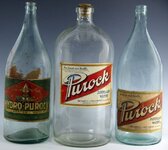
I've discovered they also produced "Purock Water" in quart sizes with paper labels from the 1920s. Apparently these quart size bottles are not necessarily rare or valuable, but definitely interesting.
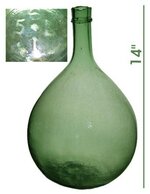
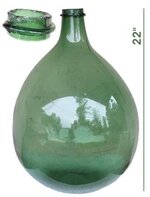
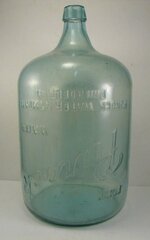
There is also a variation to the five gallon bottle (see below) which is described as a Demijohn. Notice the different closure (lip/top) on the one below and compare it to yours. The five gallon bottle below has Philidelphia, Pa. on it, but it does not have "Hires." Perhaps it was made before Hires bought the company.
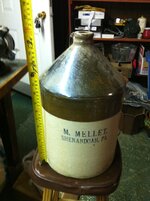
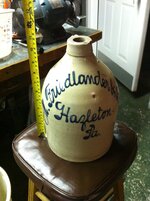
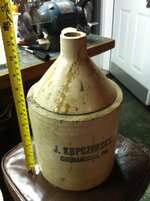
I apologize for bombarding your thread like this. But it's just my nature to do so when someone discovers something of interest to me. I just wish I knew a thing or two about ceramic jugs. Which I don't. But no doubt someone will come along soon who does.
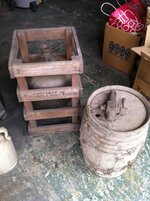
There is a "Purock" bottle almost identical to yours on e-bay right now. The seller is not familiar with dating codes, but based on his description I know it's an Owens/Illinois Glass Company bottle and made in 1952. The mark on the e-bay bottle looks something like this 28 <(I)> 52 Yours may have a similar mark. The two digits on the right are for the year it was made. The e-bay example currently has only one bid of $9.99, which indicates that the interest and rarity of it may not be as I suspected. Of course yours has the original wood frame, so that would just about double any true value. Straight up, without having to deal with shipping, etc., my educated guess on the value of your Purock/Hires bottle with original case is about $75.00 to $100.00. (I'd likely pay that much for one if I saw it in a local antique shop and didn't have to mess with shipping).
[font=comic sans ms]I would call all these water bottles "carboys" . . . right down to the half-gallon size.
Among collectors of hand-finished bottles, carboys are generally large bottles with short necks and wide mouths. Demijohns are thought of as being smaller with longer necks and a more-or-less standardized mouth diameter (without checking, I believe that diameter to be 1.25").
[size=12pt]
ETYMOLOGY OF THE TERM "DEMIJOHN"
The origins of the terms "demijohn" and "carboy" are interesting as they shed light on the historical details of their manufacture and use.
McKearin and Wilson, in their book AMERICAN BOTTLES & FLASKS AND THEIR ANCESTRY, provide this account:
Sometime about the middle of the 18th century, two new names entered the language to designate large glass bottles, usually wickered and used for transport of liquids. They were "demijohn" and "carboy," which were used sporadically by merchants and bottle manufacturers before the 19th century. "Carboy" was used far less often than "demijohn," at least in advertisements. Also, it would seem, neither was admitted to a dictionary until well into the 19th century.
According to accepted derivation, "carboy" was a corruption of the Persian "garabah"; "demijohn" of the old French "dame jeanne," as large bottles were called. Though the spelling of "carboy" apparently was consistent, that of "demijohn," perhaps because it was spelled mainly from its sound when spoken, was most unsettled before 1815; "demi-john," "demi jeanne," "Dame John," "dime-john," "Demie-John," "Demi John," "Demy John," "dimijohn," and "demijohn." "Demijohn," which became official, occurred most frequently.
In the newspaper advertisements covered, the name was not found until 1762, but in 1753 "wickered bottles wthat will hold 5 gallon" were advertised -- demijohns, of course -- which suggests that "demijohn," however spelled, was unfamiliar before the 1760s. In fact, THE OXFORD ENGLISH DICTIONARY (1933) gives 1769 as the date of its first appearance in print, and for "carboy," 1753, fourteen years before it was found in the advertisements.
In 1767, carboys ranging from a quart to seven gallons in size were offered to the public, and in 1792 demijohns of eight and nine gallons containing spirits of turpentine. The two names, it would seem, were used interchangeably in the eighteenth century, and for the same sizes of bottle. Afterward, the majority of demijohns were bottles from a quart to five gallons in capacity, a few up to ten gallons; carboys were principally a gallon to twenty gallons, with sizes from six gallons predominating.
And demijohns, wickered, were destined to contain non-corrosive and bland liquids, whereas carboys, set in very heavy wicker "tubs," were for acids and chemicals.
“A man should keep his little brain attic stocked with all the furniture that he is likely to use, and the rest he can put away in the lumber room of his library, where he can get it if he wants it.”
--Sherlock Holmes (Arthur Conan Doyle) in "The Sign of Four"
The Purock/Hires - Bottom is hard to read because of the dirt inside. It is ## <I> #. I will try to decifer tonight,.
Pepper S - it is not WAP it is CAP... Bottom reads Ashland PA and some numbers. I will try to decifer tonight.
The Purock/Hires - Bottom is hard to read because of the dirt inside. It is ## <I> #. I will try to decifer tonight,.
Pepper S - it is not WAP it is CAP... Bottom reads Ashland PA and some numbers. I will try to decifer tonight.
Thanks again...
Flip
That's a pretty nice haul! I like the stoneware jugs. Their hard to dig in this condition. DD
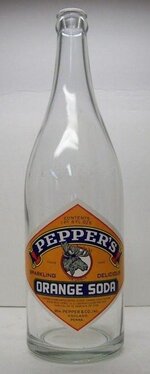
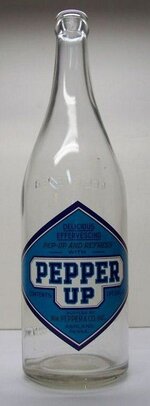
Thanks for the follow-up. It turns out that the so called Pepper S bottle is actually called "Pepper's" The large S on the end is just a clever designing of the spelling. The pictures below are variations of the different Pepper's bottles. All of them are from Ashland, Pa. I have no specifics on the dates, but they seem to range between the 1920s and 1950s. It wouldn't surprise me if the Dr Pepper Company sued the brand for copyright infringements. I haven't been able to find anything to confirm this yet, but I am still searching. The bottle doesn't appear to be rare or valuable, but it would likely be of interest to a Dr Pepper collector who also collects knock-off and copycat brands.
SBB
1st pic .... Possible variation of early embossed bottle (Smooth Sided. Yours appears to
be vertically fluted on the sides).
2nd pic ... Paper Label Variation
3rd pic .... Painted Label Variation "Pepper Up"
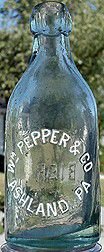
It looks like our mysterous Mr. William Pepper was also involved with bottling beer in the early days. Note that the following says he was a "Bottler" but not a "Brewery." Which has always seemed strange to me, but I have heard of this sort of thing occurring before. The bottle is a blob-top and would date sometime into the late 1800s. During the Prohibition years, which lasted between 1920 to 1933, a lot of beer makers/bottlers switched over to making soda pop. This may be what the Wm. Pepper & Co. of Ashland, Pa. did.
Wm. PEPPER & CO WEISS BIER (embossed beer bottle)
BEER BOTTLER - NOT AN ASHLAND, PA BREWERY
Aqua Green
½ Pint
Blob-top
Plate Mold
"REGISTERED" on back at heel
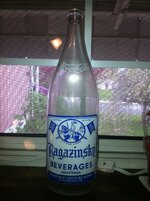
Great minds must think alike. Lol It just so happens that I am currently researching both the "Asco" and the "Ragazinsky" bottles. Unless someone comes up with something before I do ... I'll be back. And to tell you the truth, I'm thinking the "Ragazinsky" acl may be the best of the lot. Especially for a serious Pennsylvania collector.
By the way ... what do the date codes on the bases of both bottles show?