hello all i have just moved cross country from west coast to Alabama...I know there must be some places to hunt with the indian history, the civil war history (or the war of northern agression as i have heard the locals call it), moonshiners, etc....does anyone have a starting point, story, anything? i have been looking at topo maps, etc and hvent really found anything that strikes a chord...i am a fish out of water here...but a fish with many tools for treasure hunting... happy hunting
Where you live is near Tuskegee,Al. I dug in a ditch behind the Social services adminstrative building there and dug all kinds of old bottles,pottery jugs and enameled signs there.The building is not in the downtown area,but is in neighborhood near a apartment buildings and homes.The best time to dig is early Sunday morning when residents are still asleep.It is not in the best part of town,so caution should be excersized.Early Coca-Cola bottles sell for mucho money if you dig any.Sorry,I don't remember directions to site.By the way,I believe that Horseshoe bend is not for from you and would be nice to visit.
Go to your local library, history/genealogy society, etc.
I have found that local town/county history books yield vital information on old gathering spots.
There used to be very popular mineral springs in Alabama in the early to mid 1800s with resort type hotels where people came to soak in the mineral water. People used to come up from New Orleans and further to "take the water" in these places. I've found lots of old silver near Bladon Springs across the river from Coffeeville but the best areas are all off limits because of the state park. There are others on private and public property if you do a search for mineral springs.
There is an ole codger up here just outside of Birmingham that loves to do this sort of stuff. He has a wealth of knowledge on this type thing and now knows the laws about tresure hunting in Alabama better than anyone I know.
When the Alabama Historical Society made their laws about searching for relics so strict that by the letter of the law you could not pick up a broken bottle or an rusty coke can without violating the law, he was I think the first person they had arrested along with the owner of the outdoor channel. Now this ole codger don't take things lying down so he fought them so long and so hard that if I understand it correctly he is now on the board of the AHS and is working to change the laws.
He could not only tell you about some interesting sights but tell you how to make sure you don't end up in the hoosegow for doing a little something you love.
If you would like to come up and visit him let me know and I will see if I can arrange it.
"A Man should be able to change a diaper, plan an invasion, butcher a hog, conn a ship, design a building, write a sonnet, balance accounts, build a wall, set a Bone...cook a tasty meal, fight efficiently and die gallantly. Specialization is for insects."
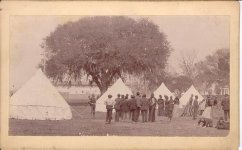
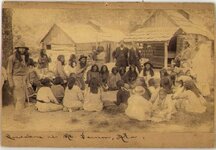
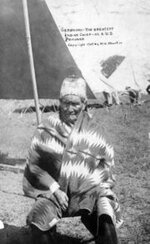
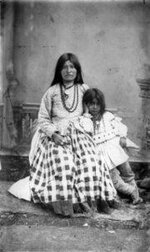
These were the followers of Geronimo. So it would be between 1887 and 1894.
Mount Vernon Arsenal and Barracks
Established 1828 by Congress to store arms and munitions for U. S. Army. Original structures completed 1830's. Arsenal appropriated by Confederacy 1861; equipment moved to Selma facilities. After Civil War used as U. S. Army barracks; from 1887-1894 served as holding ground for Apache Indian prisoners. Deeded to State of Alabama 1895.
Josiah Gorgas, later Chief of Ordnance of Confederacy, stationed here 1850's; Dr. Walter Reed, conqueror of yellow fever, served as post surgeon 1880's; Apache chieftain, Geronimo, prisoner here 1887-1894.
The Indians who did not follow him to Oklahoma after his release/death stayed and are now what are called the MOWA's(Mobile Washington County Indians). They are a mix of Indian, White, Black and Cajun. The US Gvmt has not recognized them as a tribe.
Correction: He was transferred to another Fort after Mt. Vernon:
February 18, 1909
OBITUARY
Old Apache Chief Geronimo Is Dead
Special to The New York Times
LAWTON, Okla., Feb. 17.--Geronimo, the Apache Indian chief, died of pneumonia to-day in the hospital at Fort Sill. He was nearly 90 years of age, and had been held at the Fort as a prisoner of war for many years. He will be buried in the Indian Cemetery tomorrow by the missionaries, the old chief having professed religion three years ago.
As the leader of the warring Apaches of the Southwestern territories in pioneer days, Geronimo gained a reputation for cruelty and cunning never surpassed by that of any other American Indian chief. For more than twenty years he and his men were the terror of the country, always leaving a trail of bloodshed and devastation. The old chief was captured many times, but always got away again, until his final capture, in 1886, by a small command of infantry scouts under Capt. H.W. Lawton, who, as Major General, was killed at the head of his command in the Philippines, and Assistant Surgeon Leonard Wood, today in command of the Department of the East, with headquarters at Governors Island.
The capture was made in the Summer, after a long and very trying campaign of many months, in which Lawton and Wood gained a reputation which will be long remembered in the annals of the army. Geronimo was at first sent to Fort Pickens, but was later transferred to Fort Sill. Until a few years ago he did not give up the hope of some day returning to the leadership of the tribes of the Southwest, and in the early years of his imprisonment he made several attempts to escape.
Geronimo was a Chiricahua Apache, the son of Chal-o-Row of Mangus-Colorado, the war chief of the Warm Spring Apaches, whose career of murder and devastation through Arizona, New Mexico, and Northern Mexico in his day almost equaled that of his terrible son. According to stories told by the old Indian during his last days, he was crowned war chief of his tribe at the early age of 16. For many years he followed the lead of old Cochise, the hereditary chief of the Apaches, who died in 1875 and was succeeded by Natchez, his son, who, however, was soon displaced by Geronimo with his superior cunning and genius for the Indian method of warfare.
After trailing the band led by Geronimo for more than ten years Gen. Crook would probably have captured him in 1875 had he not been transferred to duty among the Utes just as success seemed to be near at hand. For seven years after this the situation in the Southwest was the worst ever faced by the settlers. Crook was sent back in 1883. A large body of troops was placed at his disposal, and in a month he had succeeded in driving Geronimo back to his reservation, capturing him and his men on the Mexican border.
In 1885 Geronimo broke out again, and this time was surrounded by Crook in the Canon de los Embidos. But the Indians succeeded in slipping away, and Crook was removed and Nelson A. Miles placed in command. Miles had already gained a reputation as an Indian fighter, and while he did not exactly cut the field wires behind him to prevent interference from Washington, stories are told of the frequent disregard of troublesome messages.
Lawton and Wood were placed in command of the scouts late in the Summer of 1885. They asked permission to take a picked body of men into the hostile territory and endeavor to run down Geronimo. Gen. Miles finally sent them off with many misgivings. There followed months of privation and hardships which were never forgotten by the men who went with the two young officers. They were gone nearly a year, Gen. Miles often not knowing even where they were or whether or not they had been destroyed by the enemy. On the night of Aug. 20, 1886, the General was sitting at the telegraph instrument in the office at Wilcox, Ariz., waiting for dispatches, when the key suddenly clicked off the news that Geronimo and his men had been surrounded at the junction of the San Bernardino and Baische Rivers, near the Mexican border. Miles hastened there and met the chief on his way north under guard of Lawton. The old warrior was surrounded by about 400 bucks, squaws, papooses, and dogs. They had little else than their blankets and tent poles, and as Gen. Miles afterward stated in his memoirs, "The wily old chief had evidently decided to give up warfare for a time and live on the Government until his tribes gained sufficient strength to return to the warpath."
Gen. Miles writes: "Every one at Washington had now become convinced that there was no good in the old chief, and he was, in fact, one of the lowest and most cruel of the savages of the American continent." The people of the West demanded that he be not allowed to go back to the reservation. He and his bucks were accordingly sent to Fort Pickens and the squaws and papooses to Fort Marion, Florida. It was finally decided to keep Geronimo confined as a prisoner of war. His desire to get back to the West was so pitiful, however, that he was transferred to Fort Sill, where he spent the remainder of his days.
Gen. Wood tells an interesting anecdote of an incident which occurred one afternoon when he was guarding the old chief while Lawton went in search of his command, the location of which he had lost soon after the surrender: "About 2 o'clock in the afternoon the old Indian came to me and asked to see my rifle. It was a Hotchkiss, and he said he had never seen its mechanism. When he asked me for the gun and some ammunition I must confess I felt a little nervous, for I thought it might be a device to get hold of one of our weapons. I made no objection, however, and let him have it, showing him how to use it. He fired at a mark, just missing one of his own men who was passing. This he regarded as a great joke, rolling on the ground and laughing heartily and shouting, 'Good gun.'"
Gen. Miles, in his memoirs, describes his first impression of Geronimo when he was brought into camp by Lawton, thus: "He was one of the brightest, most resolute, determined-looking men that I have ever encountered. He had the clearest, sharpest dark eye I think I have ever seen, unless it was that of Gen. Sherman."
Im from Saraland and i never did get a chance to go hit this up or even find it for that matter. If you ever get a chance lemme know what you are able to come up with.
Also i was told that Mobile was actually up HW 43 a bit where Courtalds now is. Im not too sure of the validity of this but they also said that you could still see the old Church Street sign there in the woods. I only go home about once a year and im not able to go visit all the places i know of around Mobile.
I'm in the Auburn area too. I'm going to contact the Lee County Historical Society in Loachapoka. I was a member for a year and I think this is a good starting place. I'm going to start around the Mechanicsville cemetary this weekend as this is a small town that is on the Civil War maps. I sent you an email message to see if you wanted to get in contact with me.
Go out to Dauphin Island in Mobile Bay. AKA Massacre Island on some older maps. Home of Ft. Gaines. They will not let you detect on the grounds but you can search the beach. The was the site of the infamous Battle of Mobile Bay ("Damn the torpedoes...full steam ahead" - Admiral Farragot). Fort Morgen is on the other side of the bay. Wait for the next storm to roll through this summer....you'll find something!