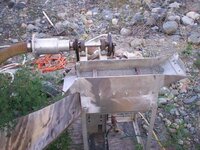
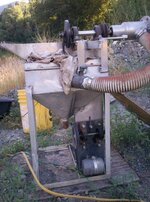
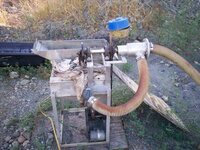
There is a big difference between a drywasher & a fluid bed.
A fluid bed would be a tank or large container such as a drum preferrably with a cone bottom. Air would be pumped in from the bottom just enough to keep everything fluid/moving. The heavier/gold would stay below anything lighter. The lightest flows out the top.
A lot of material could be processed fast & it would retain a lot of gold that would run off of a dry washer.
There is a big difference between a drywasher & a fluid bed.
A fluid bed would be a tank or large container such as a drum preferrably with a cone bottom. Air would be pumped in from the bottom just enough to keep everything fluid/moving. The heavier/gold would stay below anything lighter. The lightest flows out the top.
A lot of material could be processed fast & it would retain a lot of gold that would run off of a dry washer.
Yep, that's a drywasher.
Blows air through the material and lets the heavies (gold) settle out.
You keep the bed thin otherwise you have to increase the air pressure required to maintain the bed.
The ripple, is like what you're thinking about as a cone. The ripple and bed form a V.
Slide the material across it so you can continuously process material.
I could see something like this being a fun experiment, but one question that comes to mind is how efficient would it be compared to a traditional drywasher.
Also, while going through some of the Youtube vids, I came across a video of Virgil Hutton using a Garrett gold pan dry.
It made me think; If you took something like a LeTrap sluice and rigged it up to a jig as a makeshift drywasher, I wonder how well it would work?
Drywashers that utilize a constant flow offset elliptical vibrations are a fluidized bed as air supension creates the vortex that makes the gold settle to the bottom. Cone or riffle don't matter as exact same physics apply. I much prefer water powered but not a desert option. This pic is a good ol'Precision fluidized bed concentrator-John
Last edited by Hoser John; Oct 16, 2012 at 08:13 AM.
I could see something like this being a fun experiment, but one question that comes to mind is how efficient would it be compared to a traditional drywasher.
I think it would be more efficient. It's harder for the gold to get out.
The air shouldn't be blasting it should be just enough to keep everything stratified. The heavier gold is going to go to the bottom of the tank.
Last edited by nickmarch; Oct 16, 2012 at 09:18 AM.
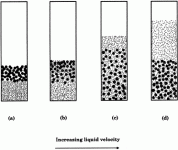
A fluidized bed is formed when a quantity of a solid particulate substance (usually present in a holding vessel) is placed under appropriate conditions to cause the solid/fluid mixture to behave as a fluid.
Fluidization (or fluidisation) is a process similar to liquefaction whereby a granular material is converted from a static solid-like state to a dynamic fluid-like state. This process occurs when a fluid (liquid or gas) is passed up through the granular material.
Objects with a higher density will sink, whereas an object with a lower density will float.
Allmineral has some commercial fluid bed and even air based products. I can kind of see with one demo what I think you were talking about with fluid bed ideas a few months back. Would still like to see a viable dry version with more reliable fine recovery.
Jcaz... I'm thinking about trying the solimar device in the middle video. It looks like it would work well with air & with water. One piece of equipment for wet & dry locations!
Gg... I've seen that before. It is dukes e sludge tank that got me thinking about water fluid beds & air fluid beds. Read the pdf & patent. It recovers the tiniest particles of gold & does it fast.
I have the sixth edition but there is now a seventh edition
'Mineral Processing Technology' provides practicing engineers and students of mineral processing, metallurgy and mining with a review of the common ore-processing techniques utilized in modern installations. Each chapter encompasses all the recent technical developments which are advancing at a rapid rate to deal with the processing of increasingly complex and refractory ores. New equipment and process routes are also discussed.
This seventh edition also highlights the developments and the challenges facing the mineral processor, particularly with regard to the environmental problems posed in improving the efficiency of the existing processes and also in dealing with the waste created. Four appendices are attached, one of which contains a valuable collection of BASIC computer programs. The work is fully indexed and referenced.
It's very technical but has all the info you need to become an expert at mineral recovery.
I've always been interested in centrifuges. Can't wait to see yours in action. You must have a garage full of cool equipment based on what I have seen in your posts!