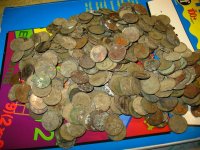
Thought I'd proudly share something that does not see the light of day too often - My pile of [mostly zinc] hopelessly corroded/bent/mauled pennies.
Must be close to 1,000.
Don't really want to throw them away, coinstar spits them out in record time, am not going to humiliate myself by taking them to the bank ,,, So I guess I am stuck with them, an ever increasing pile that my heirs can figure out what to do with.
These represent alot of exercise [and wasted time], you figure I had to bend over and pick up every one of these, most I had to dig for too.
Anyone so inclined, post your unwanted, useless ugly ducklings here.
Maybe a small percentage would be salvageable with a tumbler - The majority are beyond hope ,,, And it really wouldn't be worth the time & effort to tumble them.
Kind of an intentionally farce thread, not really looking for advice what to do with these, because I already know - Gonna save them, and let someone else down the line decide what to do.
Yes, unless they are freshly loss zinc, they almost always have enough zits or eaten away parts, that they would be very difficult to spend or use. As if modern pennies are almost NOT WORTH PICKING UP ANYHOW, zincs just make the matter worse
For this reason, when I'm turf hunting, I don't even stop to dig zincs, if I have reason to believe I'm hearing them with my TID. I'll strictly dig 6" or deeper coins only in the turf, and just pass all clad, to begin with. But on the beach, there's no avoiding them. Even if you try to only dig low conductors (to enhance the odds at gold jewelry), you still end up digging rotten zincs, that are so rotten, they read at mid conductor or even lower. I just throw them away.
My philosophy is, if I bend over to pick something up, then I'm taking it with me.
Hell, if I get 5,000 of them, then maybe they'll be worth taking to the bank.
I sometimes ignore low targets, ringing like a school bell, when field hunting - On the other hand, MD'ing is full of surprises, and it usually doesn't take much effort to retrieve a shallow target.
Too, sometimes its beneficial to remove the shallower stuff in a promising area, which can mask the deeper, more desirable targets.
I have found spots though where wheats, silver and even IHP's are only an inch or two down, so the "ignore anything 3 inches and less" strategy can have its risks of passing up keepers in the quest to avoid clad.
Nothing under 6' is extreme for me, thats about my max range for a coin with the Ace 250.
Xray, yes, it's possible that persons passing shallow clad *could* pass a shallow goodie. But it's all in the odds: if 99% of the time, a shallow zinc penny turns out to be ....... a shallow zinc penny, then that speaks for itself.
As far as masking, it is true that if you strip-mine out all the surface targets, you will eventually find things that the shallow stuff masked. Or put another way: some persons bristle at passing ANYTHING conductive in the turf (no matter how blighted or junky the turf is) because in their mind, you can have both the old, AND the new, if you "dig all". And they rationalize that sometimes an oldie is shallow (brought up by a gopher, etc...) and therefore, you can have "the best of both worlds". But invariably, here's what happens when you turf hunt in an old park, with someone using that mindset: At the end of the hunt, the person honing in on only deep coin-type sounds, will end up with 10 or 15 oldies (wheaties, silver, etc..) and only 3 or 4 clad. The person digging all will end up with 50 clad, and 2 or 3 oldies.
Now I dunno about you, but I'd rather have one silver dime, than 100 new ones, etc... The reason why the person digging all the shallow stuff will end the day with less oldies, is two-fold: 1) his ears become subconsciouly tuned to only the loud "bongs", and he ends up being less receptive, and thus subconsciously passing, the deep whispers. Contrast to the person passing shallow clad, he ends up ultimately becoming more receptive to just the deepies. 2) the clad hunter ends up spending lots of time on the ground digging and probing and such, and lessens his time that he could have spent, honing in on only oldies.
As for the "sometimes oldies are shallow in the turf", it is the exception, not the rule. So just as in black-jack, you "hold" when you have 20 in your hand, EVEN THOUGH the next card *might* be a one. You're following odds. And naturally this is all for stratified turf, where age is usually commensurate with depth.
Now turf jewelry hunting would be another matter altogether, as .... of course .... jewelry can be modern. There are still blighted inner-city urban parks where you would go psycho trying to dig all the foil and beaver tails out, in search of the elusive gold jewelry. I can imagine odds of worse than 100 to 1 in some parks I have been to. So in some turf, I'm strictly angling for old coins, and save my jewelry hunting for beaches, where jewelry odds/ratios are just better, to begin with.
You bring up some good points, and I'm glad your methods work well for you.
I am not really tied into set rules when it comes to hunting, I will vary my approach as I feel necessary.
The best lot I ever found I pulled up 100's of old coins. Wheats, V nickels, Buffalos, IHP's, silver and an assortment of artifacts - I doubt if I dug any of those over 4 inches, and no, the gophers didn't bring all of those up.
So in that lot, I obviously dug every target I could get a decent signal on, and am in fact still hunting it.
Out in some park or baseball field, I just might ignore shallow penny signals, and try for the deeper ones, in order to get a feel for whats out there.
We are all in it for something other than clad, to be sure - If we knew in advance that is all we would find, most of us wouldn't even try.
I've had my judgment and detectors judgment proved wrong enough times to know that you truly don't know what you got down there, until you dig it up ,,, And different circumstances sometimes calls for a different approach.
I may be missing out sometimes, but if you consistently dig only deep, then so are you.
put them in a bowl with water, vinegar, and some salt. the less water the stronger this is. after a minute or so the crud should loosen. you may need to scrub them a bit. you don't want to do this with collectible coins like wheats. if you don't care if it damages the coins then don't use any water.
For every ten dollars I hand the gas station, I also hand them a plastic baggie of $1.00 in 'beach change' (no quarters). I feel like I'm getting a discount at the pump--and this process also keeps the amount of my 'beach change' manageable.
I pass along a lot of my dug coins like that too Mack, I have two mason jars one for copper pennies to torn up to use and one for all the ate up zincs.
We have a homeless guy in our town that has no problem cleaning and spending the ones I give to him and his girlfriend. Where there is a will..there is a way
Woodland Detectors - Open 7 days, Toll Free 855-966-3563 - Build your own Packages!
I use to stick a few of these in every roll I took to the bank. Then I started getting them back in change! Now most of the time I just toss them. The best way I have found to get rid of them when the grandkids are visiting is to put them in a plastic bag and have one of my small grandkids take them up to a service desk and ask if they can get some money for them. Who can refuse a cherub? Then I let the grandkid buy something special with the good money they get. Sometimes they are told to beat it by some cold hearted Scrooge though! M nty
Don't make me loose the hounds! If you dig, Cover up your holes.
Tumble em and cash in all but the worst at the bank. As long as it it mostly intact, (something like 40%), they have to take them. A few zits and pock marks are okay.
And remember this. It only take 8 of them to recoup the inflation loss on a dollar. In this way, you are doing something even the bloated Federal Reserve Banking Consortium cannot do - you are restoring value to your own money.
1000 of them would revalue about $125.
You'll get it all. Or you won't
Someone else will get it. Or they won't
Someday, you'll die and leave it behind.
Act accordingly.