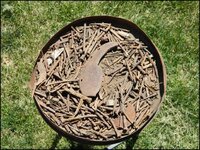
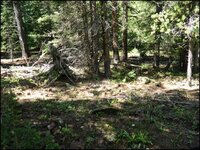
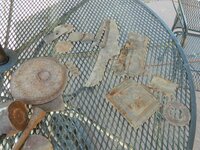
Recently found all these nails in a 10' x 15' area in gold country. Found a single foundation, lots of tin cans, cabin debris, etc and nails. LOTS of nails. So many in that one area I need to return and do more exploring.
Question: How would explain how so many nails got to one small area. And these were mostly laying on top of the ground. And they have different sizes and possible different dates. This area was crawling with placer miners from the 1880s on, so could be an interesting site.
BB
Man, that looks like a whole lot of digging there.
My guess is that was an area where somebody was burning lots of boards and wooden boxes with the nails still in them.
-Swartzie
Oldest coins: KG II Halfpence (1727-1760), Liberty Cap 1/2 cent (1795-1797), 1808 1/2 Real.
Man, that looks like a whole lot of digging there.
My guess is that was an area where somebody was burning lots of boards and wooden boxes with the nails still in them.
-Swartzie
Swartzie there was an older hunting camp nearby, and their firepit did have a bunch of nails. Wait......... I should have put that together. Elk hunting camp, Colorado high country, of course would need a lot of firewood. And the old cabin foundation could be their source. Makes perfect sense now. Thanks!
BB
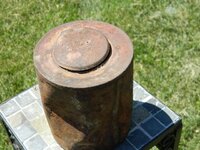
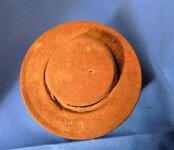
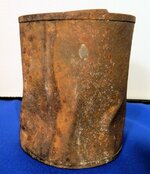
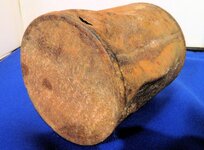
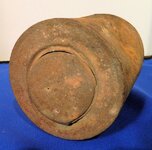
looks to be a Peach can,nice period solder seam can.Neat history behind that canning process
Peaches! Yes. What a treat after dozens of cans of beans.
Any idea of the date of the can? There were maybe three different eras that miners were up there. I think the late 1860s, another in the '80s and the most recent through 1900 or so?
That is a great old can. I can't tell from the photo, but is there a hole mark in the center of that cap? I see a small pinhole that is off center, I don't mean that one? I think it's a "hole and cap" can which is the earliest type of tin can produced. From the looks of the photo the side appears hand soldered, which is another indication of the age of it. If there is no mark from a small hole being soldered over in the center of that cap then it predates what is called a "hole in cap" can. It's at most a Civil War era can if not earlier.
DOWN WITH AMERICAN DIGGERS, SAY NO TO SPIKE TV! THEY MAKE ALL OF US LOOK BAD!
"Twenty years from now you will be more disappointed by the things you didn't do, than by the ones you did do." Mark Twain
"A handful of common sense is worth a bushel of learning." Unknown
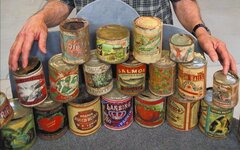
Also, there could have been any number of things in that can. Check out this collection from the 1880's with the labels still intact, that was featured on Antiques Roadshow, valued at 10-14k, I believe yours is older--
DOWN WITH AMERICAN DIGGERS, SAY NO TO SPIKE TV! THEY MAKE ALL OF US LOOK BAD!
"Twenty years from now you will be more disappointed by the things you didn't do, than by the ones you did do." Mark Twain
"A handful of common sense is worth a bushel of learning." Unknown
There is a definate dating process for them and I havent memorized anything past my period of interest which is the 1850's which it is not....the top edge is the give away there.
M.X.T , Tesoro Tejon 4"& 2.5" dredge with a little luck!!
Also, there could have been any number of things in that can. Check out this collection from the 1880's with the labels still intact, that was featured on Antiques Roadshow, valued at 10-14k, I believe yours is older--
Yes,very true,I stated Peaches because of my experiece in those type of camps,those are the most encountered.The Oyster cans were usually rectangle as were the Sardines...but yes,many different things did come in that style
There is a definate dating process for them and I havent memorized anything past my period of interest which is the 1850's which it is not....the top edge is the give away there.
The drop press was invented around 1850 I believe and partially mechanized the manufacturing by flanging the edges of the ends, so I agree with the 1850's being a good early date start point for the age. I think there may be a small vent hole that we can't see in the photo. I don't think the can is any newer than 1880's though.
There is a definate dating process for them and I havent memorized anything past my period of interest which is the 1850's which it is not....the top edge is the give away there.
The drop press was invented around 1850 I believe and partially mechanized the manufacturing by flanging the edges of the ends, so I agree with the 1850's being a good early date start point for the age. I think there may be a small vent hole that we can't see in the photo. I don't think the can is any newer than 1880's though.
There is a definate dating process for them and I havent memorized anything past my period of interest which is the 1850's which it is not....the top edge is the give away there.
The drop press was invented around 1850 I believe and partially mechanized the manufacturing by flanging the edges of the ends, so I agree with the 1850's being a good early date start point for the age. I think there may be a small vent hole that we can't see in the photo. I don't think the can is any newer than 1880's though.
LOL!Thats the one I was looking for!!Thanks
I have been a student of solder seamed cans for some time now as they are a great way to date your site.I have to say I have found some discrepancies in some of the literature vs. what I have seen in the field.The saying goes "The proof is in the pudding"?
M.X.T , Tesoro Tejon 4"& 2.5" dredge with a little luck!!
Horse shoe with nails Every miner would need them to care for his horse in the Rockies is my guess.
Problem with that theory is #1 I dont see a single horse shoe nail in the bunch and #2 very few miners had the luxury of a horse!!
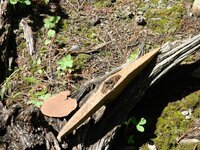
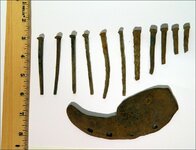
Here is a better picture of the general nail sizes. From 1-1/4" to a little over 3" long. Rather than horses it was common to have Oxen. Also shown is one half of an Oxen shoe. Pretty big hoove. Some of those nails were used for them and the rest for framing, wooden sluice boxes (there were many long ones) and whatever.
Buffalo Bob, I also found a big concentration of old square nails in a small area once. From what I read, nails were expensive and hard to come by. Folks often "recycled" them when they tore down an old building. They would burn the old lumber and rake the ashes to collect the nails. Waste not want not I guess ??
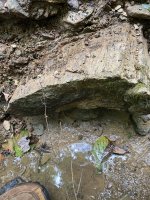
Jeff you are correct. After a little research, this mining area had a small town. When they discovered dold in the shale stone, and started hydraulic mining ( washing away the hillside dirt) the first tailings from the sluicebox actually flowed into the town site. So the buildings were torn down and used to build more sluiceboxes. Big ones. There isn't much trace of the old wood boxes anymore but that's where the nails probably came from. For use again I imagine.
Interesting note abouth the oxen shoe in the picture:
On the underside, there are a few tiny flakes of GOLD. So the ox was standing in the area where the gold was collected. Or somewhere else where the gold was on the surface. Have to go back and check it out!!
BB