Welcome guest, is this your first visit?
Member
Discoveries
 
Results 1 to 8 of 8
  1. #1
    nl
    Sep 2010
    439
    4 times

    The Stern Castle of the Senőra de las Maravillas

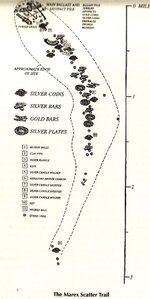
    Reading the story of padre Diego and starting at the point where he was holding on to a hatch cover we may assume that this hatch cover came from the mid section or forward section of the Maravillas . This is confirmed by his remark that he saw the stern-castle of the Maravillas , all three decks of it , crash in a tumbling fall astern to starboard . Lateron he saw in the distance the silhouette of part of the bow and foremast still protruding above the surface of the ocean . No mention of the sterncastle ! Now let us go back to the ship ,, Jesus Maria y Josef ,, under command of Don Juan de Hoyos . This ship hit a rock and lost her rudder. She anchored in less thanfour and a half fathoms of water . When daylight came they saw part of the almirantas wooden foremast sticking out of the water , less than a gunshot away . When people in the water signalled for help they launched a longboat to help them . So now we may assume that the prow section of the Maravilla stayed above water long enough to safe some of the people clinging to her . This section of the Maravilla was quite heavy because of the ballast rocks and othe material used for ballast ( think of silver bars ) . Now let us look at the treasure trail . You can see a picture of that on page 247 of Dave Horners book ,, Ship Wreck ,, . I will try to copy it on this post later . The main give-away is the ballast pile . Now normally there is no ballast pile in a stern section of a ship . The hold is the normal place for ballast , be it rocks , old cannon or silver bars . The place of sinking of the prow section was not very deep . This section was sitting on the sand . The mast was clearly in sight for some time . If the mast broke off later on it would make it easy to find the spot back because measurements taken from the ,, Jesus Maria y Josef ,, were clearly given . Water depth was sis ,,brazas,,. The hull lying just North of ,, El Mimbre,, . The bottom is clean sand . The measurements taken were , 27 1/3 degrees 27 and 20 North. A second measurement was taken and showed 27 1/6 degrees 27 and 10 North . Now the question is where is the stern castle ? The sterncastle broke away from the prowsection. This sterncastle was quite large ( three decks ) . We may assume that there was no sail on this section .The treasure was on this section of the ship ( at least the more valuable part of it ) . The weight of this treasure was not big enough to make the sterncastle sink because of the vast volume of wood in this part of the ship. Being under water for the bigger part of it , the wind had no grip on it . However the current had a great part to do with the direction this part of the ship took .My idea therefor is that the sterncastle was taken further North by the current without being influanced by the wind . The big rewards are still there for the right people to take the trouble to investigate some more . Cornelius

  2. #2
    nl
    Sep 2010
    439
    4 times

    Re: The Stern Castle of the Senőra de las Maravillas

    Here is the treasure trail of part of the Maravilla . This is a copy out of the book by Dave Horner . If interested in the complete story as told by padre Diego please read the book by Dave . Beter yet add this book to your library . I hope you don,t mind me doing this Dave . Cornelius
    Attached Thumbnails Attached Thumbnails The Stern Castle of the Senőra de las Maravillas -martavilla.jpg  

  3. #3
    ca
    Jul 2008
    Minelab/Fisher/Aquapulse
    184

    Re: The Stern Castle of the Senőra de las Maravillas

    Cornelius pulling the dogs tail.....hmm a few dogs here...some may have dived that wreck, you have some good insight and may well be right, what does Mackaydon think about that and how will the Bahamas feel about a licence...ps not calling you a dog Don hats off to you I can only dream about your adventures. Cornelius I cannot call you Corny as it reminds me of this midget that always referred to you as Corny, so Cornelius ever been to Weesp? I think you have a point many of the stern castles broke free, thanks for the fresh posts.

  4. #4
    nl
    Sep 2010
    439
    4 times

    Re: The Stern Castle of the Senőra de las Maravillas

    We may assume that the prow of the Maravilla was pointing to the South . The stern castle broke free of the prow and was falling to the starboard side , astern of the ship. Since this section of the ship was now in the grip of the current and not of the wind it was heading North ( or North West ) . I did some checking on how a piece of timber reacts in a current of water . It will not crawl up the side of a ( sand ) bank but will gradually seek deeper water . So I think that this section of the ship ( which was never salvaged , not even by Marx ) was floating , for the greatest part under water , toward the North - North West toward deeper water ( since no wreck will climb up the sides of a sand bank ) . It may have come to rest quite a distance away from the prow section which sank in about 27 1/4 to 27 1/5 degrees North . Cornelius

  5. #5

    Oct 2004
    12

    Re: The Stern Castle of the Senőra de las Maravillas

    If someone is seriously interested in the stern section of the Maravilla..as many of you know i worked on the site for many years and found a lot of treasure..we know which way it went and only stopped because of the moratorium. I intend to go back when it is lifted.
    we would certainly consider a serious and financially capable partner . My email is herbohumphreys@yahoo.com

  6. #6

    Oct 2004
    N. San Diego area (Pic of my two best 'finds')
    Minelab Explorer
    6,895
    16 times
    All Types Of Treasure Hunting
    Honorable Mentions (2)

    Re: The Stern Castle of the Senőra de las Maravillas

    I agree with Cornelis's conclusion; namely,(quote) My idea therefor is that the sterncastle was taken further North by the current without being influanced by the wind. (end quote).

    A similar situation existed here on the West Coast: In 1865, the Brother Jonathan was lost after hitting what became know as Jonathan Rock, off Crescent City, California. Many, including myself, searched for her--without success. It wasn't until Don Knight and others found her 3/4 or more of a mile away--HAVING DRIFTED UNDERWATER IN THE CURRENT would be my guess since no mention by the many survivors is made in the record of watching the vessel visibly drift away from that rock.

    Without a doubt Herbo and Marx have the greatest experience with the Maravilla; while all of us share the frustration of its lost stern section.
    Don.......

  7. #7
    us
    ARRG

    Dec 2005
    Florida
    JW Fishers Pulse 8X
    2,161
    10 times
    Shipwrecks

    Re: The Stern Castle of the Senőra de las Maravillas

    On January 1, 156 the silver fleet of the general Marquis de Montealegre departed from Havana, Cuba in route to Spain. During the four days of sailing northward through the “Canal de Bahama” (Straights of Florida) they encounter adverse winds which appeared to have been drawing them closer to the reefs of the Florida Keys. Several times new courses were set in a more northeasterly direction and later to a quarter of a point to the east. They sailed in this direction until midnight of January 4th at which time the “Nuestra Seńora de las Maravillas” Almiranta galleon of the fleet, passed in front of the Capitana galleon commanded by Montealegre. Aboard the Capitana sails were trimmed and an effort was made toturn the ship to avoid a collition but the currents were strong and little head way was made. As the Almiranta began to cross in front of the Capitana, the Capitana collided with her, ramming her starboard side causing severe damage but as the two ships broke apart The Almiranta drifted by the stern of the Capitana and was not seen after that.

    The Capitana continued to try to fight the currents in order to clear the reefs but just after sounding 12 fathoms the Capiatana struck bottom three times, bounced over thereef tops after which a leadline sounding indicated a depth of 5 fathoms after which she finally reached deep water. The following morning the five remaining ships and the Capitana turned back towards “Los Mimbres” to search for the Almiranta and the “Jesus Maria y Jose” which were missing. Upon reaching the last bank in the north side of the Mimbres they discovered a ship which they presumed to be the “Jesus, Maria y Jose” stranded on the shoals but because of the high seas and strong currents no great effort was made to reach the ship thus the fate of the Almiranta remained unknown.

    What the Marquis of Montealegre didn’t know at the time (which a combination of translated letters and testimonial accounts prove) was that the stranded ship they encountered was in fact the “Jesus Maria y Jose” which having received damage to her rudder was at anchor about a quarter to a half of a league from the remains of the wreck of the Almiranta. Due to the broken rudder and the conditions of the sea and the currents she could not get any closer.

    In a letter written on March 12, 1656 by Don Pedro Zapata, Governor of Cartagena there are given the declarations of Doctor Don Portalo and Pilot Gaspar Reyes Palacios both whom were survivors rescued from the Almiranta. In the early morning hours of January 4, 1656, within a period of one hour after the collition with the Capitana, the Almiranta threw out two anchors to keep from going into the reefs but the anchors didn’t hold.

    The Almiranta then struck a shallow water reef and sank in 6 fathoms. Of the 400 people aboard, only 44 were rescued, having saved themselves by hanging on the masts and spars remaining above the surface until the longboat from the “Jesus Maria Y Jose” rescued them. Among those drowned the Admiral Don Matias de Orellana.

    The pilot Palacios indicated that in the place where the ALmiranta sank there is much sand that is lose and without stones (meaning coral), The water is very clear and the sand is very white. He alos stated that the wreck most be found quickly or the sand will obscure its position The position of the wreck was given as being 27 degrees 15 minute latitude in the north of the Mimbres. Other celestial sightings were recorded as 27 degrees 20 minutes latitude and also 27 degrees 10 minute latitude,
    From these three sightings the Spanish fixed the position as being 27 degree 15 minutes in most of the documents. It was also indicated that the wrecksite lays one league more or less from the edge of the channel.

    After rescuing the survivors and taking the mentioned sightings and also depth soundings of where the Almiranta sank, Capt. Don Juan de Hoyos of the “Jesus Maria y Jose” returned to Cartagena.

    On June 1, 1656 a fleet of salvage ships under the command of Juan de Somovilla Texada departed from Cuba for “los Mimbres” where they worked on the wreck of the Almiranta throughout the summer. Suspending their efforts in autumn of that year. They had only recovered 1,000,000 in gold and silver due to the difficulty caused by the sand that had cover much of the site.
    In 1666 renewed efforts were made by Don Marcus Lucio who recovered one cannon and some silver.

    In the same year Don Francisco de Mella and Martin de Molgar discovered the remains of the Almiranta and remained on the wreck for seventy five days and recovered 42,000 pesos I silver coins. Ingots and plates were recovered. Further salvage efforts carried out by Martin de Melgar in 1676 and 77 produced yet another 41,744 pesos in treasure but by then the wreck was very heavily sanded over making further salvage extremely difficult.

    The last attempt which yielded some treasure from the Almiranta was made by the famous English salvor Sir William Phipps who in 1682 made a recovery of approximately 10,000 pesos after which he stated that he would not give a shilling for any mans share of what could be recovered from the remains of the wreck. This was mainly due to the sand coverage over the wrecksite .

    After Phipps salvage attempt successful salvage was no longer possible due to the coverage of the sand.

    The Almiranta had a registered cargo of 5,000,000 between 1656 and 1682 approximately 1,100,000 pesos were recovered. There should still remain, buried and scattered within the Amiranta’s wreck site approximately 3,900,000 pesos.

    Location Analysis

    From the declarations given by the survivors, the pilot, and the Capt..of the “Jesus Maria y Jose” plus the salvors who worked the wrecksite over a 26 year period, the following location factors are in evidence;

    1. The Almiranta having dropped anchors in 12 to 13 fathoms indicates that she was right on the west ridge of the shoals od “Little Bahama Bank” (Los Mimbres). The anchors not holding, she stuck the west side of the reef and immediately sank in 6 fathoms, on a sand bottom which would be on the east to southeast side of the said reef. This is based on the fact the current set was pulling the ships strongly to the east and onto the bank.

    2. Numerous celestial sightings of the Almiranta’s location range from 27 degrees 20 minutes latitude and also 27 degrees 10 minute latitude, which represents a distance variation of 10 miles, although for this period this was not uncommon considering the accuracy of the sightings instruments and the methods by which they were used from the deck of a rolling and pitching ship. The Spanish recorded three sightings of 27 degrees 20 minutes latitude and also 27 degrees 15 minute latitude and 27 degree 10 minutes, thus they used the average of 27 degrees 15 minute latitude as the location of the wrecksite.

    3. The depth of the water in which the Almiranta lies ranges from 5 to 6 ˝ fathoms which are the leadline sounding that were taken all the way around the wrecksite by the longboat of the “Jesus Maria Y Jose” that rescued the Almiranta’s survivors. In several of the written accounts by Texada, Mellia, Melgarand the English salvor Phipps, the depth is generally stated to be 6 fathoms. Because of the wreck lying extreamly close to shallow water reef, the draft of the Spanish salvage vessels used did not permit then to anchor directly over the wrecksite. The depth of the reef being 2 fathoms deep where the Almmiranta struck and sank issupported by the fact that Texada, Lucioand Melgar recovered several of the Almiranta’s cannons from the top of a 2 fathom reef.

    4. The Almiranta lieson the last bank on the north side of the Mimbres one league more or less, distance from the edge of the Canal de Bahama

    5. In 1684 when William Phipps was in the Bahama Bank and visited the site of the Almiranta’s wreck, his navigator and cosmographer Charles Salmon drew a descriptive and very accurate chart of the Bahama Bank including positions and latitudes of various navigation points and wrecksites visited. On this chart he positions Memory Rock as being at 26 degrees 57 minutes latitude which is the exact latitude on modern charts today. Salmon labels the Almiranta as the “Plate Wreck” and places its position on the east side of a reef at the north end of the Bank. The latitude is given as 27 degrees 20 minutes. Weather Salmon and Phipps knew that his wreck was in fact The Almiranta “ Nuestra Seńora de las Maravillas” is not indicated on the charts but its latitude, position related to the reef, depth of water and distance in front of the edge of the channel plus the very fact that it was referred to as the “Plate Wreck” indicates it as one and the same.

    6. On a Dutch chart of “The Bahama Bank” drawn by L Roelofsz In 1680, there is to be found on the northern most tip of the Bahama Bank a note that states” The rocks where the ALmiranta lies” The latitude at which the wreck is placed on this chart is 27 degrees and 10 to 15 minutes latitude.

    In spite of the variation in the latitudes between 27 degrees 10 minutes and 27 degrees 20 minute there are only 3 locations with reefs in 2 fathoms in one league distance fron the canal.

    I am still not sure why I posted this… I guess is one of those days were I am living by the words “give and you shall receive” so if you read this and then find the Maravillas please do remember who told you where it was…..
    All the best,

    Chagy…….
    Attached Thumbnails Attached Thumbnails The Stern Castle of the Senőra de las Maravillas -dsc01329.jpg   The Stern Castle of the Senőra de las Maravillas -dsc01332.jpg  
    Researcher, Scuba diver and adventurer , always on the quest of discovering, recovering, conserving and exhibiting colonial-era artifacts and treasure.
    Each excavation site is always treated as an archaeological project.
    "Preserving Maritime History For Future Generations"


  8. #8
    us
    Aug 2010
    113

    Re: The Stern Castle of the Senőra de las Maravillas

    I have sat in 110 feet of on the edge of Mantanilla Reef and the abyss watching pelagics swim by. Maybe it was the nitrogen narcosis, but I often wondered how many loaded galleons bounced off these same reefs and ended up in the deep water.

    Black Bart


Home | Forum | Active Topics | What's New

Sponsors

Posting Permissions

  • You may not post new threads
  • You may not post replies
  • You may not post attachments
  • You may not edit your posts
  •  

Search tags for this page

herbo humphreys maravilla wreck slavage 2012

,
los mimbres bahamas
,
maravillas wreck
,
stern castel shipwreck
,
where is rge sterncastle
Click on a term to search for related topics.
Powered by vBadvanced CMPS v4.1.3