|
-
Nov 15, 2006, 11:10 PM
#1
 ARRG
-
Nov 16, 2006, 01:41 PM
#2
 discovering & preserving our past for future generations
Re: Question about cannons
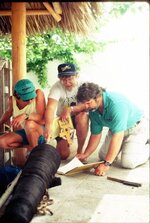
Luis, for the iron cannon-it will have to go through electrolytic reduction-which may take several years. I am pretty sure you use the same method on brass or bronze, although the process may differ slightly. The main point is to remove the salt chlorides that have penetrated the metal.
I have a fantastic CD on conservation methods made by Doug Armstrong, one of the best shipwreck conservators in the business. I will try to locate it and send it to you.
There is also some great information online here:
http://nautarch.tamu.edu/class/anth605/File9.htm
http://bronzecannon.net/cannon_conservation.htm
https://www.denix.osd.mil/denix/Publ...r/5-CU-AG.html
https://www.denix.osd.mil/denix/Publ.../3-IRON-1.html
Tom
-
Nov 16, 2006, 06:46 PM
#3
Re: Question about cannons
Hello Chagy.....
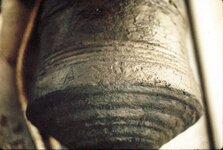
Interesting post about iron and brass cannons, indeed..... I was always interested in old cannons. By the way, does anybody know where to find identification gravings or marks on brass cannon and on the iron one for better identification if they are almost completely incrusted in coral? I know that, for example, brass cannons of East Indian Company had their famous "V" logo almost in the middle of their body. French brass cannons had marks just on the head, generally with emblem of Frech Royal family. Spanish brass cannons had a mark of the funding factory bihand the head rings, and so on.....

I was alweays intrigued about this system of marking of cannons. And how about iron cannons markings?
Any help would be appreciated.
Regards
Lobo
-
Nov 16, 2006, 07:02 PM
#4
Want to treasure dive in gin clear waters at Jupiter!
Re: Question about cannons
Chaggy,
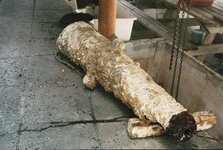
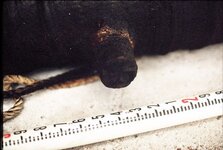
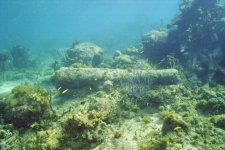
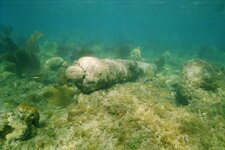
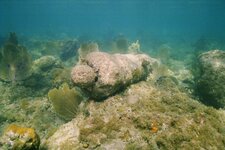
We preserved a number of iron cannons from the Jupiter Shipwreck site.
See Attachments:
If this sends I'll continue
Since 1987 our Jupiter Wreck has continued to yield coins but the question, "Where's the rest of the Ship?" has remained unanswered... There are 2 layers of shipwreck scatter and we are equipping the "Enterprise" to excavate the primary treasure layer. Join with us this year!
-
Nov 16, 2006, 07:09 PM
#5
Want to treasure dive in gin clear waters at Jupiter!
Re: Question about cannons
All the advice you have gotten is good so far.
The best place to look for markings in on the trunnions and near the large re-inforsing rings near the touch hole.
Placement and shape of the trunnios is also important in helping to date a cannon. If they are thimbled shaped and place lower off the axis of the cannon they most problably are 17th century. If they are cylindrical and on the axis - they probably are mid - eighteenth century or later
Since 1987 our Jupiter Wreck has continued to yield coins but the question, "Where's the rest of the Ship?" has remained unanswered... There are 2 layers of shipwreck scatter and we are equipping the "Enterprise" to excavate the primary treasure layer. Join with us this year!
-
Nov 16, 2006, 07:20 PM
#6
Re: Question about cannons
Hi Capt Dom,
Thanks for your detailed explanation. It definitely helps. Is it the same for brass cannons and for iron ones?
Regards
Lobo
-
Nov 16, 2006, 07:55 PM
#7
 ARRG
Re: Question about cannons
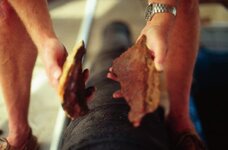
Its Bronze not brass. Yes the same reverse elctrolysis is used for both bronze and iron cannons, just iron will take a lot longer, as it is less noble. You knock off most of the coralline algae and coral with a hammer-carefully. Then soak it in freshwater for a while. This helps remove some of the salts. Then you drain off water a few times, and put in an electrolyte which is usually sodium carbonate and purified water. Could be sodium hydroxide which is soda ash, but it is real nasty, causes burns and could corrode even worse. Then you have to have a power source-thats what they are called, plugs into wall and converts to 1 volt,2, 4, 6, 9, 12 and 24 volts. Has a little switch to change it. Use the negative to attach to a stainless steel wire(Monel) and wrap the cannon well. Then with the positive wire clip to a stainless steel bar( a stainless steel spoon will work) and dont let it touch cannon or wire wrapping. Not real close but undr water. The ratio of sodium carbonate is 1 teaspoon to 1 gallon water- no chlorine! Sodium carbonate can be made by baking sodium bicarbonate for 350 degrees for at least a hour in a oven. Sodium bicarb is baking soda. sodium carbonate is washing soda, but make sure it is, as baking soda will cause corrosion and other problems. Drain off the electrolyte several times a month and keep doing it until there is no salt in water. Then soak in RO/DI water for a while to nuetralize it. Then thinned varnish- mineral spirts 1/2 and varnish 1/2, painted on.
-
Nov 16, 2006, 08:12 PM
#8
Re: Question about cannons
Hi,
WOW, it is called complete guide how to clean bronze and iron cannons incrusted in corals!!! THANKS a lot, my friend!
Regards
Lobo
-
Nov 17, 2006, 07:24 PM
#9
Re: Question about cannons
Hello Doc,
Thanks for a collection of fine pictures of weaponry and especially bronze cannons from Arsenal Madrid. Great pics!!
Regards
Lobo
-
Nov 18, 2006, 01:10 AM
#10
 ARRG
Re: Question about cannons
 Originally Posted by capt dom
Chaggy,
We preserved a number of iron cannons from the Jupiter Shipwreck site.
See Attachments:
If this sends I'll continue
capt don,
What procedure did you used to clean that cannon? And how long did it take?
Thanks,
Chagy.........
Researcher, Scuba diver and adventurer , always on the quest of discovering, recovering, conserving and exhibiting colonial-era artifacts and treasure. Each excavation site is always treated as an archaeological project.
"Preserving Maritime History For Future Generations"
-
Nov 18, 2006, 01:19 AM
#11
 ARRG
-
Nov 18, 2006, 01:39 AM
#12
Re: Question about cannons
Lobo:
You asked about gunfounder's marks on cannons. One source is "History Under the Sea" by Mendel Perterson (City of Washington, Published by the Smithsonian Institution--1965).
Don.....
-
Nov 18, 2006, 03:05 AM
#13
Re: Question about cannons
The two commonest sources of cast-iron cannons were Britain and Sweden.
For British cannons in the 17th century it was common practise to engrave the maker's initials on the barrel, usually between the ventfield and the trunnions. Later they were normally placed either side of the touch-hole. From about 1700 they adopted the Swedish practise of casting a mark on the trunnion face- these usually consisited of one letter- usually the name of the furnace- or double letter- the name of the founder. Sometimes they had both. These marks were cast onto the trunnion- ie they stick out. From about 1770 some founders became engraving mark, usually one trunnion and engraving a serial number on the other. By 1800 all British founders' marks were engraved- ie cut into the trunnion after casting. In general the only British iron guns to be date by the founder were the Scottish companies of Carron and Clyde, who engraved the name and date on the left trunnion (I always describe left and right as though standing behind the cannon).
Swedish cannon had marks cast on the trunnion from the mid-17th century. These also consisted of a single, double or occassionally triple letters but certain Swedish furnaces also cast dates on the trunnion as well, in 4, 3 or 2 numbers. Norrmally the date is on the left. Again these marks are cast on the moukd and stick out. In the late 18th century they also went to engraving marks and dates.
Other iron guns, such as those from France and Norway tended to copy the Swedish and British systems.
A number of the attributions in Medel Peterson's book, particulary the British trunnion marks are now out of date.
So to sum up, check the trunnion face first, then look round the touch-hole
Smithbrown
-
Nov 18, 2006, 07:20 AM
#14
Re: Question about cannons
You remind me that I forgot to put in a handy online check for Scandinivian gunfounders' marks- particularly useful because it includes the Norwegian/Danish marks as well as the more common Swedish ones:
http://www.arkeliet.net/cannons/cannon_prodmarks.htm
Smithbrown
-
Nov 18, 2006, 11:46 AM
#15
 ARRG
-
Nov 18, 2006, 12:08 PM
#16
 ARRG
-
Nov 18, 2006, 12:44 PM
#17
Re: Question about cannons (new pics)
Easiest to do this with some pictures:
http://cf.hum.uva.nl/galle/images/dr...on_700x411.jpg
That is from a Dutch east Indiaman from Galle- the detail is not good enough to say if it is english or Swedish- ifthe drawing is accurate, I would hazzard this was English. The ship, which started life as an English merchantmen, was lost in 1659. Anyway nice example of a mid-17th century iron gun
http://cf.hum.uva.nl/galle/avondster/story.html
Smithbrown
-
Nov 18, 2006, 12:53 PM
#18
Re: Question about cannons (new pics)
Now we move on
http://www.anthro.fsu.edu/research/u...non_fowey.html
This is an iron gun from HMS Fowey- ignore the dating which is wrong- it is now dated to 1716-1724. There is now two bands in front of the trunnions. this is called the Borgard pattern and was very short-lived- everyone decided it was utterly useless and too light.
Smithbrown
-
Nov 18, 2006, 01:03 PM
#19
Re: Question about cannons (new pics)
This is report on HMS Hazardous
http://ads.ahds.ac.uk/catalogue/arch.../downloads.cfm
She began as a French ship but was captured and continued in British service- it has both a report but also a series of pictures of the cannons taken underwater which might make for helpful comparisons for you. She was lost in the first decade of the 18th century.
Smithbrown
-
Nov 18, 2006, 01:10 PM
#20
Re: Question about cannons (new pics)
These are British again:
http://ns1763.ca/lunenco/cheslgn.html
These are the sort of cast-iron guns that helped us win the Seven years War, then lose the American Revolution. Similiar to those Bogard ones, but thicker and stronger with the cypher of the King Georges instead of a rose and crown. Made between 12725-85, in use for longer.
Smithbrown
Posting Permissions
- You may not post new threads
- You may not post replies
- You may not post attachments
- You may not edit your posts
-
Forum Rules
Search tags for this page
british cannon trunnion, english cannon trunnion markings
Click on a term to search for related topics.
|