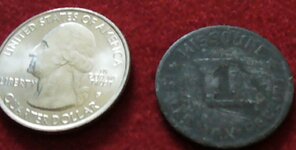
Can anyone help date this and let me know if there is any value to this token I found ? It's a Missouri sales tax receipt token that I found here in upstate NY. Not sure how it ended up here and it has me curious. Both sides look the the same. Thanks for looking !
Really great pics. That's what is known as an "invisible token."
Another onliners response to the same Q. a couple of years ago:
"You have a Depression era tax token. It is from the 1930's and some states mostly western used them. Sales taxes were new and very low sometimes it figured out to less than a cent. They used the mil denomination for it was less than a cent, 100 to a cent I believe. Sales tax tokens are worth around a $1 each. Most states stopped using them after a few years as times got better and prices started to rise ."
Don....
and another response:
First produced in 1935, sales tax tokens were used to make change for sales tax paid. Missouri was one of only 12 states to employ this practice. After a few years, both retailers and the public found their use to be too much trouble, and they were discontinued.
Don--a mill was 1/10¢, so ten to the cent. These tokens were used in areas where they didn't use the bracketing techniques commonly used today (i.e. 1-15¢ sale = 1¢ tax, 16-30¢ sale = 2¢ tax, etc.). Back then a 5¢ sale meant maybe a 2/10¢ tax, so it cost the consumer 6¢ and s/he got back 8 mills in tokens. That's why so many of them were required, and since they weren't worth a lot and were a cheap souvenir, tourists carried them home, thus scattering them all over the U. S. of A.
John in the 208