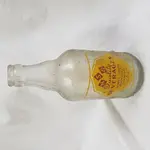
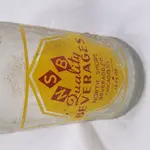
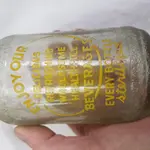
~ EARLIEST KNOWN PAINTED LABEL (ACL) SODA BOTTLES ~
By : SODABOTTLEBOB
A while back I did a thread that focused on the earliest known crown cap soda bottles, which we know was invented by William Painter in 1892, with the earliest confirmed crown closure soda bottle being a Murdock & Freeman from 1895.
~ * ~
This time the focus will be on the earliest known painted label soda bottles, which are also known as ACLs, or Applied Color Labels. The following is the result of a great deal of time and research I was involved with along with a number of other collectors. The majority of the pictures that follow were contributed by those collectors.
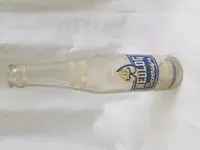
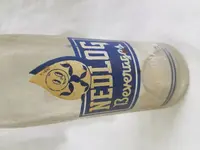
But before getting into the heart of the matter, I'd like to start with the following pictures to show as examples of what types of soda bottles were popular just prior to the advent of the acl process. During the teens thru the early 1930s, "Deco" and/or "Designer style", plus "Paper Label" soda bottles were the most abundant, and came in thousands of different brand names and style variations.
The examples shown below are just a couple of the more obscure and valuable non-acl soda bottles.
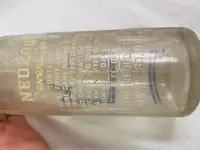
1. Nehi "Top of the World" 1927 patent.
2. The bottle itself. (Scarce and valued at $150.00+)
3. Early 1930s Mickey Mouse paper label bottle. (Rare and valued at $200.00+).
4. Mickey Mouse bottle cap. (Scarce and valued at $35.00+).
Beginning in 1933 a form of silk screening was introduced to put colored labels on milk bottles. The colored label was actually fused to the glass. This was cheaper and faster than using the molds needed for embossed milk bottles. It also made the labels much more prominent against the white background of the milk. This process was called pyroglazing (pyro for short) or Applied Color Labeling. Pyroglaze was the term used by the Thatcher Manufacturing Company of Elmira, New York. Owens-Illinois Glass Company of Toledo, Ohio used the term Applied Color Labeling or ACL for the same process. The Universal Glass Products Company of Parkersburg, West Virginia called the process Fire-Fused Color Lettering or Hi-Fired Color Lettering. Liberty Glass Company of Sapulpa, Oklahoma used the term Lustro-Color for their bottles with colored lettering.
An industry press release in May of 1933 indicated that Owens-Illinois Glass Company had developed this process at its plant in Huntington, West Virginia. Soon after, by July of 1933, they started promoting milk bottles with fused names and trademarks in color (they did not use the term ACL at that time) in their own advertisements. In August of 1932 they used the term "Applied Color" Bottles in their advertisements to refer to display milk bottles that had color fused to the inside of the glass bottle. Display milk bottles were internally colored white to simulate milk and a yellow color to indicate the cream. This was done inside the bottle and used by milk dealers in their promotional displays. One unintended use of these display milk bottles was as a way to hide liquor. Prohibition was still in place in 1932 and these painted milk bottles did a good job of concealing their contents, especially if it was not milk. We are not sure if coloring the insides of the bottle was the same technology as applying colored labels to the outside of the bottle but Owens-Illinois claimed that the colors were fused to the glass by intense heat. They said the color was an integral part of the glass and permanent and indestructible except through breakage. The first advertisement we have seen from the Thatcher Manufacturing Company for pyroglazing was in March of 1934. They used the term pyroglaze in that advertisement.
As mentioned previously, the first experimentation/use of the acl process was with milk bottles. Here is the earliest known acl milk bottle. The paint is almost gone, but the label reads ...
[Front] Drink Kolb's Milk [Back] Eat Kolb's Bread
Not much is known about Kolb's Dairy - which apparently was involved with bread making as well - but we do know the bottle itself was made by the Thatcher Manufacturing Co., (glass factory), which was located in Elmira, New York. The bottle was recently confirmed by a national bottle collectors organization as the earliest known painted label bottle in existence. The base is embossed with ... 3E4 ... for Elmira - 1934. It is also embossed on the heel with ... mTc ... for the Thatcher Mfg. Co.
T, resembling an anchor, with smaller, angular M and C nestled underneath to the left and right ... Thatcher Manufacturing Company/Thatcher Glass Mnfg. Corporation (c.1904-1985). First plant at Elmira, NY, but later many others were added including locations at: Kane, Pa; Streator, IL; Wharton, NJ; Mt. Vernon, OH; Lockport, NY; Clarksburg, WV; Olean, NY; Winchester, IN; Cedar Grove, WV; Parkersburg, WV; Lawrenceburg, IN; Muscatine, IA; Saugus, CA and Tampa FL. Mark is often indistinct and the 2 smaller letters may be illegible. This mark was first used about 1949 and is a variation on their earlier mark which was also MTC, but in a more legible format (see MTC mark).
M T C ... Thatcher Manufacturing Company, Kane, PA; Wharton, NJ; other plant locations in later years (c.1904-1985). Usually seen in the form of a large T with smaller "m" and "c" sheltered underneath the "roof" of the T. This mark was used c.1923 to the early 1950s, and is mostly found embossed on milk bottles. Also see "T, resembling an anchor..." and "TMC" mark.
Now that the foundation for the acl process has been established, the following will focus on the acl soda bottles themselves. As you will soon discover, the earliest confirmed acl soda bottles were made in 1935. There are unconfirmed rumors of a few 1934 acl soda bottles, but so far in the course of my research none have surfaced to grab their claim to fame. One such unconfirmed bottle is the "Brownie Club" shown here. If anyone who reads this has such a bottle with a 34 embossed on it somewhere, (most likely on the base) please share it with us.
Note: There are variations of this bottle ... the one to look for is like the example below with the brand name "Brownie Club" in block letters. Most variations have the name in cursive script. This particular bottle is dated 1937.
The following three pages will categorize various acl soda bottles by confirmed dates, which I call "The Top Ten" earliest acl soda bottles. And starting here with ...
1935
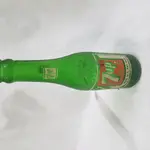
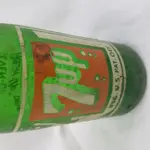
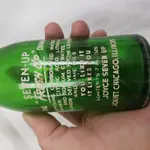
1. 7up (green standard size)
2. 7up (amber standard size)
3. Jumbo
As time progressed and the acl process became more widely accepted, the more bottlers there were who began switching over to the process. So it almost goes without saying that from about 1937 on the more and more acl soda bottles there were. By 1940 almost everyone was using it, and there are now literally thousands of different brands of acl soda bottles to be found from the 1940s and 50s.
And since 7up was the forerunner of the "national brands" to use the acl process, I thought a sub-category on 7up would be appropriate.
Starting with the following patent documents showing a starting date for the brand in 1929.
By the way ... Did you know that 7up switched from 8 bubbles to 7 bubbles on their labels around 1938? It is rumored that some employee of the company noticed it and suggested the change. So if you have an "8 bubble" 7up bottle, it likely will date during or prior to 1938. (However, a few rare exceptions to this are known).
This chart is from my acl book and shows the various locations and dates for the early "amber" 7up bottles. Note that some are listed as 'standard' - some are listed as 'stubby' (or squat as I call them), and some are listed as 'paper label.' Plus, it is of special interest to note that the only 'standard' (slim) acl was from San Diego, Ca., which is where I happen to live. I don't have one of these bottles (yet) but know of several collectors who do. In excellent condition they value locally at about $250.00.
The second picture is of me holding one of the bottles, which is on display in a local museum. I offered them good money for it, but they declined because of museum "policy."
Here are the first through the third editions of the best acl books I know of. They contain hundreds of great pictures of acl soda bottles, including some very helpful information regarding the hobby itself. But they are currently out of print and can be hard to come by. I recommend them (especially the third edition) to any and all serious acl soda bottle collectors. I received my third edition copy from the author, Rick Sweeney, who signed it for me.
I decided to add the following to assist those who may not be familar with dating acl soda bottles. Eventually I will do a seperate thread on this topic as there are numerous bottle makers to discuss. But for now I will concentrate on the Owens-Illinois / Duraglas bottles which account for the majority of soda bottles made in the 1930s through the 1970s. I realize the following may be a little confusing, but with practice you will eventually be able to recognize the differences easily. I will attempt to simply all of this when I do a seperate dating thread in a week or so.
Owens-Illinois / Duraglas
A typical O-I mark looks something like this ... <(I)>
Note: The two companies merged in 1940. So any soda bottle with both marks on it will date from 1940 or later. Those without Duraglas are pre-1940.
The inserts below are as follows ...
1. Snippet from acl book regarding dating codes, etc. on O-I bottle bases.
2. 1935 7up bottle ... 21 <(I)> 5 - No 'dot' after the 5 = 1935 (Looks like a 6 but it's a 5)
3. "Thyme" bottle ... 9 <(I)> 0 ... Transition. No dot after the 0 = 1940
4. "Cape Fear" bottle ... Has both Duraglas and 3 <(I)> 5. with dot after the
five which indicates 1945
5. Double-digit mark on the right side ... 3 <(I)> 48 for 1948. The other
numbers/letters are mold and/or tracking codes
6. Page from acl book for Owens-Illinois plant number locations and dates of
operation. (Remember ... The plant location number is on the left side of the <(I)>
symbol).