Welcome guest, is this your first visit?
Member
Discoveries
 
Results 1 to 4 of 4
  1. #1
    us
    Sep 2009
    94

    Canister and Case Shot--What's The Difference?

    Q: Artillery used different rounds against attacking troops. One was the Canister and the other was Case shot.... What is the difference?

    A: The Canister was a shell made with about 96 iron balls held together by a tin cover, the Case shot was a shell with a timed fuse that would burst over the attacking troops' heads. Sending pieces of it in to them.

    http://www.bitsofblueandgray.com/trivia.htm
    Remove not the ancient landmark, which thy fathers have set. Prov. 22:28

  2. #2
    us
    Mar 2005
    South-Central Arkansas
    Detector Pro Pirate, Troy Shadow X-5, Fisher F75
    76

    Re: Canister and Case Shot--What's The Difference?

    For a more definitive answer, go to www.civilwarprojectiles.com . Pete George hangs out there, Jim Thomas, as well as John Bartleston, and others that can give you more than you ever want to know about case and cannister. Pete wrote the "Bible" on artillery. Jim and his brother Dean have co-authored several books on civil war projectiles. And John is a genius at computer graphics that has designed many "cut away" sketches showing various shells and their constructions as if sawed in half.

    There was another "similar" artillery round called "grape shot".

    But, go to the above mentioned site and register.... then just ask your question. It is much more involved than the response you gave above.

    Take care,
    Kim
    If stupidity hurt, a lot of people would be walking around screaming!

  3. #3

    Feb 2006
    942
    22 times

    Re: Canister and Case Shot--What's The Difference?

    Here are the major differences between civil war era Canister and Case-Shot ammunition:
    Canister takes its name from the fact that its contents were contained in what was basically a "tin can" (made of thin iron sheetmetal). The can contained a certain number of iron or lead balls, packed in sawdust. The number of balls in the Canister varied according to the caliber of the ammunition. (For example, 6-pounder caliber Canister contained 27 balls which were 1.16-inches in diameter, and for 24-pounder caliber Canister the balls were 2.62 inches in diameter.) The precise size of the balls in every caliber of Canister ammo for the Army was listed in a chart in the 1861 Ordnance Manual, which can be viewed for free on the Internet at www.civilwarartillery.com/shottables.htm . IMPORTANT NOTE: Unlike artillery shells, civil war Canister did not contain an explosive powder charge. The blast of the cannon's propellant powder-charge shredded the thin "tin can," releasing the balls.

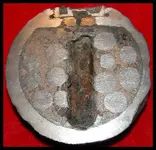
    Case-Shot was a type of civil war cannon-shell which contained an explosive powder charge and a large number of "antipersonnel" balls (or slugs or wedges). Because the Case-Shot balls had to fit inside a heavy iron projectile body, the balls were much smaller (usually between .44" to .69") than Canister balls. The Ordnance Manual specified that Case-Shot ammo was to be used with a Time-fuze (never an Impact-fuze), so that it would explode in the air over enemy troops. Here is a photo of a sawed-in-half ("halfsectioned") Bormann-fuzed 12-pounder caliber Case-Shot cannonball. As you see, its explosive powder-charge was contained in a "well" in the middle of the projectile's cavity (NOT mixed among the antipersonnel balls). Canister ammo contained no powder-charge.

    Regards,
    TheCannonballGuy
    Attached Thumbnails Attached Thumbnails Canister and Case Shot--What's The Difference?-shell_halfsection_12-pounder_bormann_cs_case-shot_gasket-rebate-fuzehole_ccr2004.jpg  

  4. #4
    Charter Member
    us
    Nov 2008
    Toll Free ~ 855~966~3563
    12,640
    10 times
    Relic Hunting
    Banner Finds (1)
    Honorable Mentions (2)

    Re: Canister and Case Shot--What's The Difference?

    Great education. Thanks
    Quote Originally Posted by TheCannonballGuy
    Here are the major differences between civil war era Canister and Case-Shot ammunition:
    Canister takes its name from the fact that its contents were contained in what was basically a "tin can" (made of thin iron sheetmetal). The can contained a certain number of iron or lead balls, packed in sawdust. The number of balls in the Canister varied according to the caliber of the ammunition. (For example, 6-pounder caliber Canister contained 27 balls which were 1.16-inches in diameter, and for 24-pounder caliber Canister the balls were 2.62 inches in diameter.) The precise size of the balls in every caliber of Canister ammo for the Army was listed in a chart in the 1861 Ordnance Manual, which can be viewed for free on the Internet at www.civilwarartillery.com/shottables.htm . IMPORTANT NOTE: Unlike artillery shells, civil war Canister did not contain an explosive powder charge. The blast of the cannon's propellant powder-charge shredded the thin "tin can," releasing the balls.

    Case-Shot was a type of civil war cannon-shell which contained an explosive powder charge and a large number of "antipersonnel" balls (or slugs or wedges). Because the Case-Shot balls had to fit inside a heavy iron projectile body, the balls were much smaller (usually between .44" to .69") than Canister balls. The Ordnance Manual specified that Case-Shot ammo was to be used with a Time-fuze (never an Impact-fuze), so that it would explode in the air over enemy troops. Here is a photo of a sawed-in-half ("halfsectioned") Bormann-fuzed 12-pounder caliber Case-Shot cannonball. As you see, its explosive powder-charge was contained in a "well" in the middle of the projectile's cavity (NOT mixed among the antipersonnel balls). Canister ammo contained no powder-charge.

    Regards,
    TheCannonballGuy

    Woodland Detectors - Open 7 days, Toll Free 855-966-3563 - Build your own Packages!


Home | Forum | Active Topics | What's New

Sponsors

Posting Permissions

  • You may not post new threads
  • You may not post replies
  • You may not post attachments
  • You may not edit your posts
  •  

Search tags for this page

12 pounder case shot cannon ball

,

24-pounder bormann fuzed ball

,

canister ball civil war

,

canister cannonball civil war

,

canister vs. case shot

,

cannister case shot

,

civil war canister balls

,

civil war case shots

,

diameter of civil war cannister balls

Click on a term to search for related topics.
Powered by vBadvanced CMPS v4.1.3