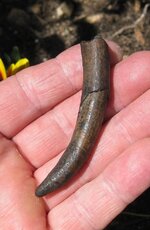
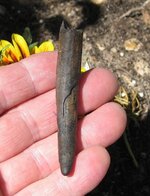
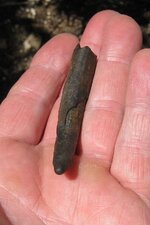
At first I thought this was an anter tine, but looking at it closer I see growth rings and was wondering could this be a very very juvenile elephant tusk or maybe someother animal tusk or tooth? Thanks in advance for any help. <9(((((><
You haven't said where you collected this object. Location could make a difference.
All the juvenile elephant tusks I have, or have seen, are without the prominent curve of your object.
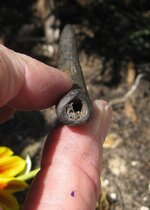
That leaves antler tine or sperm whale tooth. The object has features of both. Does it appear that the hollow end has been cut (or grooved and snapped off)? If so, it's antler. In fact, the central hollow seems too large for unworked antler -- has it been ground? If so, it's antler.
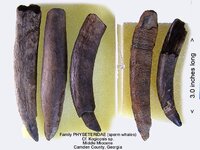
The other possibility is the enamel core of a sperm whale (Kogiopsis sp.) tooth. Growth rings should be prominent (more than the thin delamination at mid-body evident in your images). Here is an image of some whale teeth so that you can make your own comparison.
Sometimes I go about pitying myself, and all the time
I am being carried on great winds across the sky.
------Chippewa saying, translated by Robert Bly
North suwannee Harry, Thanks for the I.D......seems a little out of place , can't remember ever finding any whale in this area before!
I've never been in the river above I-10, but I don't think that is the place for Miocene sperm whales. Antler tine seems more probable.
Sometimes I go about pitying myself, and all the time
I am being carried on great winds across the sky.
------Chippewa saying, translated by Robert Bly
This piece is from around peacock spring, with the layers I'm not convienced that its antler, it is alot more denser than antler also. Thanks for the comments ,we're getting there!
America was founded by tough hell-raisers. Rugged citizens who evaded taxes, spoke strongly against tyranny, grew tobacco, brewed beer, distilled spirits, and smuggled weapons. And it will be saved by those same types of citizens.
Antlers are not hollow . . . unless they've been altered by man or some other agent (insects, bacteria, etc.) The cancellous bone in the center of an antler is relatively easy to alter.
Here is one idea to explain the hollow in the end of this antler piece:
Sometimes I go about pitying myself, and all the time
I am being carried on great winds across the sky.
------Chippewa saying, translated by Robert Bly
Could it be a tusk from a wild boar. The size and shape sure resemble the many boar tusks I have seen over the years from wild boar we've killed around here.
Maybe it's not as old as y'all are thinking...as in not back to man's paleolithic era.
I may be way off track here, but I'm thinking the dark coloration could come from laying in leaf laden water and mud for 40-50 years? Around here the tannins from oak leaves turns the water tea colored in a lot of the swampy places where the water doesn't flow freely or fast. What we call "brown water creeks" are very prevalent. Could that not have discolored or "dyed" a tusk/tooth?
This isn't my forte so take what I said with a grain of salt. I'm simply theorizing/guessing.
So far, this is the longest I've ever lived. ~ Sigman Fraud
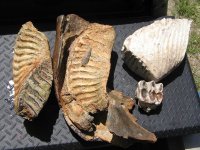
that is a root from a mammoth tooth.i also thought it was a little tusk from the ones i have found but then i found the whole tooth with the roots still attached thats how i know.i still have a couple myself somewhere.
If it were a tooth root wouldn't it have a hole/opening on the pointed end for the nerve and blood supply?
Again I'm just shooting in the dark here. But you'd think a tooth root would have a hole in it somewhere for the nerve, and for vessels that feed blood to the pulp inside.
So far, this is the longest I've ever lived. ~ Sigman Fraud
Could it be a tusk from a wild boar. The size and shape sure resemble the many boar tusks I have seen over the years from wild boar we've killed around here.
Maybe it's not as old as y'all are thinking...as in not back to man's paleolithic era.
I may be way off track here, but I'm thinking the dark coloration could come from laying in leaf laden water and mud for 40-50 years? Around here the tannins from oak leaves turns the water tea colored in a lot of the swampy places where the water doesn't flow freely or fast. What we call "brown water creeks" are very prevalent. Could that not have discolored or "dyed" a tusk/tooth?
This isn't my forte so take what I said with a grain of salt. I'm simply theorizing/guessing.
While it's true that antlers don't have growth rings, I don't see any growth rings on this object. 'Martingeetars' described his object as having "growth rings." Can you show us a close-up image of the growth rings, Martin??
I see decortification of a thin surface layer. Whales have strong growth rings which in cross-section are angled toward the apex of the tooth. This object doesn't at all appear to be enamel (or dentin).
This object bears scant resemblance to a pig tusk except that it is longer than it is wide. A tusk would have a wear facet on one side or the other.
The color has no bearing on the age of the object.
The 'broken' end of the object appears to be smoothed - wear polished, perhaps. A tooth is unlikely to have such wear. I cannot tell if the material on one side within the opening is cancellous bone, or is some gritty matrix. Which is it?
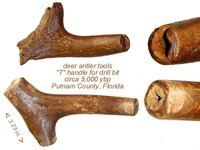
My best guess is that this is an antler tine that may have been used as a socketed tool -- a drill brace, for example, or a handle for a bone pin perforator.
Sometimes I go about pitying myself, and all the time
I am being carried on great winds across the sky.
------Chippewa saying, translated by Robert Bly
If it were a tooth root wouldn't it have a hole/opening on the pointed end for the nerve and blood supply?
Again I'm just shooting in the dark here. But you'd think a tooth root would have a hole in it somewhere for the nerve, and for vessels that feed blood to the pulp inside.
well the ones i have found which i have found over 6 mammoth teeth few mastadon teeth and lots of fossils and they look just like the pic just different color which will fossilize in different colors ect.flordia fossils are mostly brown the ones i have seen