woody50
Bronze Member
- Jun 21, 2007
- 1,879
- 203
- Detector(s) used
- XP Deus
- Primary Interest:
- All Treasure Hunting
Updated: Forgot to mention the measurements:
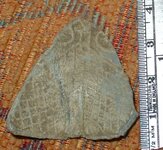
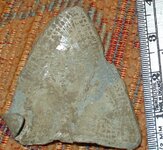
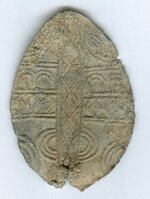
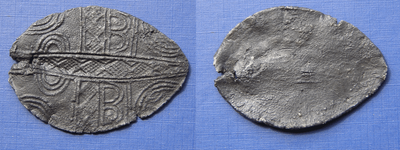
45 x 32.3 mm, mass = 10,03 gram
Also I have now found 4 other photos of other spoons, will include them... Maybe it will help to see if others turn up....
At then end of message a better photo of the spoon (front and back).
==========================================================================================================
This relic, that I found way back in 2004, has finally been determined thanks to some good English friends.
Searching up a gradual slope on a field I found many roman coins, and some roman brooches, along with a few hammered silver coins. Covering the same area again, but this time diagonally to the search pattern I received a quiet smooth signal, from which I knew would be a deep object. I knew it was not a coin, the XP GMP detector did not sing it's coin song to me. The deeper I got the more sure I was that it had to be nonferrous, the signal said to me that the object was also not so large, and that means keep digging.
It would have to be bronze, silver or lead making that sound because the signal still stayed good and there was no cracking at all at the edges of the object. I could hear hear that the object was not round but still had a funny ring to it. Finally after checking the hole again the signal was gone so I knew the object was in the removed earth, and I saw it almost at once poking it's head out of the loose clump of ground.
At first glance it appeared to be an old tin lid, one that closed a small container for jewelry and such. I carefully put it in a plastic sack and continued. That night when the other guys (www.wf4.nl) looked at it no one knew what it was, my idea of a lid could be correct. And so it stayed for 6 years, filed under boxes and lids. During one of my reclassification and ordering of my finds photos, I came across it the other day, and begin to wonder if it was really a lid after all.
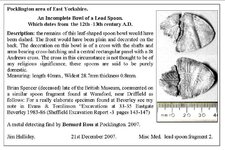
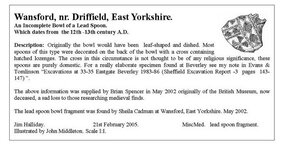
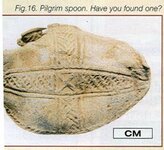
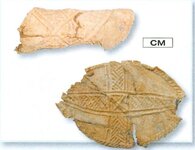
So I opened up my OE and send the photo(s) and description to several friends. After a day I received my first answers, it appeared to be the bowl of a 12/13th century Pilgrims spoon. Its not a normal spoon, but a ceremonial object, just like Pilgrim Insigne's are. More answers appeared on the second day, and all the answers were the same. One of the experts Jim Halliday (whom some of you English guys surely know) said he had only ever seen 3 fragments of the spoons.
Gordon Bailey said "The bowl is from a decorated Pilgrims spoon dating to the late 13th century, this appear to be associated with London for some complete examples have been recovered from the Thames. These bowls are normally decorated both sides of the bowl, the handle would have been about 3inches in length. Hope this is help all the best Gordon".
I cannot find any more information on the net about Pilgrim Spoons. Someone ever seen one or know why and what they were used for?
45 x 32.3 mm, mass = 10,03 gram
Also I have now found 4 other photos of other spoons, will include them... Maybe it will help to see if others turn up....
At then end of message a better photo of the spoon (front and back).
==========================================================================================================
This relic, that I found way back in 2004, has finally been determined thanks to some good English friends.
Searching up a gradual slope on a field I found many roman coins, and some roman brooches, along with a few hammered silver coins. Covering the same area again, but this time diagonally to the search pattern I received a quiet smooth signal, from which I knew would be a deep object. I knew it was not a coin, the XP GMP detector did not sing it's coin song to me. The deeper I got the more sure I was that it had to be nonferrous, the signal said to me that the object was also not so large, and that means keep digging.
It would have to be bronze, silver or lead making that sound because the signal still stayed good and there was no cracking at all at the edges of the object. I could hear hear that the object was not round but still had a funny ring to it. Finally after checking the hole again the signal was gone so I knew the object was in the removed earth, and I saw it almost at once poking it's head out of the loose clump of ground.
At first glance it appeared to be an old tin lid, one that closed a small container for jewelry and such. I carefully put it in a plastic sack and continued. That night when the other guys (www.wf4.nl) looked at it no one knew what it was, my idea of a lid could be correct. And so it stayed for 6 years, filed under boxes and lids. During one of my reclassification and ordering of my finds photos, I came across it the other day, and begin to wonder if it was really a lid after all.
So I opened up my OE and send the photo(s) and description to several friends. After a day I received my first answers, it appeared to be the bowl of a 12/13th century Pilgrims spoon. Its not a normal spoon, but a ceremonial object, just like Pilgrim Insigne's are. More answers appeared on the second day, and all the answers were the same. One of the experts Jim Halliday (whom some of you English guys surely know) said he had only ever seen 3 fragments of the spoons.
Gordon Bailey said "The bowl is from a decorated Pilgrims spoon dating to the late 13th century, this appear to be associated with London for some complete examples have been recovered from the Thames. These bowls are normally decorated both sides of the bowl, the handle would have been about 3inches in length. Hope this is help all the best Gordon".
I cannot find any more information on the net about Pilgrim Spoons. Someone ever seen one or know why and what they were used for?
Amazon Forum Fav 👍


Attachments
-
 Lead Spoon Bowl 11-13th Century-1.jpg37.7 KB · Views: 652
 -
 Finds place.jpg71 KB · Views: 633
 -
 Article Lead spoon fragment 2.jpg136.6 KB · Views: 390
 -
 Article lead spoon fragment_resize.jpg71.2 KB · Views: 393
 -
 Treasure Hunter August 2004 page 47.jpg19 KB · Views: 405
 -
 Treasure Hunter May 2010 page 37.jpg69.7 KB · Views: 395
 -
 Pelgrim Lead Spoon 12-13th Century (bowl)2.png175.2 KB · Views: 410
Upvote
0


 but it looks like a very interesting find
  perhaps not a lot are known about them, because I couldn't find anything either :P