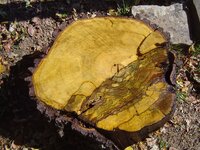
I just showed my wife your pic, and she said she just read someplace about people who pay some serious money for samples like that, to be able to study the patterns made by the lightning or something.
She's gonna try and remember where she read it and I'll let you know.
I've cut more trees with that same effect. I always assumed it was minerals carried up the tree but never tried to find out for sure.
Neat!
I don't know for sure, but it's neat anyway, notice the piece of bark (lower left), that was driven into the tree.
Fossis..............
Yeah, and it has some other cracking too. I didn't know for sure, just throwing out what were my thoughts when I've seen that in person.
It would be really cool if it holds that look after drying and finishing. If it does I'll have to save some of that for projects when I come across it. How cool would it be to turn a bowl with a chunk of that?
I've cut more trees with that same effect. I always assumed it was minerals carried up the tree but never tried to find out for sure.
Neat!
I don't know for sure, but it's neat anyway, notice the piece of bark (lower left), that was driven into the tree.
Fossis..............
Yeah, and it has some other cracking too. I didn't know for sure, just throwing out what were my thoughts when I've seen that in person.
It would be really cool if it holds that look after drying and finishing. If it does I'll have to save some of that for projects when I come across it. How cool would it be to turn a bowl with a chunk of that?
That would be a' priceless bowl' for sure.
Fossis.............
fossil hunter Indian Artifact collector MDer Antique collector
That "patterning" in the wood is called "spalting", and is actually caused by fungi. Spalted wood is sought after by many woodworkers & especially folks that do wood turnings. Until it becomes very "advanced" spalting does not significantly weaken most wood.
My guess is that the spalting caused that portion of the tree to contain more moisture than the rest and therefore created a more conductive path for the lightening to follow........................
Diggem'
Yup. The end of a way of life. Too bad. It's a good way. Wagons forward! Yo!
Yes definitely cool. Others have some great ideas for woodworking projects. My first thought when I saw this was some wall clocks made from slices of it. I don't know anything about the characteristics of persimmon wood, but if it dries without too much warping or checking, would make some neat clocks.
That "patterning" in the wood is called "spalting", and is actually caused by fungi. Spalted wood is sought after by many woodworkers & especially folks that do wood turnings. Until it becomes very "advanced" spalting does not significantly weaken most wood.
My guess is that the spalting caused that portion of the tree to contain more moisture than the rest and therefore created a more conductive path for the lightening to follow........................
Diggem'
Good to know, after thinking about it, the stump had several splintered places that could have soaked up more moisture, & the other areas didn't have this pattern.
Fossis.........
fossil hunter Indian Artifact collector MDer Antique collector
Yes definitely cool. Others have some great ideas for woodworking projects. My first thought when I saw this was some wall clocks made from slices of it. I don't know anything about the characteristics of persimmon wood, but if it dries without too much warping or checking, would make some neat clocks.
Thanks, it will make some beautiful pieces if it can be saved, (pretty fractured) though.
Fossis............
fossil hunter Indian Artifact collector MDer Antique collector