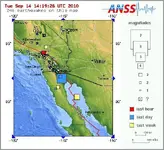
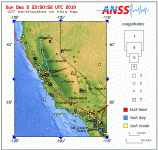
I am just posting this to see if we (or I) can "predict earthquakes".
Mr Marc, is there a connection between earthquakes and ouija boards?
(Earthquakes are cool to write about if only to use the word "seismicity" once in a while).
I imagine others are as eager as I for more ouija info. Bring it, please.
Mr Marc, is there a connection between earthquakes and ouija boards?
(Earthquakes are cool to write about if only to use the word "seismicity" once in a while).
I imagine others are as eager as I for more ouija info. Bring it, please.
Wayne
Nope.
This is just an educated guess - based on an obsession with analyzing USGS sensor data....
p.s., Just remember that big red dot over Devore Californa
"There is growing concern among seismologists that the 7.2 Mexicali earthquake on April 4 placed more pressure on faults in Southern California, resulting in increased quake activity over the last three months.
The latest evidence of this was Wednesday's magnitude-5.4 Collins Valley earthquake that rolled from the mountains south of Palm Springs, causing no major damage but rattling nerves across the region.
Wednesday's quake was centered in the San Jacinto fault zone — Southern California's most active — which runs 100 miles from the border northwesterly toward Riverside and San Bernardino. Scientists had warned for some time that the Mexicali quake had transferred pressure from the Mexican border area toward the San Jacinto fault and nearby Elsinore fault — which extends 110 miles and could cause major damage in urban areas — making quakes there more likely.
"The probability of a larger earthquake on those faults could be high within the next year or two," said John Rundle, a professor of physics and geology at UC Davis.
Rundle said the aftermath of the Mexicali quake is turning out to be significantly different from the aftermath of the two other large temblors to hit Southern California in the last two decades. Both the 7.3 Landers quake in 1992 and the 7.1 Hector Mine quake in 1999 in the Mojave Desert resulted in aftershocks that dissipated relatively quickly. By contrast, the Mexicali quake has been followed by aftershocks and "triggered earthquakes" that are showing no signs of ending.
"This thing seems to be popping off with lots of small earthquakes, and it's not decaying very quickly … which to me is worrisome, frankly," Rundle said.
Experts are particularly concerned because the northern edges of the Elsinore and San Jacinto fault zones line up, respectively, near the Whittier fault, which runs into Orange and Los Angeles counties, and the San Andreas fault. Both faults could produce catastrophic quakes.
Smaller earthquakes continue at an unexpectedly high level far north of the Mexicali quake in the Inland Empire.
"Under normal circumstances, you have a rather rapid die-off of activity after an earthquake. But in this case, the activity seems to be motoring along at a fairly high level," Rundle said.
In contrast, Rundle's analysis shows that the probability of a large earthquake — for example, a magnitude 7 — has decreased closer to the Mexicali quake area, such as near San Diego."
Terms like "it might be ready to rupture" and "the fault is locked and loaded" would make me REAL serious about earthquake preparedness if I lived in CA.
Southern California residents should be on heightened alert today after a 5.0 earthquake occurred this morning in Baja California - shortly afterwards (45 minutes ago) a 3.0 magnitude quake occurred to the north along the San Andreas. Who knows when the big one will hit, but IMHO California is teetering!
This hour there was an interesting sequence of quakes. One north and one south of the Salton Sea, and one in the Bay Area. There was a 3.7 near the CA/Mex border a little over 4 hours ago
These "triggered quakes" near Baja continue pounding their way up to the north... getting ever so closer to the locked up San Andreas.