
You are using an out of date browser. It may not display this or other websites correctly.
You should upgrade or use an alternative browser.
You should upgrade or use an alternative browser.
excal 2 mod
- Thread starter snooksion
- Start date

tiggar
Full Member
- Joined
- Sep 26, 2011
- Messages
- 127
- Reaction score
- 1
- Golden Thread
- 0
- Location
- South Jersey
- Detector(s) used
- Minelab Sovereign GT
- Primary Interest:
- Beach & Shallow Water Hunting
that really looks nice !!! nice work, congrats....50 hrs. that is great....
hh,
George
hh,
George

OBN
Gold Member
- Joined
- Dec 30, 2008
- Messages
- 6,891
- Reaction score
- 8,265
- Golden Thread
- 0
- Location
- Maryland Waters
- Detector(s) used
- "Excalibur"..
"AQ" Impulse
- Primary Interest:
- Other
Real Nice work snooksion, 50 hours is well worth cracking her open, takes maybe 60 seconds....How much is the setup....Thanks for sharing.....joe

h2ojunkie
Jr. Member
Sorry, didn't mean that in a derogitory way. I've never opened my pod unlike the volumes of DIY threads OBN's posted over the years. As OBN asked...what did the set up cost? 50 hours of play time sounds awesome.

Les West Central Fl
Bronze Member
- Joined
- Jun 14, 2009
- Messages
- 2,334
- Reaction score
- 1,306
- Golden Thread
- 0
- Location
- Bradenton, Fl
- Detector(s) used
- Aquasound, Excal 2, Excal (NY), Infinium
- Primary Interest:
- All Treasure Hunting
Great idea. No down time while hunting and no extra battery to carry out with you.
h2ojunkie
Jr. Member


Buried Crap NJ
Hero Member
- Joined
- Dec 5, 2009
- Messages
- 658
- Reaction score
- 233
- Golden Thread
- 0
- Location
- New Jersey
- Detector(s) used
- CTX 3030, Minelab Excalibur II, Minelab GT,Compass XP-Pro,Fischer 1210X
- Primary Interest:
- Beach & Shallow Water Hunting
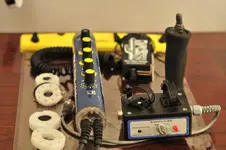
I think this a great idea. I have to ask what/which voltage cut off device are you using to prevent the battery from being brought down lower than allowed! Normally this would be 2.7vdc per cell which is 10.8vdc as your using a 4 cell 14.8vdc battery. I set my speed control to stop at 3.0vdc for safe carring of the battery! The Excalibur might run the battery pass that point without any knowledge to the end user and that would be the end of the battery! Its hard to see if you include a cut device in the pictures. I also don't know if there's room in the pod for one? .steve

dewcon4414
Bronze Member
- Joined
- Mar 22, 2006
- Messages
- 2,141
- Reaction score
- 1,237
- Golden Thread
- 0
- Location
- Gulf Coast, Fl
- Detector(s) used
- MDT, Nox, Blue Xcals and CTX
- Primary Interest:
- All Treasure Hunting
Ive going another direction with a lith ion.... IF they guys are telling me the truth i talked to. I was looking at a new Explorer/Etrac battery from new products During the conversation i asked about the Xcal he said they were putting one together as we spoke and should be out soon. Also lith ion and the battery charger charges it in 2 hours and has a green light when fully charged. Im going to book mark this page in case. Now i know on the Exp it says NOT to use lith ion because it produced more than 13V. Does the Xcal have a similar restriction and how many volts does this produced?
Dew
Dew
Mark west central florida
Greenie
- Joined
- Jun 11, 2012
- Messages
- 17
- Reaction score
- 28
- Golden Thread
- 0
- Location
- Bradenton,FL
- Detector(s) used
- Minelab Excalibur 2
- Primary Interest:
- All Treasure Hunting
Great idea. No down time while hunting and no extra battery to carry out with you.
I have been using method for years, first on my Sovereign and now on my Excaliburs. My charger cost $75.00 an I use Thunderpower 1320mh 11.1volt there half the size battery that Dave uses and they still get the same amount of run time. What I like about using lipo's there super lite and they never lose there charge after you charge them. They can hold a charge for months. The worst part is spilting the battery pod to recharge. HH
OBN
Gold Member
- Joined
- Dec 30, 2008
- Messages
- 6,891
- Reaction score
- 8,265
- Golden Thread
- 0
- Location
- Maryland Waters
- Detector(s) used
- "Excalibur"..
"AQ" Impulse
- Primary Interest:
- Other
14.8 Dew
now they have a new ...... G6 Pro Power 65c Series
G6 Pro Power 65C series batteries deliver up to 60% more power than previous generation LiPo batteries and up to an incredible 600+ cycles. Their ultra-low internal resistance (IR) also allows them to be capable of ultra-fast charge rates up to a technology-leading 12C* for charge times of 5 minutes or less.
Interesting to see if there is any performance gain over the stock setup other then run time. Mark have you noticed any? Thanks Joe
now they have a new ...... G6 Pro Power 65c Series
G6 Pro Power 65C series batteries deliver up to 60% more power than previous generation LiPo batteries and up to an incredible 600+ cycles. Their ultra-low internal resistance (IR) also allows them to be capable of ultra-fast charge rates up to a technology-leading 12C* for charge times of 5 minutes or less.
Interesting to see if there is any performance gain over the stock setup other then run time. Mark have you noticed any? Thanks Joe
critterhunter
Tenderfoot
- Joined
- Oct 31, 2012
- Messages
- 3
- Reaction score
- 0
- Golden Thread
- 0
- Primary Interest:
- All Treasure Hunting
If I may, a few things...First, you are using a 4 cell lipo in your Excalibur. Not only are you at risk of burning up the voltage regulator by using a 4 cell series lipo pack, but it won't do a darn thing to increase performance. Voltage regulators are used to stabilize a constant and set lower voltage to the circuit board to keep the detector in tune and stable. No matter if the voltage is say 10.5V or say 14V, the regulator is only going to put out what the detector needs to run properly, which off hand is probably 8 or 9V DC. All you are doing by running a 4 cell lipo is risking burning out the regulator. Linear regulators, which I'm assuming most detectors use due to the nature of switching regulators producing a lot of circuit noise, get rid of excess voltage by wasting it off as heat to a heat sink.
The Sovereign/Excalibur's low battery alarm kicks in at about 9.8 to 10V or so, so so long as the input voltage is above that the detector will work fine and not sound off the low battery alarm. Regulators normaly have a wide input window. The lowest voltage needed has to be somewhat above the static output it's designed for, and the upper input voltage range can't be above what the regulator is designed to handle or you risk either it shutting down due to thermal overload (and if your lucky it will work again once it cools down) or burning it out completely. I don't know off hand what the upper window limit is for the design specs on the regulator the Sov/Excal is using, but since they are designed to run on 8AA series cells at 12V, I would suspect they can tolerate *perhaps/maybe* an upper voltage range of maybe 13 to 14 volts or so, but I'd be very afraid to push it at the 4 cell series lipo voltage you are using. It's needless anyway. A 3 cell series lipo pack is 12.6V when fully charged, which is ideal to replace 8AAs in *probably* any detector requiring 8AAs.
I'm running a 3 cell 750ma Rhino lipo pack in my GT and get about the same run time as the 1000ma stock nimh pack, due to lipos holding their voltage very high to the end of discharge, unlike regular store batteries or nimhs that drain more steadily in voltage as they discharge. I was shooting for max weight savings on a light weight shaft build for my GT, so I didn't opt for a 1500ma pack, which I could easily fit inside the stock alkaline holder as well. Even a pack that size is probably a good bit lighter than 8AAs, but I wanted to save every ounce or gram I could, and I still get at least two long hunts before needing a re-charge. The stock alkaline holder required no modification other than solding in a tiny JST plug, which I can easily move out of the way to run 8AAs again if for some insane reason I wanted to.
Also, lipos should never be drawn down further than 3V per cell (9V total for a 3 cell series pack), so by using a 3 cell the low battery alarm on the GT/Excalibur is perfect to sound the alarm at around 10V before I risk destroying the pack. On other detectors typical low battery alarm levels are below 9V I believe, so in that case somebody would have to either monitor run time/voltage, or plug a cheap lipo low battery alarm into the pack.
Further, you are using some pretty pricey lipos and chargers there. Thunder Power is about the most expensive lipos there are. Same with that charger brand name. Back in the day they were about the only options and so earned a well deserved reputation, but these days there are most cheaper and just as good options out there. Those Thunder Powers also use some very non-standard charging/balancing plugs, where as everybody else has agreed on an industry standard, which is why most chargers have the balance plug built right into the side of the charger instead of external like that.
The Rhino packs are about $7 a piece and are roughly 1/3rd the size of a pack of smokes, so I bought two, and when in doubt about how much more run time I have with the pack I just throw the other one in my shirt pocket or something. Much easier than carrying 8AAs around for sure.
And the Accucel 6 charger I'm using cost me only $20, which will do things chargers costing well over $100 won't. This charger is very popular among the RC electric plane crowd because of this. It will also do various other battery types such as nimhs and nicads, but being a computerized charger with a screen and settings, it does require reading to know what you are doing. Or, there are simply plug and charge lipo chargers for as little as $7 out there. It's all in knowing where to look. HobbyKing/City is dedicated to RC and is about the cheapest place for chargers and batteries.
There are many perks to lipos. 1 hour (1c) charge times without pushing the pack (never excede the max charge rate ability of a lipo! some can handle 2C or higher charge rates but who can't wait an hour and not push the pack?). Virtualy no self-discharge on the shelf so months after charging it's ready to roar, unlike nimhs or nicads which self drain quickly, although there are now low self-discharge nimhs on the market (some are better than others so do your reading). Light, compact, dirt cheap and even cheaper/lighter than lithium ion cells, and so on. Lipos and brushless motors have taken the RC electric plane world by storm, and for good reason. Like night and day in run time, power, and performance.
Lipos got a bad rap early on about 6 years or so ago before they featured balance plugs and chargers having balance ports. Without those, lipos would over charge a cell or two and cause a fire. These days, provided you don't charge too fast, don't short the pack, and don't cut it open, it's as safe IMO as any other battery technology out there. In some ways safer than nimhs or nicads, since those don't feature balance ports to keep the cells in balance. I've used lipos for many years here flying RC. Even crashed and dented them badly, and still they have never given me a problem.
That said, lipos, like any other battery, should be treated with respect and understanding on how to feed and care for them. I don't care what kind of battery I'm charging, I always place it in a fire proof location while charging if I can't keep an eye on it. I also store my batteries in a metal box (painted on the inside to prevent shorts) and in my refrigerator for extending life spans. When not being used for months I put them at a sleep charge (Accucel does this) for best storage conditions to insure long life spans and high capacity.
Don't mean to knock your mod. Always love to see people do-it-their-self and enhance detector battery technology, as metal detecting circles seem to be about 15 years behind the times in terms of prices and technology of what is out there. Just mainly saying I feel you are risking the detector with a 4 cell, and it's a needless risk since you won't get more performance than any other battery voltage above about 10V, and that a 3 cell is perfectly suited for the Sov/Excal due to the low battery alarm above 9V, and that Thunderpower and that charger are some hefty price tags when so much cheaper options are out there these days.
One more thing- Don't worry about the discharge ability (other C raiting) of the lipo. Detectors are drawing well below 1 amp. On the Sovereign GT it's around 50 to 70ma, depending on it being under load (sounding off to a target) or not. My 750ma Rhino 3 cells are raited at 20C discharge ability, which means about 15 amps in total continuous amp delivering ability. Well beyond what a detector could ever hope to draw.
Incidently, there are two C raitings for a lipo...C charging rate (typical 1C but some above that now, but I prefer 1C (1 hour) charge rates to keep the math simple and not make a mistake, plus who can't wait an hour and not risk pushing the pack's health?), and then C discharge rate. The C discharge rate is usually one for continues and one for burst modes it can deliver for seconds at a time.
PS- Don't know if I made it clear, but the other problem with using a 4 cell besides risking blowing the regulator, is that you now can't rely on the built in low battery alarm of the Excal or Sovereign. A 4 cell pack, at a minimum of 3V per cell series, is 12V mimimum. Obviously if you drain to the low battery alarm of about 10V you've probably ruined the pack. A 3 cell's max discharge should not excede below 9V, so 10V is well within safety. For other detectors not featuring a low battery alarm above 9V for a 3 cell, they can plug in a $3 low battery alarm for it.
WARNING: Use my advice at your own risk to person, property, animals, and perhaps the very destruction of the universe. I don't claim to be right, as there are many wars being waged on the net for years as to proper battery care. Messing with any battery, lipo or not, can cause serious risk, even among those of us seasoned enough to think we know what we are doing. Just one small example...Wanting to change a plug on a lipo? First, why would you want to do that? But, something as harmless as cutting both wires at the same time will cause a short which might make things go nuclear. Never expose two wires at ones for that matter. Secure/heat shrink one to the new plug, then move onto the other. Second small example...You may have seen videos on Youtube of lipos exploding by being exposed to water. Well, if a lipo is ruptured, or any lithium based battery type for that matter, if very well could explode like that, but more than probably if it's been cut open you'd know long before you got it near water that you had a problem, because the very moisture in the air can cause such a thing. Lipos are to be drained dead and then put in a buck of salt water for days to insure they are dead in order to dispose of them. At least that is what many on the web say. So if merely the battery, without any punctures, was at risk of explosion or fire with contact with water, would they really be recommending you put it in a bucket of salt water? Again, research for yourself and don't follow my advice. I don't claim to be an expert, and have not kept up on the latest recommended methods for lipo disposal.
The Sovereign/Excalibur's low battery alarm kicks in at about 9.8 to 10V or so, so so long as the input voltage is above that the detector will work fine and not sound off the low battery alarm. Regulators normaly have a wide input window. The lowest voltage needed has to be somewhat above the static output it's designed for, and the upper input voltage range can't be above what the regulator is designed to handle or you risk either it shutting down due to thermal overload (and if your lucky it will work again once it cools down) or burning it out completely. I don't know off hand what the upper window limit is for the design specs on the regulator the Sov/Excal is using, but since they are designed to run on 8AA series cells at 12V, I would suspect they can tolerate *perhaps/maybe* an upper voltage range of maybe 13 to 14 volts or so, but I'd be very afraid to push it at the 4 cell series lipo voltage you are using. It's needless anyway. A 3 cell series lipo pack is 12.6V when fully charged, which is ideal to replace 8AAs in *probably* any detector requiring 8AAs.
I'm running a 3 cell 750ma Rhino lipo pack in my GT and get about the same run time as the 1000ma stock nimh pack, due to lipos holding their voltage very high to the end of discharge, unlike regular store batteries or nimhs that drain more steadily in voltage as they discharge. I was shooting for max weight savings on a light weight shaft build for my GT, so I didn't opt for a 1500ma pack, which I could easily fit inside the stock alkaline holder as well. Even a pack that size is probably a good bit lighter than 8AAs, but I wanted to save every ounce or gram I could, and I still get at least two long hunts before needing a re-charge. The stock alkaline holder required no modification other than solding in a tiny JST plug, which I can easily move out of the way to run 8AAs again if for some insane reason I wanted to.
Also, lipos should never be drawn down further than 3V per cell (9V total for a 3 cell series pack), so by using a 3 cell the low battery alarm on the GT/Excalibur is perfect to sound the alarm at around 10V before I risk destroying the pack. On other detectors typical low battery alarm levels are below 9V I believe, so in that case somebody would have to either monitor run time/voltage, or plug a cheap lipo low battery alarm into the pack.
Further, you are using some pretty pricey lipos and chargers there. Thunder Power is about the most expensive lipos there are. Same with that charger brand name. Back in the day they were about the only options and so earned a well deserved reputation, but these days there are most cheaper and just as good options out there. Those Thunder Powers also use some very non-standard charging/balancing plugs, where as everybody else has agreed on an industry standard, which is why most chargers have the balance plug built right into the side of the charger instead of external like that.
The Rhino packs are about $7 a piece and are roughly 1/3rd the size of a pack of smokes, so I bought two, and when in doubt about how much more run time I have with the pack I just throw the other one in my shirt pocket or something. Much easier than carrying 8AAs around for sure.
And the Accucel 6 charger I'm using cost me only $20, which will do things chargers costing well over $100 won't. This charger is very popular among the RC electric plane crowd because of this. It will also do various other battery types such as nimhs and nicads, but being a computerized charger with a screen and settings, it does require reading to know what you are doing. Or, there are simply plug and charge lipo chargers for as little as $7 out there. It's all in knowing where to look. HobbyKing/City is dedicated to RC and is about the cheapest place for chargers and batteries.
There are many perks to lipos. 1 hour (1c) charge times without pushing the pack (never excede the max charge rate ability of a lipo! some can handle 2C or higher charge rates but who can't wait an hour and not push the pack?). Virtualy no self-discharge on the shelf so months after charging it's ready to roar, unlike nimhs or nicads which self drain quickly, although there are now low self-discharge nimhs on the market (some are better than others so do your reading). Light, compact, dirt cheap and even cheaper/lighter than lithium ion cells, and so on. Lipos and brushless motors have taken the RC electric plane world by storm, and for good reason. Like night and day in run time, power, and performance.
Lipos got a bad rap early on about 6 years or so ago before they featured balance plugs and chargers having balance ports. Without those, lipos would over charge a cell or two and cause a fire. These days, provided you don't charge too fast, don't short the pack, and don't cut it open, it's as safe IMO as any other battery technology out there. In some ways safer than nimhs or nicads, since those don't feature balance ports to keep the cells in balance. I've used lipos for many years here flying RC. Even crashed and dented them badly, and still they have never given me a problem.
That said, lipos, like any other battery, should be treated with respect and understanding on how to feed and care for them. I don't care what kind of battery I'm charging, I always place it in a fire proof location while charging if I can't keep an eye on it. I also store my batteries in a metal box (painted on the inside to prevent shorts) and in my refrigerator for extending life spans. When not being used for months I put them at a sleep charge (Accucel does this) for best storage conditions to insure long life spans and high capacity.
Don't mean to knock your mod. Always love to see people do-it-their-self and enhance detector battery technology, as metal detecting circles seem to be about 15 years behind the times in terms of prices and technology of what is out there. Just mainly saying I feel you are risking the detector with a 4 cell, and it's a needless risk since you won't get more performance than any other battery voltage above about 10V, and that a 3 cell is perfectly suited for the Sov/Excal due to the low battery alarm above 9V, and that Thunderpower and that charger are some hefty price tags when so much cheaper options are out there these days.
One more thing- Don't worry about the discharge ability (other C raiting) of the lipo. Detectors are drawing well below 1 amp. On the Sovereign GT it's around 50 to 70ma, depending on it being under load (sounding off to a target) or not. My 750ma Rhino 3 cells are raited at 20C discharge ability, which means about 15 amps in total continuous amp delivering ability. Well beyond what a detector could ever hope to draw.
Incidently, there are two C raitings for a lipo...C charging rate (typical 1C but some above that now, but I prefer 1C (1 hour) charge rates to keep the math simple and not make a mistake, plus who can't wait an hour and not risk pushing the pack's health?), and then C discharge rate. The C discharge rate is usually one for continues and one for burst modes it can deliver for seconds at a time.
PS- Don't know if I made it clear, but the other problem with using a 4 cell besides risking blowing the regulator, is that you now can't rely on the built in low battery alarm of the Excal or Sovereign. A 4 cell pack, at a minimum of 3V per cell series, is 12V mimimum. Obviously if you drain to the low battery alarm of about 10V you've probably ruined the pack. A 3 cell's max discharge should not excede below 9V, so 10V is well within safety. For other detectors not featuring a low battery alarm above 9V for a 3 cell, they can plug in a $3 low battery alarm for it.
WARNING: Use my advice at your own risk to person, property, animals, and perhaps the very destruction of the universe. I don't claim to be right, as there are many wars being waged on the net for years as to proper battery care. Messing with any battery, lipo or not, can cause serious risk, even among those of us seasoned enough to think we know what we are doing. Just one small example...Wanting to change a plug on a lipo? First, why would you want to do that? But, something as harmless as cutting both wires at the same time will cause a short which might make things go nuclear. Never expose two wires at ones for that matter. Secure/heat shrink one to the new plug, then move onto the other. Second small example...You may have seen videos on Youtube of lipos exploding by being exposed to water. Well, if a lipo is ruptured, or any lithium based battery type for that matter, if very well could explode like that, but more than probably if it's been cut open you'd know long before you got it near water that you had a problem, because the very moisture in the air can cause such a thing. Lipos are to be drained dead and then put in a buck of salt water for days to insure they are dead in order to dispose of them. At least that is what many on the web say. So if merely the battery, without any punctures, was at risk of explosion or fire with contact with water, would they really be recommending you put it in a bucket of salt water? Again, research for yourself and don't follow my advice. I don't claim to be an expert, and have not kept up on the latest recommended methods for lipo disposal.
Last edited:
dewcon4414
Bronze Member
- Joined
- Mar 22, 2006
- Messages
- 2,141
- Reaction score
- 1,237
- Golden Thread
- 0
- Location
- Gulf Coast, Fl
- Detector(s) used
- MDT, Nox, Blue Xcals and CTX
- Primary Interest:
- All Treasure Hunting
Joe..... did you read ALL that book? I need cliff notes lol. Joe im not sure you would be able to increase the coil current since i believe it has a current limiting resistor installed to extend battery life. Would be nice to get a tad more juice to that coil.
Dew
Dew
Last edited:
critterhunter
Tenderfoot
- Joined
- Oct 31, 2012
- Messages
- 3
- Reaction score
- 0
- Golden Thread
- 0
- Primary Interest:
- All Treasure Hunting
When dealing with batteries, one can not be too careful in getting things right before proceding due to risk to man and machine. If somebody doesn't have the patience to read and be sure of what they are doing, then I would strongly recommend not to delve into messing with alternative battery sources. Just like gasoline is "safe" if handled properly, so are rechargeable batteries, so long as you are willing to put in the time to know the do's and don'ts.
Far as increasing power to the TX winding of the coil, the only way to do that easily without mucking around on the circuit board, would be to do what Shaun's Amp did- Plug a device in between the detector and the coil, which then via it's own independent battery source increases voltage directly to the TX winding to generate a stronger magnetic field.
That approach is a wash in many instances or will even hurt depth. Good reason why on most detectors the pre-amp for the coil can't be adjusted power wise. Too much power at the TX winding and you begin to have issues with both mineralization and balance between the TX/RX coils. Some found Shaun's amp was not usuable in their mineralization, for instance. Increasing sensitivity on a detector normaly adjusts the gain on the received signal, and does not adjust the power to the transmit coil. The transmit power on a detector is calibrated for best results under most soil conditions, and is why most detectors won't allow you to change that.
Far as increasing power to the TX winding of the coil, the only way to do that easily without mucking around on the circuit board, would be to do what Shaun's Amp did- Plug a device in between the detector and the coil, which then via it's own independent battery source increases voltage directly to the TX winding to generate a stronger magnetic field.
That approach is a wash in many instances or will even hurt depth. Good reason why on most detectors the pre-amp for the coil can't be adjusted power wise. Too much power at the TX winding and you begin to have issues with both mineralization and balance between the TX/RX coils. Some found Shaun's amp was not usuable in their mineralization, for instance. Increasing sensitivity on a detector normaly adjusts the gain on the received signal, and does not adjust the power to the transmit coil. The transmit power on a detector is calibrated for best results under most soil conditions, and is why most detectors won't allow you to change that.
Last edited:
OBN
Gold Member
- Joined
- Dec 30, 2008
- Messages
- 6,891
- Reaction score
- 8,265
- Golden Thread
- 0
- Location
- Maryland Waters
- Detector(s) used
- "Excalibur"..
"AQ" Impulse
- Primary Interest:
- Other
Got it Dew but it is to much for most beach's, falses like crazy when near the saltwater. Drysand, fresh water, it smokes.Dew
Would be nice to get a tad more juice to that coil.
dewcon4414
Bronze Member
- Joined
- Mar 22, 2006
- Messages
- 2,141
- Reaction score
- 1,237
- Golden Thread
- 0
- Location
- Gulf Coast, Fl
- Detector(s) used
- MDT, Nox, Blue Xcals and CTX
- Primary Interest:
- All Treasure Hunting
Apparently it doesnt agree with the factory salt setting Joe.... hey but i knew if it had been tried you did it lol.
Dew
Dew





Featured Treasure Finds
Featured Treasure Finds
Similar threads

- Suggestion
- Replies
- 4
- Views
- 459

- Replies
- 8
- Views
- 1K

Users who are viewing this thread
Total: 1 (members: 0, guests: 1)














