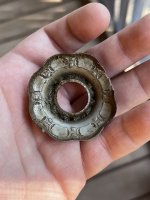
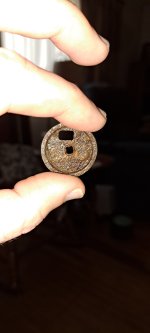
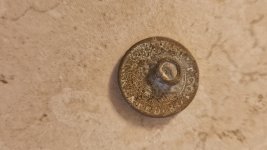
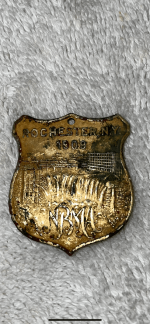
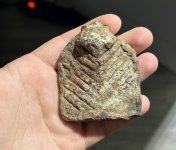
Sorry forgot to add the button pictures......The Buttons Diam. are 18.45mm to 18.93mm on the disc"s and
18.22 on the two backs. thanks. Any info will be Great!
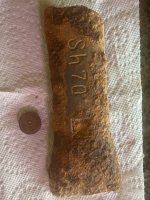
Bullet on the left in your second photo is an 1850s/60s Colt .44 revolver bullet manufactured by the Hazard Powder Works. Bullet on the right is an 1850s/60s Maynard .50 Carbine bullet. Both of those two bullets are unfired. Unlike the .44 Colt bullet you found, your Maynard Carbine bullet was in a metal cartridge, made of brass. So, there ought to be an empty Maynard brass casing somewhere nearby.
The two round brass discs with corroded solder on one side and a tiny hole in their center are from the base of a .50 Maynard bullet's brass casing.
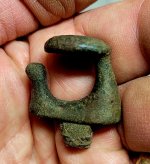
The small teardrop-shaped brass object, with a "collared" stud on its bottom, is the finial from an 1850s/60s army pistol's cap-box, which was made of leather and worn on the soldier's belt. The small brass finial's purpose was to keep the cap-box's flap tightly closed. (The end of the leather cover-flap had a hole in it, which fit over the finial on the bottom of the cap-box.)
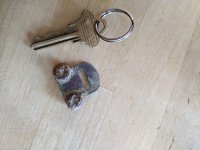
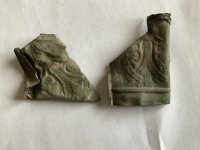
The button backs you found are most probably from yankee Enlisted-men's "eagle buttons" ...which are the most common of all civil war era Military buttons.
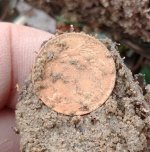
The two flat disks are not "coin" type buttons, or even buttons for that matter. They are in fact the base pieces from .50 caliber Maynard rifle/carbine casings or cartridges. The Maynard cartridge was not internally primed, therefore the firearm utilized a separate initial firing device, which caused a flash that ignited through the pinhole opening in the base of the cartridge (note the small hole in the center of your recovered disks). These disks were larger in diameter than the actual casing tube on Maynard cartridges, to facilitate removal of the empty casing after firing. These disks were originally attached to the base of the casing tube with solder. The effects of being buried in ground, along with moisture and temperature changes, results in the disks quite often being found separated from the casing tube.
The bullet on the right in your second photo, appears to be a .50 caliber Maynard.
Providing we have the honor of TheCannonballGuy also replying on this topic, more in depth information can assuredly be added regarding Maynard bullets, cartridges, and rifle/carbines.
The two button backs on the right side of your last photo, are from two-piece brass buttons. The face of the buttons is now missing, where the design detail would have been. One appears to be a blank back button, and the other appears to possibly carry a company mark in Raised Letter Depressed Chanel (RMDC) style.Although the complete marking is not legible in the photo, RMDC style markings are consistent for time frame on buttons beginning in the 1840's up to the American Civil War. Most likely the buttons were originally plain eagle design, general service buttons.
CC Hunter
P.S. While I was typing my reply, TheCannonballGuy was also replying. He's faster on the "draw" with guns!
The two flat disks are not "coin" type buttons, or even buttons for that matter. They are in fact the base pieces from .50 caliber Maynard rifle/carbine casings or cartridges. The Maynard cartridge was not internally primed, therefore the firearm utilized a separate initial firing device, which caused a flash that ignited through the pinhole opening in the base of the cartridge (note the small hole in the center of your recovered disks). These disks were larger in diameter than the actual casing tube on Maynard cartridges, to facilitate removal of the empty casing after firing. These disks were originally attached to the base of the casing tube with solder. The effects of being buried in ground, along with moisture and temperature changes, results in the disks quite often being found separated from the casing tube.
The bullet on the right in your second photo, appears to be a .50 caliber Maynard.
Providing we have the honor of TheCannonballGuy also replying on this topic, more in depth information can assuredly be added regarding Maynard bullets, cartridges, and rifle/carbines.
The two button backs on the right side of your last photo, are from two-piece brass buttons. The face of the buttons is now missing, where the design detail would have been. One appears to be a blank back button, and the other appears to possibly carry a company mark in Raised Letter Depressed Chanel (RMDC) style.Although the complete marking is not legible in the photo, RMDC style markings are consistent for time frame on buttons beginning in the 1840's up to the American Civil War. Most likely the buttons were originally plain eagle design, general service buttons.
CC Hunter
P.S. While I was typing my reply, TheCannonballGuy was also replying. He's faster on the "draw" with guns!
CC... perhaps CannonballGuy's answer was of the Cuff
And to follow up with an item that the others appear to have missed...
The piece on top in the very first photo is the brass tip to a strap that was on a mid-1800s leather valise. See photos below (at the end of the long leather strap that was used to close the bag):

Best Wishes,
Buckles
Spring 2012 CaneField Bandits Totals: TEN Half Reales:
1740, 1777, 1784, 1796, 1801, 180?, 1806, 1807, 1808, and 1814
1836 8 Reales
A 17?? One Real
1819 Token/Jeton
Two "Russian Blue" Trade Beads
Henry Clay Campaign Button FIVE Early New Orleans Seated Coins:
1838-O Dime (no stars), Three 1839-O Half Dimes, an 1840-O Dime, and an 1842-O Half Dime
1892 Barber Dime
1918 Walking Liberty Half
1866 and 18?? Shield Nickels, and some GawGag V's and Beefaloes. Military Relics: Possible Spanish Colonial Era Cap Badge
FOUR War of 1812 Artillery Buttons
1820s Pewter Militia "U.S." Button
CW Eagle Artillery Cuff Button
CW Eagle Infantry Officer's Coat Button
3-Ringers, Enfields, Musketballs, and Shell Fragments
Any relics, coins, or other items appearing in my finds posts were found on PRIVATE PROPERTY with total consent and permission from the owners of said property.
P.S. While I was typing my reply, TheCannonballGuy was also replying. He's faster on the "draw" with guns!
CC... perhaps CannonballGuy's answer was of the Cuff
SS
For British humor thats hilarious.
I live in a state of rules where I am not permitted to live on my own country land because my home is not 130 MPH rated! I can only visit it from time to time and pay the fines. I feel so safe with Big Government protecting me. In some states its illegal to collect rainwater.
BTW Great IDs. Very educational. Im not well versed on CW items being from South Florida so I may not be depicting the right item but you get the idea.
Originally Posted by TheCannonballGuy
The small teardrop-shaped brass object, with a "collared" stud on its bottom, is the finial from an 1850s/60s army pistol's cap-box, which was made of leather and worn on the soldier's belt. The small brass finial's purpose was to keep the cap-box's flap tightly closed. (The end of the leather cover-flap had a hole in it, which fit over the finial on the bottom of the cap-box.)
I live in a state of rules where I am not permitted to live on my own country land because my home is not 130 MPH rated! I can only visit it from time to time and pay the fines. I feel so safe with Big Government protecting me. In some states its illegal to collect rainwater.
CBG,CC, Thanks alot guys , you people amaze me with the combined knowledge on this site, Thanks again HH
Do the same thing, but do it to your original post, and the green check will appear in the correct place.
I live in a state of rules where I am not permitted to live on my own country land because my home is not 130 MPH rated! I can only visit it from time to time and pay the fines. I feel so safe with Big Government protecting me. In some states its illegal to collect rainwater.
Thanks BigC...alass it was lost on CC Hunter, to clever I guess
SS
SS,
A Lass was lost on me? Was she a cute one?
"to clever I guess?":
"To" means connected with or going towards, rather than "too" which would mean excessive. Hence, I gather you are headed towards clever, yet have not exceeded that point yet.
Thanks BigC...alass it was lost on CC Hunter, to clever I guess
SS
SS,
A Lass was lost on me? Was she a cute one?
"to clever I guess?":
"To" means connected with or going towards, rather than "too" which would mean excessive. Hence, I gather you are headed towards clever, yet have not exceeded that point yet.
CC Hunter
It's a shame some of you Americans can take a harmless remark, then turn it around to make insults, but it's not the first time and probably not the last.
Not worth getting upset about, my friend. Great job on the IDs everyone!
-Buckles
Spring 2012 CaneField Bandits Totals: TEN Half Reales:
1740, 1777, 1784, 1796, 1801, 180?, 1806, 1807, 1808, and 1814
1836 8 Reales
A 17?? One Real
1819 Token/Jeton
Two "Russian Blue" Trade Beads
Henry Clay Campaign Button FIVE Early New Orleans Seated Coins:
1838-O Dime (no stars), Three 1839-O Half Dimes, an 1840-O Dime, and an 1842-O Half Dime
1892 Barber Dime
1918 Walking Liberty Half
1866 and 18?? Shield Nickels, and some GawGag V's and Beefaloes. Military Relics: Possible Spanish Colonial Era Cap Badge
FOUR War of 1812 Artillery Buttons
1820s Pewter Militia "U.S." Button
CW Eagle Artillery Cuff Button
CW Eagle Infantry Officer's Coat Button
3-Ringers, Enfields, Musketballs, and Shell Fragments
Any relics, coins, or other items appearing in my finds posts were found on PRIVATE PROPERTY with total consent and permission from the owners of said property.