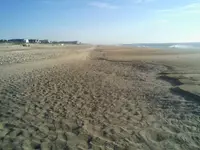
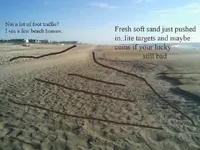
OK, you have 3 hours. How would you attack this beach. The tide is starting back in and will be filling in the washed out area in about an hour. Please give your plan of ATTACK!
Two words: Hard Pack. Go vertically and figure out where the hard pack is and what is soft sand. Search the hard pack closest to fill in first horizontally and then work up. Skip soft sand. Trust your bare feet. I always find oldest and best stuff in hard pack and amount of sand over hard pack shifts with each tide.
To be a successful hunter get to know that beach. Watching the before weather, winds, tides (days before) ..frequent it to watch the changes And The most important thing when looking at a beach is History of, whether it be yesterdays or 300 years ago.. once I have that I look at what's in front of me when I arrive. And is it worth the effort at that moment. Both above are excellent advice, look for the lows, shells, hard pack... stay away from the soft sand .. look for any targets, you hit iron, could be other good targets near.. dig everything.. learn the target history and what to expect the next trip..
One thing I have found out about Delaware \ Maryland Ocean beach's .. you need a event to find treasures.. this one here is a long shot unless these have happened recently .. I more then likely would spend about 30 minutes here checking it out, working the marked areas...then shoot down the coast and hope to find a better .. And I would have been out there 3 hours before the Lowtide..and more then likely in the water, or wetsand slopes...dry sand rarely excites me..
Thanks for the insight, I ended up with small gold toe ring and a silver hair pin with cz, 2$ change. This area is just below bethany beach and is early morning. Well hunted area and I am amazed at the number of coins i find that have been out there since last year! Hair pin was found in the fresh loose sand and the ring was near the dunes as I was leaving! Go figure. Anyway, thanks for the advice and happy huntin.
See the pic that OBN put up see if there is a drop off in that middle section...look at the sand and look for changes to the size of the grains...
It will tell you if the water from the last tide out was fast or slow also.
OK, you have 3 hours. How would you attack this beach. The tide is starting back in and will be filling in the washed out area in about an hour. Please give your plan of ATTACK!
If it was a regular beach that I hunt, I'd already know where the most likely spot would be. If it was an unknown beach or one I haven't hunted in a long time, I'd run a zig zag pattern from water to dry sand and see if there is any kind of trough or section with more good targets than other areas and then concentrate on that. Once you find a trough or layer that is paying off with good finds, run a grid parallel to the water and follow that trough. The look of an unknown beach doesn't necessarily mean much. I've hunted beaches with a 6' cut and found nothing and other beaches that "looked" sanded in and found plenty. Hunt where the targets are, not where you want them to be.
Right on Cudamark! It's all about target density. If your in squishy sand and digging canslaw move up or down until targets with more density are found and hard packed sand.
You know, that sounds good and makes perfect sense. Problem is , I found a 4oz sinker that looks pretty old yesterday and it was in a fresh,soft sand area just above the high tide line. Just when you think you have it all figured out! All i know from several years of beach hunting is this. Swing and dig, the more you swing the more you dig. Wet or dry, high or low, the only thing that seems to work is work. Luck comes with work. Period.