Oilfield Diver wrote:
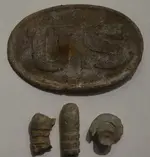
> I am finding quite a few of these. Are they also 1861 - 1865 Minies??
Duggap and Nova Treasure are correct, those bullets are .45-70 bullets, which date from a few years after the end of the Civil War. Specifically, the .45-70 bullet first appears in 1873, as metallic-cartridge ammunition for the breechloading .45-70 Springfield (or .45-70 "Government") rifle.
If you want to learn more about the .45-70 rifle, and see a photo of an unfired .45-70 cartridge, go to:
http://en.wikipedia.org/wiki/.45-70
Sidenote:
Part of your question asked if your bullets are "Minies." Your bullets are not a Minie-type, even if they dated back to 1861-65. The #1 distinguishing characteristic of Minie-type bullets is the presence of a large and deep cavity in the bullet's base, to enable its expansion into the gunbarrel's rifling grooves. Bullets for breechloading firearms (which are loaded into the gunbarrel's back end, called the "breech") do not need to expand, so there was no need to use Minie-type bullets in breechloading firearms.
> Does the smashed one mean it possibly hit somebody or just a tree or something?
Almost all of use civil war relic diggers have asked that question on the first time we dug some fired civil war bullets.

The FACTUAL answer is, there's almost always no way to tell the difference between a fired bullet that hit somebody or just hit a tree/rock/dirt. We know that's true because some soldiers actually kept the bullet which wounded them, as a souvenir. Photos of those soldiers' wounding-souvenir bullets show they almost never look "distinguishably" different from the millions of fired bullets we've dug.
I should also mention that statistics compiled by the US Army during the civil war show that the VAST majority of fired bullets missed their human target. The US Ordnance Department said that based on comparing the number of bullets issued with the known number of enemy casualties, "it took a man's weight in bullets to kill one."
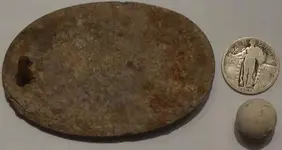
> Also, I was told the ammo box buckle was the early style 1830's or something, is that correct?
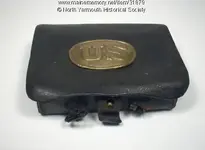
The following info is mostly for other readers here, who may not already know the info. It's not an "ammo box buckle." The front of a civil war Oval US belt-buckle and the Oval US cartridge-box plate look identical. The belt-buckle version had three large brass attachment-hooks on its back, and the cartridge-box version had two simple small loops (almost always made of iron wire) on its back. The cartridge-box version is called a "plate," not a buckle. Note: Very often, on excavated cartridge-box plates, one or both of the iron-wire loops will have rusted away to nothing.