What's new

Big iron ball, LG CC button? sun finds

junkhunter

Hero Member
Joined
Oct 4, 2010
Messages
595
Reaction score
1,159
Golden Thread
0
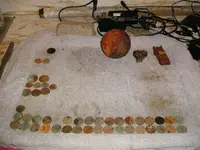
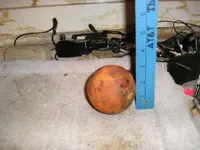
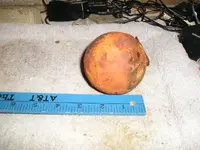
Well I got this big iron ball in creek today.May have been tossed of a bridge.I have dug musket balls,a 50 cal shell,various other live rounds,but this is different.The relic hunter in me hopes its a cannon ball.The rational person in me says its a big freaking counter weight.Can anyone confirm or deny what this thing is?

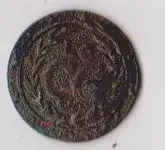
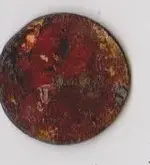
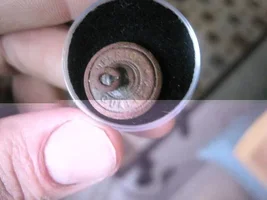
Next up got what appears to be a lapel or button that says LG CC?was gold at one time.Looks like it has back part missing.solid medal with missing pin on back.Also got a odd suspender clip,2 wheat cents,and clad
 

Attachments

  • july 089.webp
    july 089.webp
    461.6 KB · Views: 588
  • july 087.webp
    july 087.webp
    166.1 KB · Views: 549
  • july 088.webp
    july 088.webp
    385 KB · Views: 597
  • july 090.webp
    july 090.webp
    4.3 KB · Views: 585
  • july 091.webp
    july 091.webp
    3.8 KB · Views: 565
Upvote 0
Cool find. It could very well be a 12 pounder solid shot. You will not be able to tell for sure without it's weight and a good measure of its diameter. Does it have any markings, mold seam, sprue?
 
My betting money is on a cannonball! Have you weighed it?
 
To discover with certainty whether the ball is a cannonball or not, first go to:
www.civilwarartillery.com/shottables.htm
and check the chart which lists the exact diameter and exact weight of Solid-Shot cannonballs. Then get the ball extra-precisely measured for its exact diameter and exact weight. You'll probably need to clean off the rust-crustation at spots on opposite sides of the ball to get a "true" size-measurement. If the ball doesn't match up precisely, for both size and weight) with anything in the Shot Tables charts, it is not a cannonball.

For your sake, I hope it is. :)
 
CBG: I understand what you are saying and why it has to be so precise. But I have had this discussion and have been told that the early colonial and English/French balls do have sprues and seams. Is that true, and do your "rules" just apply to CW shells and shot?

I have gone into so many antique stores out here and they have mill balls at shot prices. Huge mold seams and flat spots the size of half dollars. The proprietor said "They guy told me they were cannon balls, and so they are cannon balls". Next time, I take my tools and charts in for the occasional one that doesn't have seams and sprues.

Thanks for expanding my education.
 
High Plains Digger wrote:
> But I have had this discussion and have been told that the early colonial and English/French balls do have sprues and seams.
> Is that true, and do your "rules" just apply to CW shells and shot?

The 1861 Ordnance Manual's "Shot Tables" list several calibers of cannonballs used in the Revolutionary War and the War of 1812. Examples are 1-pounder, 3-pounder, 4-pounder, and 9-pounder. They were included in the civil war "Shot Tables" because some of those old obsolete cannons and ammo were still in the Federal Arsenals at the outbreak of the war. That being said, there seems to be no documented usage of 1-pdr, 3-pdr, or 4-pdr. cannons by either side in the civil war. Historical records show the Confederates did use a (very) few 9-pounders during the first year of the war, due to the serious shortage of cannons in the South at that time. One 9-pounder is listed as captured by the yankees at the fall of Fort Donelson.

Yes, some RevWar cannonballs have a noticeable "protruding" mold-seam or very short sprue. Their use was acceptable because the cannon's "windage" (the space between the ball and the cannon's bore) was larger in that era. By the time of the civil war, acceptable "windage" for Field Artillery cannons had shrunk considerably. Example: for a 12-pounder cannon (4.62-inch bore diameter), the ball was specified to be 4.52-inches in diameter. That means the "windage" was only one-tenth of an inch. Thus, a cannonball with even a .05-inch (1/20th-inch) sprue or moldseam projection would be rejected by the Ordnance Inspector.

By the way... those are not "my" rules ...they come from the Ordnance Manual of both the USA and CSA. Those rules were in the Manual, and strictly applied, for important reasons. Shooting "improperly formed" cannonball tends to cause the cannon to burst quite violently, usually killing several of the gun-crew.
 
Sure looks like a cannon ball! Nice finds and HH, Mike
 
I only ment "your rules" due to the discussion and your dissertation. I have seen pictures of a "shot tester" where they put an appropriately sized testing ring over the ball. As you explained, a small protrubance could be the worst. I figured that perhaps the shot would hang up in the barrel and cause a lot of problems.

Here's another question for you: What happened when, the Spanish in St. Augustine, for instance, heated a shot to red hot and shot it. From what you said, the fit wasn't that tight, so if it expanded "significantly" it still had wiggle room. Would this be the case? The range of cannons must have been increased dramatically with the precision fits.

Thank you for the upgrade in my artillery education.
 
High Plains Digger wrote:
> Would this be the case?

Yes -- and you did a good job of explaining it. :)

> The range of cannons must have been increased dramatically with the precision fits.

Again, yes. The bigger the "windage" (the gap between the cannonball and the bore), the more loss of power from the propellant-charge's blast, due to "blow-by." That's a lot like what happens when a car engine's piston rings have worn down.

The basic problem was that the technology and knowledge for cannon-casting was still very "rudimentary" in the Colonial era. Due to very frequent flaws in the casting process of massive metal objects (such as, large air-bubbles trapped inside the molten metal), cannons had to be cast extremely thick to withstand the explosive blast of firing. Large-gap windage actually was a safety-feature, because it lessened the strain put on the cannon's metal by the propellant powder charge's explosive blast.

Firing-strain is the reason bronze was preferred over iron for cannons during the Colonial era. Bronze is a more "flexible" metal than cast-iron ...which is metallurigically classified as a "brittle" metal.

Eventually, in the early 1800s, advancement in methods of metal-refining and "large" metal-casting allowed the production of cannons which were strong enough to withstand a tighter fit between the cannonball and the cannon's bore, without causing the cannon itself to burst. The result of the advancements was a lighter-weight cannon which also had longer range. That is why, around the very end of the Colonia era, in artillery-armament listings, you begin to see the term "Light 12-Pounder Gun" -- to distinguish the new version from the old ponderously heavyweight 12-pounder.
 

Users who are viewing this thread

Latest Discussions

Back
Top Bottom