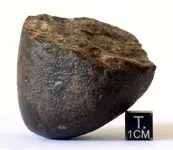
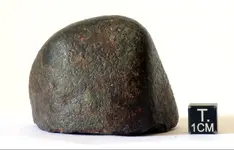
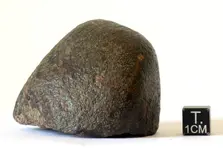
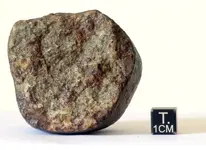
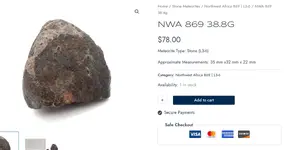
are the stone on the photoś nwa 869? if so i think that my stone is also from that fall or not?
Yes, those three in post #8 are all from the NWA 869 strewnfield and consistent with the appearance and lithology of NWA 869. But it’s quite a leap of faith to say that your specimen is also NWA 869 from the pictures you have and without any additional information. You don’t even have the specimen in your possession yet, according to post #3.
When NWA meteorites first began to reach the collector market in the late 1990s, they were mostly purchased in the markets in Morocco from nomadic Berber tribesmen who had found them in the deserts of Algeria, Mauretania, Mali and Morocco itself. The exact find locations were often unknown and the meteorites were unclassified. The Meteoritical society began granting provisional names pending classification, beginning with NWA 001 in 2000 (purchased in Morocco in 1999).
Even today, there are 464 provisional names for unclassified meteorites leading up to NWA 869 that represent a backlog which may never be fully cleared. In addition, there are a large number of unclassifieds which were not submitted for a provisional name, often without a known location beyond somewhere in North West Africa. More detailed typology for those unclassified may well result in them being determined as consistent with NWA 869 and its probable pairings… or not, as the case may be.
The original type specimen for NWA 869 was initially classified as an Ordinary chondrite (L4–6 fragmental breccia) with a shock stage of S3 and a weathering grade of W1. The classification was revised in 2013 as follows:
Physical characteristics: Most samples are individual meteorites but some fragments (mostly >1 kg) also occur. In most cases the fusion crust has been polished or ablated by wind erosion. Many samples are more severely affected and show faces with deep wind erosion features. Fracture faces, formed by ground collision, show a typical gray-green color and sometimes visible brecciation (light and/or dark clasts). Due to the coarseness of this breccia, there are some stones that consist of only a single lithology.
Petrography: This chondritic breccia consists of about 75 vol% matrix with unequilibrated and equilibrated L-chondrite clasts (up to 5.5 cm), some of which display shock-darkening. Impact melt-rock clasts, themselves either clast-free or clast-poor, also occur and are strongly depleted in Fe,Ni metal and sulfide.
Geochemistry: Northwest Africa 869 is a regolith breccia, containing solar noble gases and preirradiated lithologies. Olivine in lithic clasts: Fa0.2-49.2; olivine in matrix: Fa10.3-29.3; low-Ca pyroxene in lithic clasts: Fs2.1-35.9; low-Ca pyroxene in matrix: Fs7.0-23.9. Bulk oxygen isotopes: δ17O = 3.52; δ18O = 4.67; Δ17O = 1.09 per mil. Terrestrial age: 4.4 ± 0.7 ka. Preatmospheric meteoroid size and mass: 225 ± 25 cm, 120-230 T.
Classification: Because NWA 869 contains unequilibrated clasts, its classification is revised to L3-6.
By the time we get to the NWA 8000s in 2014 and beyond, the proportion of unclassified NWA meteorites drops dramatically. They’re still being found, but mostly the names have been moved to official names as and when (or if) data submissions are made. The previous provisional names have also been weeded out as duplicates and synonyms are discovered, along with probable pairings to meteorites already classified (and a dozen or so discredited pseudometeorites which have been eliminated). Currently, we’re up to NWA 18273.
Without those submissions, they remain unclassified, although the likelihood them being NWA 869 or its probable pairings can often be determined from cursory examination to establish consistency with the general appearance, low metal lithology and location (if known) of NWA 869 finds. At its simplest(?) magnetic susceptibility or X-ray diffraction helps to confirm this.
Without supporting data, ‘unclassified’ means what it says.