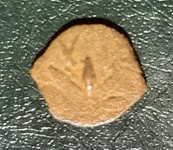
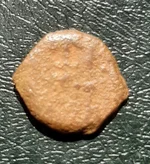
The narratives of the widow giving all she had in the treasury of Herod’s temple described in the gospels of Mark and Luke are derived from texts originally written in Greek, since Judea had long been part of the Greek Empire until the Romans conquered Jerusalem in 63 BC. Judea then became a semi-autonomous client kingdom under Roman influence, but not under direct Roman imperial governance and taxation until around 41-44 AD.
The event is described as occurring in the final week of Jesus's life in Jerusalem, which puts it around 30 or 33 AD (although the gospel texts were composed decades later). The original Greek text references “λεπτὰ δύο (lepta duo)” using the plural rather than the singular “lepton”, indicating that she actually gave two coins. At the time, the coins in circulation in Jerusalem would have been a mixture of still-valid pre-Roman issues, subsequent Judean coins with Roman-approved designs or inscriptions, and (in lesser quantities) actual Roman coins.
“Lepton” literally means “small/thin” and the term was used generically, usually referring to the smallest fractional denomination copper coin in circulation in the Greek-speaking world, whatever the actual root currency denomination might have been. In Jerusalem at the time it was understood that there were 2 lepta to the prutah (ie the half-prutah was actually the smallest coin known as a lepton). Mark adds (for the benefit of Roman readers to emphasise how small the amount was) that these two coins equalled a quadrans (the smallest denomination Roman coin of the time) but this isn’t mentioned in the original Greek text. In fact, the exchange rate at the time between Roman and Judean currency was that 1 prutah equalled 1 quadrans, so it appears that Mark is by implication taking the coins to be to be half-prutahs, which is consistent with the use of the term “lepta” in the Greek texts.
The use of the word “mite” comes to us from the later English translation as the ‘King James Bible’, published in 1611. For the translators, the most suitable English word to describe a small coin was “mite”, which had entered the English vocabulary in the 14th Century from the Middle Dutch word meaning “a little bit" and originally used to describe a tiny Flemish copper coin of very low value.