timekiller
Silver Member
- Joined
- Feb 10, 2009
- Messages
- 3,853
- Reaction score
- 966
- Golden Thread
- 1
- Location
- Morehead City / Newport NC
- 🥇 Banner finds
- 1
- Detector(s) used
- Minelab E-Trac
- Primary Interest:
- All Treasure Hunting
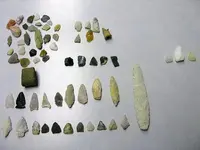
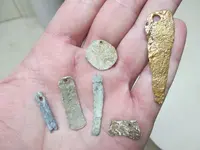
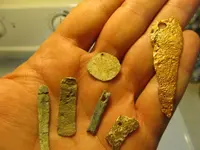
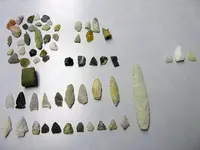
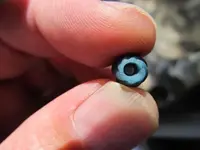
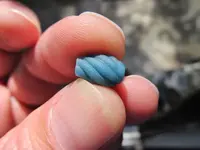
Just some more indian finds made here lately.To bad the big point tip was gone as it measures 6 1/4" as it is.The other items are trade items I'm now almost convinced.I have been finding them in shell bed with the detector here.And had a feeling they were as they are mixed with early colonial items from 17th century.
Take Care,
Pete,
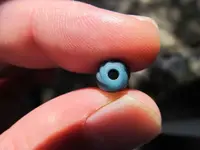
Copper Bead and Pendant
The English settlers at James Fort studied the drawings of John White and the writings of Thomas Hariot before they sailed across the Atlantic Ocean. They learned that the Powhatan Indians valued copper as highly as the English valued gold. The early shipments to the colony included sheets of copper that the English purchased in central Europe. This was more economical to send sheets of copper to the colony than to trade whole copper pots or sections of pots to the Indians as the Dutch did.
Some of the early settlers at Jamestown probably studied the copper beads and ornaments that the Powhatan Indians wore and produced similar items out of the copper sheets. The English colonists who produced copper beads and pendants did not put their own stamp or decorations on the objects. They kept them simple as they saw the Indian-made beads and jewelry were. The settlers at James Fort traded the copper objects to the local Indians for food.
The copper beads and pendants were important trade items in the early years of the colony. There was a small source of copper in an area of southwestern Virginia that the Monacan Indians controlled. However, the Powhatans and the Monacans were at war in the early seventeenth century. The Monacans also prevented the Powhatans from participating in a trade network that extended from Virginia to the Midwest and to a source of copper in present-day Michigan.
http://www.virtualjamestown.org/images/artifacts/jamestown.html
The Collector's Illustarted Encyclopedia Of The American Revolution by George C. Neumann and Frank J. Kravic says the following about the relic: "Trading with the American Indians in the 1700s was an enormous industry to the British, Dutch, French, and Americans. Involved were a great variety of goods, sold, traded, or given away, including ornaments - a wide range of bright objects which could be worn with clothing or in their hair - much of it in silver ("trade silver") and lead." There is also a picture of a typical Indian neck pendant (number 2) in that book. Here is a picture of previously found neck pendants which were photographed together with that picture.
http://metaldetectingworld.com/05cb11_indian_artifact.shtml
Take Care,
Pete,
Copper Bead and Pendant
The English settlers at James Fort studied the drawings of John White and the writings of Thomas Hariot before they sailed across the Atlantic Ocean. They learned that the Powhatan Indians valued copper as highly as the English valued gold. The early shipments to the colony included sheets of copper that the English purchased in central Europe. This was more economical to send sheets of copper to the colony than to trade whole copper pots or sections of pots to the Indians as the Dutch did.
Some of the early settlers at Jamestown probably studied the copper beads and ornaments that the Powhatan Indians wore and produced similar items out of the copper sheets. The English colonists who produced copper beads and pendants did not put their own stamp or decorations on the objects. They kept them simple as they saw the Indian-made beads and jewelry were. The settlers at James Fort traded the copper objects to the local Indians for food.
The copper beads and pendants were important trade items in the early years of the colony. There was a small source of copper in an area of southwestern Virginia that the Monacan Indians controlled. However, the Powhatans and the Monacans were at war in the early seventeenth century. The Monacans also prevented the Powhatans from participating in a trade network that extended from Virginia to the Midwest and to a source of copper in present-day Michigan.
http://www.virtualjamestown.org/images/artifacts/jamestown.html
The Collector's Illustarted Encyclopedia Of The American Revolution by George C. Neumann and Frank J. Kravic says the following about the relic: "Trading with the American Indians in the 1700s was an enormous industry to the British, Dutch, French, and Americans. Involved were a great variety of goods, sold, traded, or given away, including ornaments - a wide range of bright objects which could be worn with clothing or in their hair - much of it in silver ("trade silver") and lead." There is also a picture of a typical Indian neck pendant (number 2) in that book. Here is a picture of previously found neck pendants which were photographed together with that picture.
http://metaldetectingworld.com/05cb11_indian_artifact.shtml
Attachments
Upvote
0

![DSCN0602[1].webp](/data/attachments/374/374398-305357a8c849905f1de4c317a019edc2.jpg?hash=KzO7ohc4tY)
![DSCN0603[1].webp](/data/attachments/374/374442-f37576faa91f663b4316ec0a42e2d90c.jpg?hash=hjz18O0NEq)
![DSCN0604[1].webp](/data/attachments/374/374481-3b548e26221632724e602f234326b103.jpg?hash=Fl1Dx22A3V)
![DSCN0604[1].webp](/data/attachments/374/374499-3b548e26221632724e602f234326b103.jpg?hash=Fl1Dx22A3V)
![DSCN0603[1].webp](/data/attachments/374/374467-f37576faa91f663b4316ec0a42e2d90c.jpg?hash=hjz18O0NEq)
![DSCN0602[1].webp](/data/attachments/374/374414-305357a8c849905f1de4c317a019edc2.jpg?hash=KzO7ohc4tY)