What's new

🔎 UNIDENTIFIED Mystery token found alongside 1640s copper in MA

Fossils

Full Member
Joined
Oct 25, 2019
Messages
233
Reaction score
479
Golden Thread
0
Location
MA
Primary Interest:
All Treasure Hunting
Hi all,
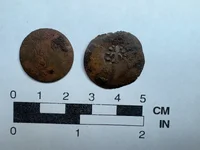
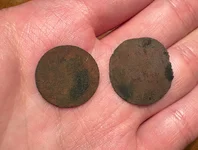
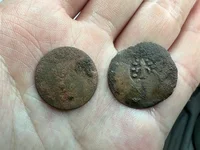
I found these two coins in the same hole while detecting in Massachusetts. I've ID'd the coin on the left as a French double tournois copper, which were minted until the 1640s. Example here: https://en.numista.com/52949

The other coin is a mystery. It's made of copper and is wafer thin. One side has a stamp with a central motif surrounded by dots. The other side is completely blank.

My best guess is that it's some type of jetton, perhaps locally made. Most European jettons I've seen, while also very thin, tend to have more elaborate and recognizable designs.

Any guesses about the identity of the mystery coin or the stamp on it would be appreciated.

Weights of the two coins as found:
- Double Tournois: 2.24 grams
- Mystery token: 1.40 grams
 

Attachments

  • IMG_5722.webp
    IMG_5722.webp
    1.1 MB · Views: 53
  • IMG_5728 (1).webp
    IMG_5728 (1).webp
    640 KB · Views: 48
  • IMG_5871.webp
    IMG_5871.webp
    510.5 KB · Views: 44
That double tournois sure is old! I didn't know that the French were in Mass that early. I'd been less surprised if it had been found in Quebec.
Sorry I can't help ID the other one. It's probably very old also.
 
Upvote 0
5be5135e1cb5f.webp

Great old coin finds you have there. I just googled 1600s coin with Fleur de Lis and found a few with this design. This is a 1621 French coin. May be correct? Hope that leads you in the right direction.
 
Upvote 0
Oops I tired to ID the coin you already did. I'll give the other a go.
 
Upvote 0
Your mystery coin has been counterstruck.
What is evident is the counterstrike mark. Counterstruck coins are previously minted coins that have been stamped a second time with a new design, symbol, or value by an official government, a private merchant, or due to a manufacturing error.

The countermark appears to be a fleur-de-lis surrounded by a continuous line of tiny, raised pearls or dots encircling the face or reverse of an object; called a grenetis (French) design.
Don in SoCal
 
Last edited:
Upvote 0
My guess: This is a 1640-ish French countermarked coin with a fleur-de-lis design minted to revalue older circulating douzains from 12 deniers to 15 deniers so the government could supply currency to its colonies.
Don in SoCal.
 
Upvote 0
My guess: This is a 1640-ish French countermarked coin with a fleur-de-lis design minted to revalue older circulating douzains from 12 deniers to 15 deniers so the government could supply currency to its colonies.
Don in SoCal.
Thank you for the comment. This is an excellent idea and I think may solve the mystery.

The examples of revalued douzains I see online seem to be made of billion (silver-copper alloy) with a finer bead border on the stamp. Whereas my stamp seems more crude in comparison, like a homemade facsimile of a fleur-de-lis. I wonder if mine could be a contemporary counterfeit that tried to mimic the douzains stamped by the French government. This might make sense as mine perhaps a bit lighter than the real douzains (1.40 vs 2.40 grams), and seems to be made of copper rather than billion.

Example I am referencing here:
 
Upvote 0
Thank you for the comment. This is an excellent idea and I think may solve the mystery.

The examples of revalued douzains I see online seem to be made of billion (silver-copper alloy) with a finer bead border on the stamp. Whereas my stamp seems more crude in comparison, like a homemade facsimile of a fleur-de-lis. I wonder if mine could be a contemporary counterfeit that tried to mimic the douzains stamped by the French government. This might make sense as mine perhaps a bit lighter than the real douzains (1.40 vs 2.40 grams), and seems to be made of copper rather than billion.

Example I am referencing here:
I collect the 1640 countermarked douzains and this is definitely not one of them, not genuine anyway. It's possible that it's a very crude counterfeit of one, or could be just an unrelated private counterstamp. I do have pictures of counterfeit counterstamps in some of my references, but none that look like this one. It's a possibility, but I'd keep investigating!
 
Upvote 0
I collect the 1640 countermarked douzains and this is definitely not one of them, not genuine anyway. It's possible that it's a very crude counterfeit of one, or could be just an unrelated private counterstamp. I do have pictures of counterfeit counterstamps in some of my references, but none that look like this one. It's a possibility, but I'd keep investigating!
Thanks for the comment. I agree that the stamp on mine doesn't look that close to the examples of douzain stamps online, even the known counterfeit ones. I'm thinking perhaps a very crude counterfeit made in the colonies. Just a guess at this point.

From the while I've spent scrolling numista and reverse image search, this feels like the closest I've gotten so far. But I concur nothing is a slam dunk yet.
 
Upvote 0
What great finds and educational thread! Goes to show for every hour you spend in the field, you can spend 10 attempting to clean, preserve, date and identify an artifact. If your find is indeed a counterfeit, wonder if the owner knew it.
 
Upvote 0
More GREAT FINDS :)
 
Upvote 0
That double tournois sure is old! I didn't know that the French were in Mass that early. I'd been less surprised if it had been found in Quebec.
Sorry I can't help ID the other one. It's probably very old also.
I would guess a result of trade with French colonies to the north.
 
Upvote 0
That seems like a reasonable explanation about its location in Mass.
 
Upvote 0

Users who are viewing this thread

Back
Top Bottom