What's new

Possible Fossil ?????

pganjon

Hero Member
Joined
Nov 6, 2008
Messages
573
Reaction score
425
Golden Thread
0
Location
South Central Pa.
Detector(s) used
Garrett Master Hunter 5, Ace 250
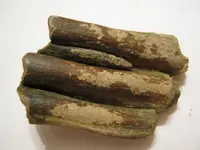
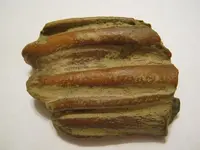
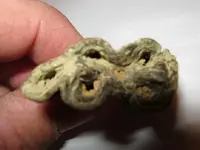
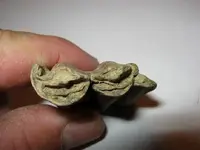
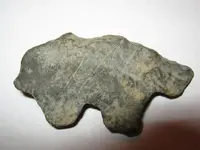
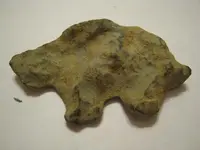
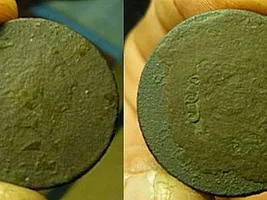
Hello, I found this laying in the wash next to a creek here in Maryland and I wonder if it could be a Fossil? Its about 1&1/2 inches long, 1&1/4 inches wide and about 1/2 inch thick. Its very hard and heavy for its size weighing about 1 oz. It has a small hole in each of its tube like area's that I thought maybe could have come from veins or where food was distributed like the veins of some kind of plant. I also found this funny looking rock at the same place that looks like a animal shape made out of stone. Any thoughts on this, I would greatly appreciate it :dontknow: Thanks for reading :icon_thumleft: Paul :coffee2:
 

Attachments

  • IMG_0117.webp
    IMG_0117.webp
    27.4 KB · Views: 369
  • IMG_0118.webp
    IMG_0118.webp
    25.4 KB · Views: 358
  • IMG_0119.webp
    IMG_0119.webp
    15.7 KB · Views: 357
  • IMG_0120.webp
    IMG_0120.webp
    18.5 KB · Views: 369
  • IMG_0121.webp
    IMG_0121.webp
    34.8 KB · Views: 355
  • IMG_0123.webp
    IMG_0123.webp
    25.1 KB · Views: 353
That first one is a tooth of some kind, don't know about the second one, hopefully someone will be along to help you.

Maybe a horse tooth? just a guess :dontknow:
 
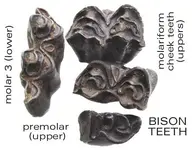
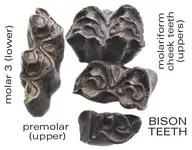
The first object is a lower third molar (m3) from an artiodactyl, probably a bison. In MD, it might be from a "woods bison," Bison athabascae.

The second object, with no evidence of being worked, must be an oddly-shaped rock.


bisonteethocclusal.webp​
 

Attachments

  • bisonteethocclusal.webp
    bisonteethocclusal.webp
    21.1 KB · Views: 332
Hello, Thank you both very much :icon_thumleft: Harry, I really appreciate the pictures and accurate ID :headbang: Do you think that this is an actual tooth or is it a fossil of the tooth since it feels very heavy to me. I don't know how far back Bison go :dontknow: Thank you, Paul :coffee2:
 
If the tooth is from a bison, it is likely to be Late Pleistocene-to-Recent in age. That is, a few hundred years to about a million years.

Many times, the superhard enamel of mammal teeth is preserved unaltered while the softer (dentin) roots are worn away. Sometimes the tooth is somewhat permineralized. I cannot say which condition prevails in this case.
 
Thank you very much Harry :icon_thumleft: You are definitely the go to guy for fossils :notworthy: Have a blessed week :icon_sunny: Paul :coffee2:
 

Users who are viewing this thread

Back
Top Bottom