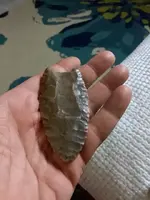
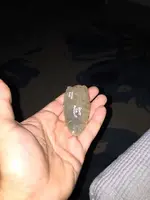
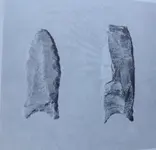
Clovis points are really knifes, scrapers, butcher tools, and lastly points. I think Collins, or one of the other Clovis experts, said only maybe 10% of their use was as a true projectile point.
Plenty of them have perfectly normal tips, but there are a lot that do have rounded tips. If you are using the sides for cutting, you don't really need the tip and a narrow tip might actually be weaker and more prone to breakage. You can always add a point to a rounded tip without losing too much material. If you have snap the tip with torque or dropping it, you'll risk losing more length and width as you rework it. There has been some discussion around rounded tips for penetrating hides, I don't know if it makes that much of a difference.
Can a Clovis be unfluted? Sure, many of their larger bifaces are unfluted, but those aren't often recognized as Clovis artifacts unless they come from a known site or quarry deposit. When you get to Clovis projectile points, most are fluted just because they seemed to be creatures of habit. Some of the smaller clovis points are rebased tips (a tip that they put a base on) those might not be fluted. Many points are fluted on a single side. Some points were thin enough that fluting is just a light feather like flake from the base up.
Do all Clovis points show overshot? Nope. I tend to think that almost all Clovis bifaces were made with some overshot flaking, but quite often that flaking is covered up by subsequent flaking or fluting. Overshot flakes are just convenient ways to thin a biface, lots of groups used that technique. But if the spall was already thin enough, and the material nice enough, I don't think they would force overshot flaking just to follow their mental paradigm of how to make a point. If it needed to be thinned, they thinned it. If it was already thin enough, they skipped that step.