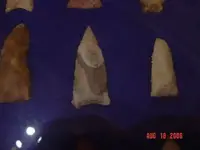
The Safety Harbor point was first written about in 1964 in Jarl Malwin's paper titled, "Early Man Journals of the Peninsular Archaeological Society Inc." This name came from collectors like Bradley Cooley, James Gibson, and Michael Harrell. I'm not sure which one named it but I'll inquire to find out. It was missed by Bullen but added in later publications. The confusion over the point comes from the name being changed to Manasota in later books. It was changed for no other reason than to sell more books and more points. "Do you have a Manasota?" It was done for no other reason than to generate hype about new point types and I disagree with changing names of established points.
If I may quote a friend:
A guide to the Identification of Florida Projectile Points. Bullen did not include Thonotosassa, Six Mile Creek Serrated, Hardee, Coker, Gadsden, Broward, Fl Adena, Florida Spike, Gilchrist, Hamilton, Levy, Ocala, Union Side Notch, Or Putnam. He did list an Appendix, 1. Coker Spear, 2. Gibson, 3. Six Mile Creek Serrated, 4. Palm River Valley.
1975, Bullen revised his publishing by adding those types. Coker Spears became Hamiltons. Gibson became Hardee's. Palm River became Thonotosassa. and he still left out the Six MIle Creek Serrated.
Four types not listed in the alphabetical list in front of the book. In the 1975 revised edition of Bullens A Guide To The Identification of Florida Projectile Points. In the list on page 5, he didn't list Levy, Marion, Alachua nor PUtnam. Found them listed as Florida Archaic Stemmed on page 32. There he listed those four types.
The Appendix list two forms for the Coker Spear, either could be taken to be Thonotosassa, Wills, or Fl Hamiltons. Bullen has not figured out first stage and beveled by resharpening worked, so shows Gibson Serrated beveled, and Gibson Serrated Plain. I was the first to figure this out in the early 1970. Didn't take long to figure out, the Gibson, (Hardee) became beveled after the first resharpening. Alternately beveling conserves the point, because the edge is only flaked off once to sharpen. Also a great method to get a sharp edge on a thick point. In the Appendix he shows two forms for Six Mile Creek Serrated. Wide and a narrow form with expanded stem, serrated. Appendix shows two examples of Palm River, I and II. (Thonotosassa in the revised edition) The 1975 revised edition shows, Bullen eventually threw out all the point type names collectors had been using before he showed up.
In 1984 Son Anderson showed up with a field guide for Florida points. In this publishing the Cowhouse Slough, Cypress Creek and Weedon Island was added to Bullen's list. The 1984 publishing also has photo's instead of line drawings like Bullen used.
1987, Son Anderson published again with a field guide, American Indian Point Types of North Florida, South Alabama and South Georgia. In this publishing types were added again. Boggy Branch, Kirk Serrated Six Mile Creek, Osceola Greenbriar I and II, Seminole and Waller Knife. Again, photo's were used instead of line drawings. The 1987 publishing was revised in 1999 to include Safety Harbor, serrated and non-serrated. Many Georgia and Alabama types were also included. Note: I named the Boggy Branch type for a creek found in Henry Co. Alabama. The late Ralph Allen of Montgomery had asked me to name em. Ralph later wrote up a description for Central States, where he finally agreed with me on the type two. He wouldn't agree when the type was first named. This is a little History on point typology in the lower Southeast.