You are using an out of date browser. It may not display this or other websites correctly.
You should upgrade or use an alternative browser.
You should upgrade or use an alternative browser.
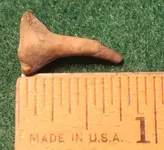
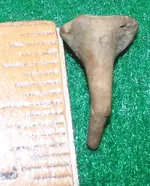
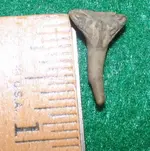
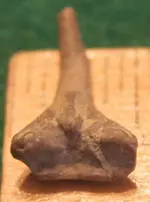
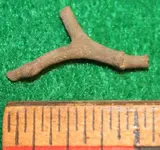
Small tooth or claw? Solved---its a Crinoid Spine
- Thread starter Charmin
- Start date
Re: Small tooth or claw?
Crinoid spine Calyxes
Edited by me. 7/27/2010
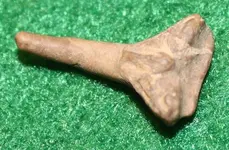
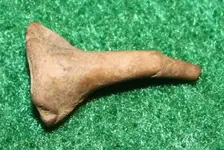
sandcreek4 said:Found this at the creek awhile back----I think its a toothbut from what? Or is it a claw?
It is fossilized and approx. 3/4" in length. Thanks for looking and any help!
sandcreek
Crinoid spine Calyxes
Edited by me. 7/27/2010

Charmin
Bronze Member
- #3
Thread Owner
Re: Small tooth or claw?

 .
.
Oh well, I'll keep looking.......Someday maybe I'll find a tooth .
.
Thanks reef12!!! Appreciate the help!!!
sandcreek~~
It is?! I thought I'd found something really neat and its just a crinoid spinereef12 said:sandcreek4 said:Found this at the creek awhile back----I think its a tooth
sandcreek
Crinoid spine
. Oh well, I'll keep looking.......Someday maybe I'll find a tooth
.Thanks reef12!!! Appreciate the help!!!
sandcreek~~

naturegirl
Bronze Member
Re: Small tooth or claw?
I was watching this one, just a crinoid spine? I thought it looked like a claw maybe. It's still different, how many of those have you found compared to the number of crinoids laying around? It's different, cool find in my book. Keep looking Sandcreek, one of us HAS to find an awsome fossil! (Oh yeah, I had no idea crinoids had spines)
I was watching this one, just a crinoid spine?
I thought it looked like a claw maybe. It's still different, how many of those have you found compared to the number of crinoids laying around? It's different, cool find in my book. Keep looking Sandcreek, one of us HAS to find an awsome fossil! (Oh yeah, I had no idea crinoids had spines)
Charmin
Bronze Member
- #5
Thread Owner
Re: Small tooth or claw?
Me either, naturegirl! I used to pick up every crinoid I would find---I've got a big jar full of them  . Now I just leave them where they lay unless they are really big.
With all this rain we've been getting maybe it'll wash something good out eventually. (We had a downpour last night.)
sandcreek~~
naturegirl said:I was watching this one, just a crinoid spine?
Me either, naturegirl! I used to pick up every crinoid I would find---I've got a big jar full of them . Now I just leave them where they lay unless they are really big. With all this rain we've been getting maybe it'll wash something good out eventually. (We had a downpour last night.)
sandcreek~~

Harry Pristis
Bronze Member
- Joined
- Feb 5, 2009
- Messages
- 2,359
- Reaction score
- 1,305
- Golden Thread
- 0
- Location
- Northcentral Florida
Re: Small tooth or claw?
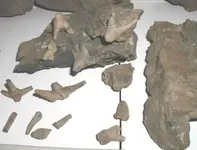
I, too, am skeptical about that object being a crinoid spine. I'm not certain what the object is, but "crinoid spine" would be low on my guess list. A projection of a crinoid hold-fast would be more likely, I think.
I, too, am skeptical about that object being a crinoid spine. I'm not certain what the object is, but "crinoid spine" would be low on my guess list. A projection of a crinoid hold-fast would be more likely, I think.
Charmin
Bronze Member
- #7
Thread Owner
Re: Small tooth or claw?
So, you think its probably something like this, Harry? (This picture came off of google images) http://digsfossils.com/fossils/pics/Turbotsville-crinoid-holdfast-001.jpgHarry Pristis said:I, too, am skeptical about that object being a crinoid spine. I'm not certain what the object is, but "crinoid spine" would be low on my guess list. A projection of a crinoid hold-fast would be more likely, I think.
Attachments
naturegirl
Bronze Member
Re: Small tooth or claw?
Wow, so there's a chance of finding something like those? It sure looks like yours is a piece of one. ??
Wow, so there's a chance of finding something like those? It sure looks like yours is a piece of one. ??
Charmin
Bronze Member
- #9
Thread Owner
Re: Small tooth or claw?
With as many crinoids as we find, why don't we find more of the "hold fast"?
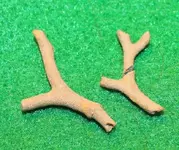
There were also some little stem looking things, too....not sure what they are . Here's some pics of the stems.
This is the only one of these I've ever found and I found it on a little bitty gravel bar on the bend of the creek(where a bunch of small gravel had lodged in the bend.....I always like to look that small gravel for arrowheads cause they seem to get caught up in that stuff).naturegirl said:Wow, so there's a chance of finding something like those? It sure looks like yours is a piece of one. ??
With as many crinoids as we find, why don't we find more of the "hold fast"?
There were also some little stem looking things, too....not sure what they are
. Here's some pics of the stems.Attachments
Harry Pristis
Bronze Member
- Joined
- Feb 5, 2009
- Messages
- 2,359
- Reaction score
- 1,305
- Golden Thread
- 0
- Location
- Northcentral Florida
Re: Small tooth or claw?
The "stem" seems to be a portion of the skeleton of a colonial animal such as a coral or a branching bryozoan. I believe it to be a bryozoan fossil.
Each dimple - a zooecium, if it's a bryozoan - covering the stem is evidence of an individual animal. The bryozoan skeleton - the "stem" - is called a "zooarium."
There will be a quiz later.
The "stem" seems to be a portion of the skeleton of a colonial animal such as a coral or a branching bryozoan. I believe it to be a bryozoan fossil.
Each dimple - a zooecium, if it's a bryozoan - covering the stem is evidence of an individual animal. The bryozoan skeleton - the "stem" - is called a "zooarium."
There will be a quiz later.
Charmin
Bronze Member
- #11
Thread Owner
Re: Small tooth or claw?
Thanks so much Harry for all the information---But I don't think I want to take a quiz from you  .
.
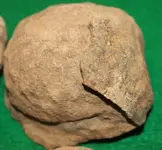
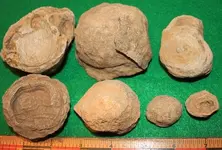
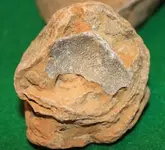
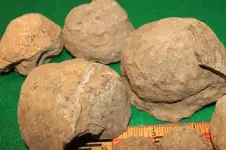
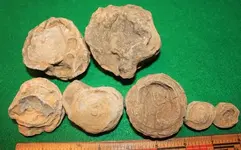
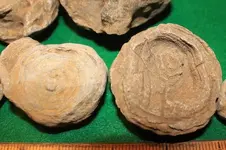
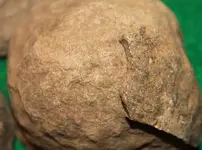
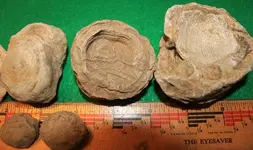
Yes, I was wondering about those "dimples" on the stems. Did these tiny animals(zooecium) attach themselves to other things, forming what looks like "layers"? I've found some hump-back shaped fossils with the dimples. It looks like there are remnants of a brachiopod( is that right?) on the bottom of some of these fossils. Here's some pics.....Harry Pristis said:The "stem" seems to be a portion of the skeleton of a colonial animal such as a coral or a branching bryozoan. I believe it to be a bryozoan fossil.
Each dimple - a zooecium, if it's a bryozoan - covering the stem is evidence of an individual animal. The bryozoan skeleton - the "stem" - is called a "zooarium."
There will be a quiz later.
Thanks so much Harry for all the information---But I don't think I want to take a quiz from you
.Attachments
-
 IMG_1110 (650x605).webp56.7 KB · Views: 547
 -
 IMG_1109 (650x440).webp75.2 KB · Views: 514
 -
 IMG_1111 (650x593).webp62.5 KB · Views: 518
 -
 IMG_1114 (650x433).webp57.5 KB · Views: 512
 -
 IMG_1112 (650x405).webp56.7 KB · Views: 530
 -
 IMG_1113 (650x433).webp61.1 KB · Views: 533
 -
 IMG_1115 (650x484).webp46.5 KB · Views: 508
 -
 IMG_1118 (650x386).webp55.9 KB · Views: 514
Harry Pristis
Bronze Member
- Joined
- Feb 5, 2009
- Messages
- 2,359
- Reaction score
- 1,305
- Golden Thread
- 0
- Location
- Northcentral Florida
Re: Small tooth or claw?
Thanks so much Harry for all the information---But I don't think I want to take a quiz from you .
[/quote]
"Brachiopod"? They look like sea shells to me. I collect vertebrate fossils, so I don't know much about these inverts.
Seriously, they could have been brachiopods or pelecepods which were used as a substrate for the bryozoan zooarium. I can't discern enough details to guess which it is. It is common to this day for bryozoans to colonize abandoned valves of pelecepods.
What is the age of these fossils?
Yes, I was wondering about those "dimples" on the stems. Did these tiny animals(zooecium) attach themselves to other things, forming what looks like "layers"? I've found some hump-back shaped fossils with the dimples. It looks like there are remnants of a brachiopod( is that right?) on the bottom of some of these fossils. Here's some pics.....Harry Pristis said:The "stem" seems to be a portion of the skeleton of a colonial animal such as a coral or a branching bryozoan. I believe it to be a bryozoan fossil.
Each dimple - a zooecium, if it's a bryozoan - covering the stem is evidence of an individual animal. The bryozoan skeleton - the "stem" - is called a "zooarium."
There will be a quiz later.
Thanks so much Harry for all the information---But I don't think I want to take a quiz from you
.[/quote]
"Brachiopod"? They look like sea shells to me. I collect vertebrate fossils, so I don't know much about these inverts.
Seriously, they could have been brachiopods or pelecepods which were used as a substrate for the bryozoan zooarium. I can't discern enough details to guess which it is. It is common to this day for bryozoans to colonize abandoned valves of pelecepods.
What is the age of these fossils?
Charmin
Bronze Member
- #13
Thread Owner
Re: Small tooth or claw?
Seriously, they could have been brachiopods or pelecepods which were used as a substrate for the bryozoan zooarium. I can't discern enough details to guess which it is. It is common to this day for bryozoans to colonize abandoned valves of pelecepods.
What is the age of these fossils?
[/quote]You're asking the wrong person ....I was hoping you could tell me more about them and how old. I'm in the northern part of Oklahoma, Harry, in the Flint Hills, if that would help any with age of these fossils.
Thanks again!!
sandcreek~~
"Brachiopod"? They look like sea shells to me. I collect vertebrate fossils, so I don't know much about these inverts.Harry Pristis said:Yes, I was wondering about those "dimples" on the stems. Did these tiny animals(zooecium) attach themselves to other things, forming what looks like "layers"? I've found some hump-back shaped fossils with the dimples. It looks like there are remnants of a brachiopod( is that right?) on the bottom of some of these fossils. Here's some pics.....Harry Pristis said:The "stem" seems to be a portion of the skeleton of a colonial animal such as a coral or a branching bryozoan. I believe it to be a bryozoan fossil.
Each dimple - a zooecium, if it's a bryozoan - covering the stem is evidence of an individual animal. The bryozoan skeleton - the "stem" - is called a "zooarium."
There will be a quiz later.
Thanks so much Harry for all the information---But I don't think I want to take a quiz from you
Seriously, they could have been brachiopods or pelecepods which were used as a substrate for the bryozoan zooarium. I can't discern enough details to guess which it is. It is common to this day for bryozoans to colonize abandoned valves of pelecepods.
What is the age of these fossils?
[/quote]You're asking the wrong person
....I was hoping you could tell me more about them and how old. I'm in the northern part of Oklahoma, Harry, in the Flint Hills, if that would help any with age of these fossils.Thanks again!!
sandcreek~~
Harry Pristis
Bronze Member
- Joined
- Feb 5, 2009
- Messages
- 2,359
- Reaction score
- 1,305
- Golden Thread
- 0
- Location
- Northcentral Florida
Re: Small tooth or claw?
The Flint Hills are a small wedge of limestone uplands extending south from Kansas into Osage County, Oklahoma. Their age is Permian (290 - 248 mybp). This relatively-small area of OK is surrounded by exposures of Pennsylvanian and Mississippian age.
The Flint Hills are a small wedge of limestone uplands extending south from Kansas into Osage County, Oklahoma. Their age is Permian (290 - 248 mybp). This relatively-small area of OK is surrounded by exposures of Pennsylvanian and Mississippian age.
Charmin
Bronze Member
- #15
Thread Owner
Re: Small tooth or claw?
Those last fossils I've posted pictures of are really neat and I've only found them on one small area of the creek. I guess colonies of tiny sea creatures just formed on whatever was laying on the sea floor and these fossils were the result?
Naturegirl--Do you and Buckshot ever find anything like those last fossils I posted?
That was during the Paleozoic Era, right? I think this part of Oklahoma was covered with shallow seas. There is a hill, north of where I live, that is covered with huge horn corral----It is just beautiful to see! When I was a little girl my grandpa used to take me there to collect it.Harry Pristis said:The Flint Hills are a small wedge of limestone uplands extending south from Kansas into Osage County, Oklahoma. Their age is Permian (290 - 248 mybp). This relatively-small area of OK is surrounded by exposures of Pennsylvanian and Mississippian age.
Those last fossils I've posted pictures of are really neat and I've only found them on one small area of the creek. I guess colonies of tiny sea creatures just formed on whatever was laying on the sea floor and these fossils were the result?
Naturegirl--Do you and Buckshot ever find anything like those last fossils I posted?
naturegirl
Bronze Member
Re: Small tooth or claw?
Nothing like that -yet. But it seems everytime we go out, we are finding more. I guess the eyes have to train to pick up the fossils the same way they do for flint and points. I'm just as happy with a fossil as a point. Trying to Id them is a bugger though. There doesn't seem to be much online for Okla. But the Kansas info is good for us too. I think most of what I find is from the Pennsylvian age, and the oil was formed during the Permian age, so I figure that's going to be most of what we find?
Nothing like that -yet. But it seems everytime we go out, we are finding more. I guess the eyes have to train to pick up the fossils the same way they do for flint and points. I'm just as happy with a fossil as a point. Trying to Id them is a bugger though. There doesn't seem to be much online for Okla. But the Kansas info is good for us too. I think most of what I find is from the Pennsylvian age, and the oil was formed during the Permian age, so I figure that's going to be most of what we find?
Charmin
Bronze Member
- #17
Thread Owner
Re: Small tooth or claw?
.
http://www.freewebz.com/oklahomarocks/permian.htm Quote from this website:
"During the Permian, insects flourished and in Elmo, Kansas and further south into Oklahoma, evidence of as many as 20 orders have been catalogued from the era. Amphibians also left a fossil record from the Permian and generally clustered around water holes and streams. Amphibian fossils of the Permian were generally quite large. Similarly, the reptiles also left an abundant fossil record from the Permian."
Wouldn't it be cool to find an amphibian or reptile fossil, naturegirl? Maybe we need to look harder  .
.
Yes, trying to ID the fossils I've found has been a bugger---I looked at all the sites online for "common" Oklahoma fossils and couldn't find much of anything---they say most Okla. fossils are found in the southern part of the statenaturegirl said:Nothing like that -yet. But it seems everytime we go out, we are finding more. I guess the eyes have to train to pick up the fossils the same way they do for flint and points. I'm just as happy with a fossil as a point. Trying to Id them is a bugger though. There doesn't seem to be much online for Okla. But the Kansas info is good for us too. I think most of what I find is from the Pennsylvian age, and the oil was formed during the Permian age, so I figure that's going to be most of what we find?
. http://www.freewebz.com/oklahomarocks/permian.htm Quote from this website:
"During the Permian, insects flourished and in Elmo, Kansas and further south into Oklahoma, evidence of as many as 20 orders have been catalogued from the era. Amphibians also left a fossil record from the Permian and generally clustered around water holes and streams. Amphibian fossils of the Permian were generally quite large. Similarly, the reptiles also left an abundant fossil record from the Permian."
Wouldn't it be cool to find an amphibian or reptile fossil, naturegirl? Maybe we need to look harder
.
naturegirl
Bronze Member
Re: Small tooth or claw?
Oh wow, that is good to know. Yes, I do think we need to try harder. Would the most fossils be in the lowest of elevations? I mean the deepest valleys. I know the landscape changed dramatically, but in my mind, i picture the receeding waters staying in the valleys longer, and more life being in those places. Maybe there is no similarities to the landscape today as then. I have a small fossil that I always thought might be a claw, if I can find it I'll post a picture, maybe it's a big ol' lizard claw!
Oh wow, that is good to know. Yes, I do think we need to try harder. Would the most fossils be in the lowest of elevations? I mean the deepest valleys. I know the landscape changed dramatically, but in my mind, i picture the receeding waters staying in the valleys longer, and more life being in those places. Maybe there is no similarities to the landscape today as then. I have a small fossil that I always thought might be a claw, if I can find it I'll post a picture, maybe it's a big ol' lizard claw!
Charmin
Bronze Member
- #19
Thread Owner
Re: Small tooth or claw?
Please do post that "lizard claw" you have, naturegirl......I bet Harry Pristis could tell you what(and if) it really is one .
.
Most of the fossils I find are on the "lowest of elevations"---the gravel bars/creeks that produce the most fossils for me are next to really tall rocky bluffs......which would only be logical I guess....I never find anything on the creek where its level with the surrounding terrain.naturegirl said:Oh wow, that is good to know. Yes, I do think we need to try harder. Would the most fossils be in the lowest of elevations? I mean the deepest valleys. I know the landscape changed dramatically, but in my mind, i picture the receeding waters staying in the valleys longer, and more life being in those places. Maybe there is no similarities to the landscape today as then. I have a small fossil that I always thought might be a claw, if I can find it I'll post a picture, maybe it's a big ol' lizard claw!
Please do post that "lizard claw" you have, naturegirl......I bet Harry Pristis could tell you what(and if) it really is one
.
Harry Pristis
Bronze Member
- Joined
- Feb 5, 2009
- Messages
- 2,359
- Reaction score
- 1,305
- Golden Thread
- 0
- Location
- Northcentral Florida
Re: Small tooth or claw?
If you're collecting in NE Oklahoma, the paleontology of Kansas would be useful. Here a link that should prove useful. Also study any Mississippian and Pennsylvanian accounts of fossils from Kansas.
If you're collecting in NE Oklahoma, the paleontology of Kansas would be useful. Here a link that should prove useful. Also study any Mississippian and Pennsylvanian accounts of fossils from Kansas.


Featured Treasure Finds
Featured Treasure Finds
Similar threads

- Replies
- 4
- Views
- 653

- Replies
- 8
- Views
- 786


Users who are viewing this thread
Total: 1 (members: 0, guests: 1)