What's new

Strange vases

duffer04

Jr. Member
Joined
Jul 25, 2024
Messages
47
Reaction score
102
Golden Thread
0
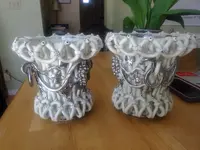
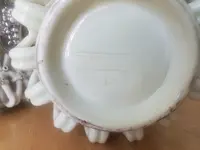
These vases likely came to the US with my grandmother in 1911 from GB. They are 7" tall, ceramic and metal overlay. The name on the back goes likethis but it is not completen(or correct): CH de Bossimon (??) E Cie and on the second line: Langlais (????) e Loire.

Sorry but this is hard to read.
Any thoughts as to age, maker , and value?
Thanks
 

Attachments

  • 20260222_091549.webp
    20260222_091549.webp
    560.9 KB · Views: 71
  • 20260222_091630.webp
    20260222_091630.webp
    330.9 KB · Views: 55
Upvote 2
This from a eBay seller of one of the same vase/basket/cup, the price for these seem to be all over the place, some less than this one and others more, there also seems to be a lot of them out there for sale.

"Langeais Earthenware Jardiniere French open work cup early 19th century.
The plateaux surrounding Langeais are covered with senonian (Cretaceous) clay which was laid down about 60 million years ago. The composition of this clay renders it highly malleable and
refractory after baking. These properties have led to it being used to manufacture bricks. Bricks have always been made in Langeais and in a hamlet 7 km away, La Rouchouze. This craft activity
led to the establishment of many factories in the first half of the 19th century. One of these, founded in 1839, is very well-known not only for its bricks but also for its semi-fine china, generally called "Langeais earthenware".
In 1839, Charles de Boissimon, from Angers, set up in Langeais near the bridge, building a brickworks. On the advice of Brongniart, the famous chemist from the Sèvres Manufacture, he launched into the production of "Langeais". The best-known are white or white and platinum, decorated with bunches of grapes, vine leaves or other plant designs. However, there are also blue, brown, and green pieces adorned with transfers or hand-painted.
For a definite identification, you must find the famous CB printed on the base or the grand signature Ch. de Boissimon à Langeais I et L (Indre et Loire).
The Langeais line of earthenware were hand produced between 1839 until 1909."

 
As an eBay Associate we earn from qualifying purchases.
Very nice looking Vases !
 
This from a eBay seller of one of the same vase/basket/cup, the price for these seem to be all over the place, some less than this one and others more, there also seems to be a lot of them out there for sale.

"Langeais Earthenware Jardiniere French open work cup early 19th century.
The plateaux surrounding Langeais are covered with senonian (Cretaceous) clay which was laid down about 60 million years ago. The composition of this clay renders it highly malleable and
refractory after baking. These properties have led to it being used to manufacture bricks. Bricks have always been made in Langeais and in a hamlet 7 km away, La Rouchouze. This craft activity
led to the establishment of many factories in the first half of the 19th century. One of these, founded in 1839, is very well-known not only for its bricks but also for its semi-fine china, generally called "Langeais earthenware".
In 1839, Charles de Boissimon, from Angers, set up in Langeais near the bridge, building a brickworks. On the advice of Brongniart, the famous chemist from the Sèvres Manufacture, he launched into the production of "Langeais". The best-known are white or white and platinum, decorated with bunches of grapes, vine leaves or other plant designs. However, there are also blue, brown, and green pieces adorned with transfers or hand-painted.
For a definite identification, you must find the famous CB printed on the base or the grand signature Ch. de Boissimon à Langeais I et L (Indre et Loire).
The Langeais line of earthenware were hand produced between 1839 until 1909."

Thanks for your helpful answer!
 
As an eBay Associate we earn from qualifying purchases.

Users who are viewing this thread

Latest Discussions

Back
Top Bottom