What's new

Toasted large cent?

dts52

Bronze Member
Joined
Jun 20, 2015
Messages
1,600
Reaction score
2,286
Golden Thread
0
Location
NW CT
Detector(s) used
Equinox800 / AT Pro / AT Gold / Makro Racer
Vibra-probe / TRX pp
Primary Interest:
Other
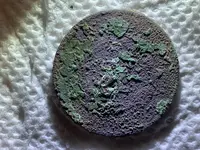
Found this in "the cornfield" which years back yielded two completely toasted discs which, based on their size and weight, TNet members surmised had once been large cents. The one found today has a tiny bit of the original face left (I think). I believe I can make out the letters "ber" just to the left of the hole. It appears that the only remaining copper is the green material, right? The rest is non-metallic but doesn't seem to be copper. Was this possibly a counterfeit? If it is, how does one even break even by counterfeiting one cent pieces? Seems to me that time and material required to make a passable fake would exceed the value. IMG_0417.webpIMG_0418.webp
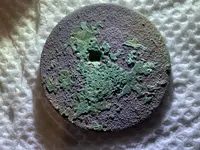
NOTE: Sorry, the photo should be rotated 90 degrees to the right. In the picture as shown, the lettering is below the hole.
HH
dts
 
Upvote 10
Its always a tough call when they are in that shape. Good luck on your quest for an ID.
 
Interesting find. Congrats. I’m no expert but possibly a coin or token.
 
Either a classic head or matron head large cent (1808-1838). The lettering you're seeing is what's left of the Liberty in the headband. The green material is patina remnants which are a mixture of copper sulfates, carbonates, and nitrates from soil action. The material below it is the copper with a layer of copper oxide. The fairly pure copper planchets used to make large cents do particularly badly in fields so it's not unusual to find them in that shape, although sometimes you get lucky.
 
Either a classic head or matron head large cent (1808-1838). The lettering you're seeing is what's left of the Liberty in the headband. The green material is patina remnants which are a mixture of copper sulfates, carbonates, and nitrates from soil action. The material below it is the copper with a layer of copper oxide. The fairly pure copper planchets used to make large cents do particularly badly in fields so it's not unusual to find them in that shape, although sometimes you get lucky.

Thanks for the information. I don't know why this particular cornfield eats up coins that way. Maybe all the fertilizer over the years, or just another strike against Connecticut in general?
HH
dts
 
Nice!!! Congrats!!!
 
how does one even break even by counterfeiting one cent pieces?

Inflation
 
Nice save on the copper, congrats
 

Users who are viewing this thread

Latest Discussions

Back
Top Bottom