|
-
Aug 05, 2012, 12:45 PM
#1
-
Aug 05, 2012 12:45 PM
# ADS
-
Aug 05, 2012, 01:39 PM
#2
 Peace Through Superior Firepower
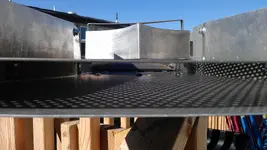
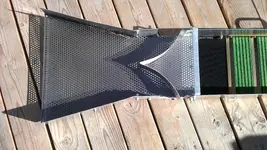
Great design! Looks like all you need to do is make the exit holes a little bigger like you said. Also straightening and lengthing the wings of the divider might help the material move out quicker. The curve looks like it's catching material and holding it. I wouldn't worry about losing gold out the side, because that 1/4 puch plate is allowing the heavies to get through as long as your not overloading it. If your A52 can handle it, your punch plate classifier can use more water flow. Maybe lower the plate to a hair over 1/4 above the bottom of the flare. I have a Top Runner Sluice classifing, great sluice with no riffles, just punch plate, and it catches all of the heavies. The water flow for the Top Runner is best at medium-fast, so you might need more flow to clear waste off the screen.
-
Aug 05, 2012, 04:28 PM
#3
 I can dig it! "WP"
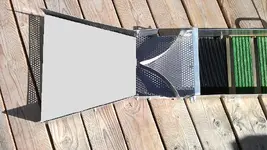
I would suggest some slick plate in front of the punch plate.
The slick plate will move the rocks way faster, plenty fast enough to get them past the short section of punch plate.
Trust me, there is more than enough punch plate left before the exits to capture all the fines, test it and see.
Something like this....

Polishing the punch plate or painting it with a hard slick finish would also help.
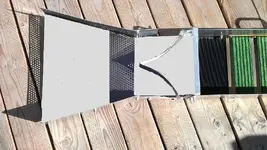
Another way would be to run slick plate all the way past the exits with a 4" section of punchplate crossing the sluice 4" before the exits.
Something like this....

The first way is better due to the overlap of the second slick plate on the second version causing an uphill lip at the punchplate.
The only remedy would be to lap the punchplate over the second slick plate by a quarter inch or so.
GG~
Last edited by Goodyguy; Aug 05, 2012 at 07:57 PM.
~Diggin The Adventure~
-
Aug 05, 2012, 08:35 PM
#4
Thanks guys for the suggestions! I did cut out the exits right after I made the video but it didn't work. I also straitened the dividers but it didn't help much.
GG, I will try the first mod you posted, I just want as much punch plate as possible but here's a question, really stupid one, what is an slick plate? Is it just aluminum?
On a side note here is my take for yesterday
-
Aug 06, 2012, 05:52 AM
#5
 I can dig it! "WP"
 Originally Posted by omnicron
GG, I will try the first mod you posted, I just want as much punch plate as possible but here's a question, really stupid one, what is an slick plate? Is it just aluminum?
Aluminum or stainless steel. I normally use aluminum to cut cost plus it's easier to work with and lighter. However stainless holds up better over the long haul and stays smoother.
GG~
Last edited by Goodyguy; Aug 06, 2012 at 05:55 AM.
~Diggin The Adventure~
-
Aug 06, 2012, 06:35 AM
#6
OOh duh...sometimes I'm really stupid and talk before I think! We have some tempered aluminum at work (used on semi-trailers) that should work great! It has a painted side that is ultra smooth. Thanks for answering my ultra dumb question.
-
Aug 06, 2012, 11:38 AM
#7
I still think that if you were to put a little pitch to your punch plate, the water underneath it will tend to squirt water UP through the punch plate and help move the rocks. Also seemed like there still wan't enough flow as seen in the video. You need to find some fast water. Before you make any mods, try some faster water first. 
Bob
Just because you CAN do something, doesn't mean you SHOULD.
Visit my Idaho Gold Prospecting Blog at Bedrock or Bust
-
Aug 06, 2012, 02:37 PM
#8
What a great couple of threads! Omnicron: you really put a lot of thought into this! One question, how much does it weigh now? Part of what I like about my setup is that it attaches to my box(less stuff to wrangle), AND it don't add any weight(maybe a pound). Maybe I'm just gettin old, but 3 or 4 pounds extra kill me on the hike out. Keep the pics comin!
-
Aug 06, 2012, 06:28 PM
#9
 Originally Posted by 419GottaMinute
What a great couple of threads! Omnicron: you really put a lot of thought into this! One question, how much does it weigh now? Part of what I like about my setup is that it attaches to my box(less stuff to wrangle), AND it don't add any weight(maybe a pound). Maybe I'm just gettin old, but 3 or 4 pounds extra kill me on the hike out. Keep the pics comin!
Thanks for the kudos! I am not sure how much it weigh right now as the puch plate is steel as I couldn't get aluminum locally but will be ordering a sheet when I go into production, it could even end up being stainless but experience with metal tells me alum. will be the best choice based on cost and weight. I'll have to wait and see how it all works out.
My final design should not require any holes to be drilled, just bolt it up and go but thats going to be tough due to the handle.... Cant wait to try some things this weekend mainly faster water and the addition of a slick plate over the first 2/3 of the punch plate. Could also be just as simple as an angle change as was suggested by Underburden. Going to try all this and other stuff and find what works the best with the least amount of cost/work.
-
Aug 06, 2012, 06:57 PM
#10
 I can dig it! "WP"
My other suggestion is that you do not want to have a curve in your diverter. The curve is causing a sleight bottleneck. A straight wedge shape will provide a faster non restrictive discharge for the gravel and rocks.
Your design has certain aspects of an "over under" sluice used by dredgers. Whereby a section of punchplate at the beginning of the sluice allows the fines to drop out of the faster flow on top and into a slower flow sluice underneath that is designed to catch only the fines while the top sluice with the really fast flow is designed to catch the larger gold while washing away the rocks.
Your task is to have a fast enough flow on top to efficiently wash away the rocks while at the same time not having too fast of a flow underneath that would wash out the fines. Looks to me that your design with a little fine tuning will accomplish that perfectly. 
GG~
Last edited by Goodyguy; Aug 06, 2012 at 08:20 PM.
~Diggin The Adventure~
-
Aug 06, 2012, 09:20 PM
#11
Your correct, when I cut the discharge ports bigger I also bent the vane back as much as I could without removal or breaking, tempered alum. has a tendency to break once bent. I beleive the beauty of my design is that it sets a perfect water level and speed accross the riffles due to trying to force a larger volume of water into a smaller space. I can tell you from my past experience in the place I have been sluicing (same exact place and material for 4 weeks) and I recovered the same amount as past weeks. I am in the proccess of re-running my cons from saturday and am finding micro gold that I missed (poor setup of my miller table to be sure) BTW, I loaded the front part of my sluice with water, to the point it was at the very top edge of the vane and the water speed and level stayed the same as far as my eye and ears could tell. The material cleared off the rubber mating the same as with the first and second riffle but unfortantly it did not help with clearing the rocks off.
 Originally Posted by Goodyguy
My other suggestion is that you do not want to have a curve in your diverter. The curve is causing a sleight bottleneck. A straight wedge shape will provide a faster non restrictive discharge for the gravel and rocks.
Your design has certain aspects of an "over under" sluice used by dredgers. Whereby a section of punchplate at the beginning of the sluice allows the fines to drop out of the faster flow on top and into a slower flow sluice underneath that is designed to catch only the fines while the top sluice with the really fast flow is designed to catch the larger gold while washing away the rocks.
Your task is to have a fast enough flow on top to wash away the rocks while at the same time not having too fast of a flow underneath that would wash out the fines. The more efficiently you can wash away the rocks on top without increasing the flow underneath the better your chances of retaining all the fines will be.
GG~
Last edited by omnicron; Aug 06, 2012 at 09:25 PM.
-
Aug 07, 2012, 09:54 PM
#12
Just a update, I'm going up tomorrow after work to Moores Creek to test things out. It is a bigger creek and has areas with fast water. Going to try the slick plate and without the slick plate. I'll post a few videos.
-
Aug 09, 2012, 11:19 PM
#13
Sorry for the delay guys, I had family things to do. So I added a slick plate and changed the angle of the punch plate. It helped but still needs some tweaking. As you can see I had much faster water flow but it didn't help much. After watching the video a few times I think I have the problem solved but I am going to keep it under wraps for now. I'm going up this weekend and will be trying a few things but I'm sure I know the exact problem...more to come later.
Here's the video...
Last edited by omnicron; Aug 09, 2012 at 11:21 PM.
-
Aug 10, 2012, 03:28 AM
#14
Cclamps for the win!!
Watch your speed when panning {the camera}. That's the downfall of most videos.
Not so sure,.. why not just a slick plate down the sluice instead of out the sides. Same thought I had when I saw the underflow sluice video.
-
Aug 10, 2012, 11:56 AM
#15
 Peace Through Superior Firepower
Your accomplishing your purpose with your current design, all you have to do every so often is just brush away the few rocks hanging up on the diverter.
-
Aug 10, 2012, 03:56 PM
#16
 I can dig it! "WP"
The slick plate worked as expected but perhaps would have worked even better if it had extended to the point of the diverter.
Still seems that if the punch plate could be made to be smoother the hang up problem would be solved. Perhaps a glossy painted or teflon coating or polished finish would do the trick. Maybe try buffing the punch plate to a super smooth finish so that the holes have a smooth edge.
Anyway, I like your idea. Keep up the good work 
GG~
Last edited by Goodyguy; Aug 10, 2012 at 07:33 PM.
~Diggin The Adventure~
-
Aug 11, 2012, 05:37 PM
#17
 Originally Posted by omnicron
Thanks for the kudos! I am not sure how much it weigh right now as the puch plate is steel as I couldn't get aluminum locally but will be ordering a sheet when I go into production, it could even end up being stainless but experience with metal tells me alum. will be the best choice based on cost and weight. I'll have to wait and see how it all works out.
My final design should not require any holes to be drilled, just bolt it up and go but thats going to be tough due to the handle.... Cant wait to try some things this weekend mainly faster water and the addition of a slick plate over the first 2/3 of the punch plate. Could also be just as simple as an angle change as was suggested by Underburden. Going to try all this and other stuff and find what works the best with the least amount of cost/work.
I would go with stainless steel for your punch plate. Sure aluminum will work, but you will need a thicker sheet frp durability. Thick punch plate tends to catch and trap lots of rocks in the holes. They also become a pain to remove from the holes. You can get by with thinner perforated sheets using stainless. I think mine is .32 or .37 and I bend it at the corners to add durability. Nice sluice BTW.
-
Aug 12, 2012, 07:26 AM
#18
-
Aug 15, 2012, 11:06 PM
#19
Ok guys, here is the skinny on this last weekend. I built a new diverter that was about 4" longer and had no bends looked like this ^. I ran 3 buckets without the slick plate, capturing all the discharge material from the sides and the end of the sluice. I had zero gold loss. I added the slick plate and did the same thing and had gold loss out the side dischages...not good. And what I am after the most at this stage is for the rocks to clear and unfortantly they are not. I tried adjusting the angle of the sluice, the punch plate angle, faster water, slick plate added and different angle but it's still a no-go.
It was suggested that a polished punch plate would help but honestly I don't think it will. Maybe smaller holes in the plate would help but I don't really want to drop below the 1/4" size I'm at.
So let me ask this question, is it such a big issue to reach down and clear the rocks off every few scoops? It's still faster then having to classify while shoveling into a bucket, the only real issue I see is after all day bending over my back was aching, but then again I'm 42yrs old and have billions of miles on my bones 
I will add the video and some pics tomorrow
-
Aug 16, 2012, 05:22 AM
#20
 I can dig it! "WP"
Check out this idea.........
Posting Permissions
- You may not post new threads
- You may not post replies
- You may not post attachments
- You may not edit your posts
-
Forum Rules
Similar Threads
-
By Caminochaos in forum Sluicing
Replies: 61
Last Post: Dec 11, 2012, 10:21 AM
-
By Goldbear in forum Drywashing
Replies: 19
Last Post: Apr 13, 2012, 07:24 PM
-
By GoldinSocal in forum Sluicing
Replies: 13
Last Post: Mar 26, 2012, 07:16 PM
-
By TerryC in forum Gold Prospecting
Replies: 11
Last Post: Apr 22, 2010, 07:19 PM
-
By advhtgac in forum Gold Prospecting
Replies: 4
Last Post: Mar 21, 2009, 12:51 AM
Search tags for this page
classifier sluice, dose a52 classifier screen work, keene a52, keene a52 classifier, keene a52 classifier screen, keene sluice, punch plate, underflow sluice, underflow sluice box, underflow sluice design
Click on a term to search for related topics.
|