What's new

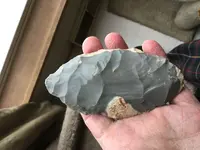
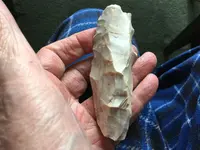
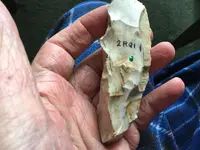
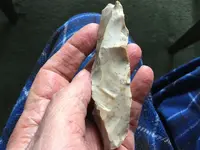
A Paleo Bifacial Core

uniface

Silver Member
Joined
Jun 4, 2009
Messages
3,224
Reaction score
2,907
Golden Thread
0
Location
Central Pennsylvania
Primary Interest:
Other
A Clovis (fluted point) era bifacial core of "Kentucky Blue" hornstone found in Christian County, Kentucky (Little River Complex) by Will Puckett. A nearly identical but somewhat bigger one is illustrated as fig. 9A in the Adams Site report by Sanders (1988).

image.webp
 
Upvote 0
Unless it came from definite paleo site, how can it be identified as paleo? It looks like any generic early archaic biface to me. With all the cortex on it, it might be a discard. Gary
 
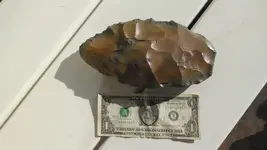
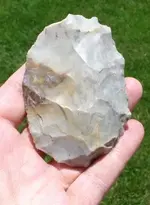
It's more likely a Hopewell cache piece in my opinion. Here's one heavily patinated, and larger from NW Ohio.

CoyoteBob.webp
 
This one is Indianna Hornstone, though the patination obscures the true color.
 
OK. We've got Paleo, Early Archaic and Hopewell. Are there characteristics that reliably distinguish these from each other ? What convinces me is that it's essentially identical to the Adams site example (I cited plate 9A but found a note citing 12a), and from the heart of the Little a River complex, where there are five (known) major Paleo sites -- about one every half mile or so. I could send it to Brian Williard and ask him to do an o. s. l. age determination, but then people would only want to argue over that, so we'd have two disagreements in the same thread. Keeping it down to one is tidier.
 
Dirtscratcher, your picture illustrates the difference really clearly. The flaking on the later examples (Hopewell, Adena, etc.) typically goes to the middle of the blade. Paleo biface cores often have overshot/outrepasse flakes that go from edge to edge like Uni's piece shows.
 
Only half of one here ; this was found by later people and one side flaked their way. But half a loaf is better than none.

i've seen this material called both Flintridge and Coshocton. Anybody know which confidently ? Speak up if so.

Bremen, Ohio late Paleo-- early Archaic site. Michael Gibson gift.

image.webp image.webp
 
I’d say it’s not Coshocton Chert
(An Upper Mercer Chert Variant), but more likely Flint Ridge (Flint)

I know that the GrimReaper has many examples of artifacts made of this lithic. I have two. Both of which traveled here from outside of my region. Most examples that I have seen are very dark in color -shades of black with few veins of white. Few Rusty inclusions.

https://images.app.goo.gl/p3VnEUBKsfP6YSG6A

Description of Physical Characteristics:

Color: Coshocton Flint ranges from a medium gray to a dark bluish gray with bands of various shades of blue. It commonly has bands of white quartz to cream color and may have orange streaks.

Texture: Fine Grain

Luster: The luster may range from dull to waxy with a glassy vitreous when heat treated.

Silica Fabrics / Fossils: Fossils are absent

Patina: The patina ranges from yellow to brown or yellowish green

Heat Treatment: Heat treatment darkens the blues and gives a glassy vitreous sheen.
 
Last edited:
FLINT RIDGE FLINT
RAW FLINT ON LEFT & HEAT TREATED ON THE RIGHT
RETURN TO PAGE TWO

http://lithiccastinglab.com/gallery-pages/roymillerheatedflakeslarge.jpg

These Flint Ridge flakes show the dramatic
contrast in color before and after heat treating. The
flakes on the left are unaltered as they appear from
the Flint Ridge quarries. The more colorful flakes
on the right were altered by heating the preforms.
Roy uses an electric kiln to heat treat his flint. The
process takes from three to four days before the
preforms are removed from the oven. He programs
the kiln to slowly heat 25 degrees per hour until it
reaches a maximum of 500 to 550 degrees. He can
control the temperatures close enough to bring out
more of the yellows at a slightly lower temperature
and more of the reds with a higher temperature.
All of these flakes were quarried from Roy Miller's
property which is part of the ancient Flint Ridge
quarry complex in eastern Ohio.

Heat treated and unheat-treated Flint Ridge flint.
 
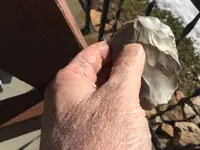
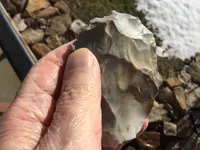
Thanks. It most nearly resembles this artifact from NE Ohio (Erie Co). Brian Williard OSL identified it as Flintridge, and older than Clovis. Both tips are chisel edged.

image.webp

image.webp

image.webp
 
Last edited:
Found a better picture of the second one on the dinosaur computer:

Core.webp
 

Users who are viewing this thread

Back
Top Bottom