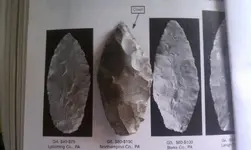
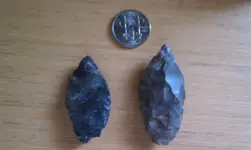
The feedback I received from my friend was similar...the shape is right, but the flaking is not. Also lacks the basal grinding. I'd still like to know more. I Found this online...and the description of the Eastern Version seems to match. I'm not trying to make it something it is not. Which brings up the question: How does one 'type' a point that doesn't fall cleanly into a category?
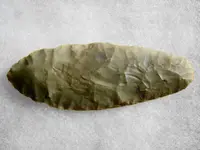
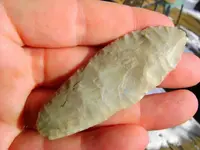
General Description: The Agate Basin is a medium to large sized long, slender lanceolate unfluted blade which is usually skillfully made, especially specimens from the west. The basal edge is either concave, convex or straight and is typically ground. The blade edges are most often excurvate to slightly parallel with basal grinding extending from one-fourth to one-third of the length of the blade from the base. Basal thinning is usually not present. The cross section is typically lenticular.
In the central and eastern states areas, flaking on Agate Basin specimens is usually random with only a few points showing fine horizontal flaking. The differences in this flaking shows the influence that reached the eastern states from the west during the terminal Paleo Early Archaic transitional phase. A type of Agate Basin is found in many areas of the eastern United States however these points are cruder and lack the horizontal flaking most often seen in points originating from the western states. The eastern specimens are not as delicately made and the flakes are wider and larger.
There seems to be very little information in regards to the central primary distribution area of the Agate Basin type. However, studies of collections indicate that the point can be found in the following states: Wyoming, Colorado, New Mexico, Texas, Oklahoma, Kansas, Nebraska, Iowa, Missouri, Arkansas, Minnesota, Illinois, Michigan, Indiana, Ohio and much of south-central and southwestern Canada.
The size of Agate Basin point can range from 63 mm to 128 mm in length. The typical width is less than 32 mm. Thickness averages 8 mm. The Agate Basin was named by Frank H. H. Roberts Jr. in 1943 for examples that were recovered from the Agate Basin site in eastern Wyoming. The point type was further described by H. Marie Wormington in 1957.