What's new

An odd stone, but what? Native American? Help please

Alchemy

Sr. Member
Joined
Nov 30, 2006
Messages
339
Reaction score
74
Golden Thread
0
Location
Beautiful Burnett county, WI
Detector(s) used
Ace 150
Primary Interest:
All Treasure Hunting
First let me say it's been ages since I've posted. I come here quite a bit and lurk, read up and still love this place!

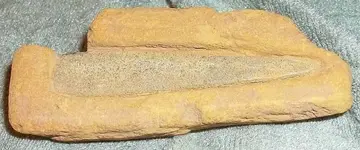
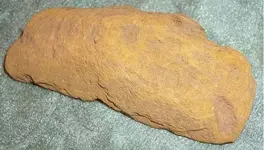
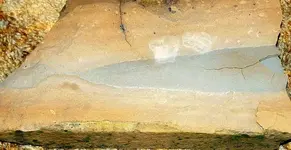
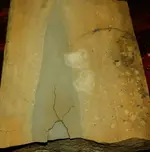
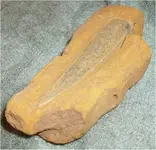
Ok, now to the strange stone. It looks man cut for sure, but why and what it was used for, I am clueless.
It's pretty small at 4 1/4" by 1 3/4". The thickest part is approximately an inch or so.

I thought before I take it to the rock and gems area, I thought I'd pick some brains here first! ;D
 

Attachments

  • stone1.webp
    stone1.webp
    110.8 KB · Views: 1,805
  • stone3.webp
    stone3.webp
    63.6 KB · Views: 1,057
  • stone4.webp
    stone4.webp
    71.5 KB · Views: 1,083
Possibly a fire starter stone...rapidly pushing a stick in the groove creating a high heat to spark a fire...
 
Upvote 0
Only a wild guess on my part, but my first thought was the center part looks like a fossil.
 
Upvote 0
Tn Gizmo said:
Only a wild guess on my part, but my first thought was the center part looks like a fossil.

x2!
 
Upvote 0
kuger said:
Tn Gizmo said:
Only a wild guess on my part, but my first thought was the center part looks like a fossil.

x2!
x3. . . .or either a stone hotdog bun! :wink: Breezie

 
Upvote 0
ginnysdaddy said:
Looks like a mold used for pouring molten iron to make a arrowhead.

That was my main thought.
I can see why some would say it looks like a fossil too, but the way the corner is cut, and the way it looks dug out around what looks like the fossil part, seems to have been cut out by human hands. It's a little too perfect. Unless it was done on purpose to make the fossil stand out more :dontknow:

I did a little checking on pouring molten metal in rocks as molds, and it seems it was done, but there is little info out there on it. And, I would think if it had been used this way, it would have more burn to it, on it, around it. All I know about is sand casting (in ancient times) Most Native Americans hammered or pounded out their copper arrow heads, knives, jewelry and etc...

Thanks all

Maybe someone else will come in and say "Oh, this is easy! It's a -----" We'll see :wink:
 
Upvote 0
Alchemy said:
ginnysdaddy said:
Looks like a mold used for pouring molten iron to make a arrowhead.

That was my main thought.
I can see why some would say it looks like a fossil too, but the way the corner is cut, and the way it looks dug out around what looks like the fossil part, seems to have been cut out by human hands. It's a little too perfect. Unless it was done on purpose to make the fossil stand out more :dontknow:

I did a little checking on pouring molten metal in rocks as molds, and it seems it was done, but there is little info out there on it. And, I would think if it had been used this way, it would have more burn to it, on it, around it. All I know about is sand casting (in ancient times) Most Native Americans hammered or pounded out their copper arrow heads, knives, jewelry and etc...

Thanks all

Maybe someone else will come in and say "Oh, this is easy! It's a -----" We'll see :wink:

After looking at the photos more closely, I agree the shape looks deliberate. Here's a blurb I found on Ancient Blacksmithing:


The first ancient blacksmiths cut patterns and designs in solid rock to serve as casting molds. Hot liquid metal was poured into the mold from a crude crucible, and the solidified metal was allowed to cool and take on the shape of the mold design. Later clay was used for molds, since it could be shaped more easily by hand. The clay mold was broken and discarded after the object had been formed. Bronze molds were the next advancement in mold-making. Bronze molds were made of two sections that were clamped together. Molten metal was poured into a small top hole of the mold. Once the metal cooled to hardness, the bronze halves were separated and the object extracted.
 
Upvote 0
Isn't the "fossil" area raised (convex)? Maybe a mold for making molds. Clay would be pressed into it and allowed to harden (or fired), and then removed via the corner. Then you would have a concave clay mold for pouring into. You could make a bunch of them and do one pouring.
 
Upvote 0
I'm going to have to agree with what stefen posted. He said it could've been used as a fire starting tool. I think the chunk in the corner that's cut out is where all of the ashes would've fallen out as they were rubbing the stick on it.
 
Upvote 0
I found one that looks very similar some time ago, never did decide what it is. It was suggested to me that it might be a "Cephalopod Fossil" but I think mine is only a rock.
 

Attachments

  • DSC07201.webp
    DSC07201.webp
    75.6 KB · Views: 1,062
  • DSC07202.webp
    DSC07202.webp
    39.8 KB · Views: 1,119
Upvote 0
it probably pointed the way to a treasure chest
 
Upvote 0
My first gut feeling is that it is a belemnite or a bacculite--a straight ammonite. The porportions look right. Tn Gizmo's looks like a leaf that didn't do well and was replaced with mud. But the bacculite may or may not have "sutures", but if it does, that is very telling. The sutures are hard to describe but they look like salamander gills coming from north to south (if the long axis is e-w). Look up ammonites and there will be a picture of sutures. If there looks like there is still shell in places, that is it! I don't know if belemnites had actual shells, but bacculites did, complete with mother of pearl colors. They should have somewhat of a convex---ed. shape along the length, but it is possible the fossilization process flattened it. I have dug bacculites that don't have shell or sutures, which I believe are mud fillings of the shell. And I have dug some that had a lot of shell on them and broke at the suture lines, leaving a very wavey, uneven junction. Unfortunately, when things are fossilized under different conditions, they can look very different.
 
Upvote 0
I have found many forms of this and it was almost always associated by a close water source. My take on it is..... I think it is Metamorphic rock. A stone is encapsulated by mud and then the mud hardens and eventually turns into stone itself. I'm still trying to explain to my girlfriend that she did not find a Dinosaur egg. I have found all different forms of stones encased like this........Just my take on it!!......................................GTP
 
Upvote 0

Users who are viewing this thread

Latest Discussions

Back
Top Bottom