What's new

Bee Castles

fossis

Gold Member
Joined
Jan 5, 2007
Messages
7,837
Reaction score
100
Golden Thread
0
Location
eastern Oklahoma
Detector(s) used
Whites Prizm 11 & White's XLT
Primary Interest:
All Treasure Hunting
I had to work on my garden , weed eat, take my Grandson fishing, (no luck), so didn't have time to 'prowl around' much.
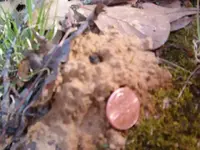
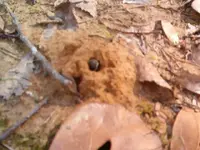
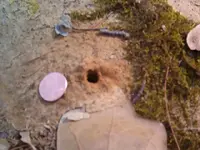
But, i drove down to the river & 'caught a little nap', & while walking around noticed these little 'Bee castles', they are made of mud, & I watched
the Bees going in & out.
they are about the size of a 'Honey-bee', but darker colored, they are not 'Yellow-jackets', (they build in one large nest), & too small for 'Bumble Bees'.
After all my years in the woods, I have never seen these kind.

fossis...............
 

Attachments

  • bee castles 001.webp
    bee castles 001.webp
    37.3 KB · Views: 416
  • bee castles 004.webp
    bee castles 004.webp
    35.8 KB · Views: 398
  • bee castles 003.webp
    bee castles 003.webp
    36.9 KB · Views: 411
glad they didn't take offense at your close inspection.
 
bigfish31 said:
Watch where you sit down.

That's for sure, but I took a stick & played with them, they didn't 'get mad'. ;D

Fossis.............
 
mamabear said:
glad they didn't take offense at your close inspection.

'Bee-leave me' I got 'eyeball to eyeball', & they didn't get agressive. :)

Fossis...............
 
now i have heard everything, tame wild bee's
glad they didnt attack but, i would be too much of a wuss to toss a stick at them---lol
 
olegoat said:
now i have heard everything, tame wild bee's
glad they didnt attack but, i would be too much of a wuss to toss a stick at them---lol

I actually 'poked one', it didn't seem to want to leave the hole, (er I mean castle'.) ::)

fossis..............
 
Those are just Mud Dobbers (I believe?)... I don't know if they sting or not, 'cause I've never messed with them.

Bran <><
 
We have them here.
A cup of gasoline down the hole after dark, cover the hole for the night will cure your problem.
Yes they do sting.
 
godisnum1 said:
Those are just Mud Dobbers (I believe?)... I don't know if they sting or not, 'cause I've never messed with them.

Bran <><

Mud Daubers collect mud from the ground, but build up under the eaves of houses usually.

Fossis...................
 
bbqbull said:
We have them here.
A cup of gasoline down the hole after dark, cover the hole for the night will cure your problem.
Yes they do sting.

These are on 'public land', so I didn't bother them, they're just 'doing their thing'. :thumbsup:

Fossis..................
 
fossis said:
Mud Daubers collect mud from the ground, but build up under the eaves of houses usually.

Fossis...................

Yep, they sure do. But I've also seen them with holes and pushed up mud around some creeks back home...
Maybe yours are different than the ones I've seen though.

Bran <><
 
seger98 said:
Nice photos fossis.

Thanks

Fossis...................

 
godisnum1 said:
fossis said:
Mud Daubers collect mud from the ground, but build up under the eaves of houses usually.

Fossis...................

Yep, they sure do. But I've also seen them with holes and pushed up mud around some creeks back home...
Maybe yours are different than the ones I've seen though.

Bran <><

These are about the size of 'honey bees, only darker', our 'daubers' are the size of wasps.

Fossis................

 
Ernest T Bass said:

Thanks Earnest T, these bees don't seem to match any on the post, the holes are just big enough for them, (the Bee), to get into.
I think i have seen the 'Cicadia killer wasps', they are quite large.
I have had a 'lot of experience' with Yellow-jackets, (23 stings on one arm), quit counting all the rest. :-\

I think Bumble-Bees have the most 'painful sting', (three times in the face).
Fossis.................

 
Fossis, Looks like it may be a mining bee. What do you think?

Mining bees, or digger bees, (familys Andrenidae & Anthophoridae) nest in burrows in the ground. Unlike the honey bee, mining bees are "solitary" bees. They do not form long-lived colonies, nor do they live inside a single, well-defended nest controlled by one queen bee. Instead, each mining bee female usually digs her own individual burrow to rear her own young. Large numbers of these bees may nest near one another if soil conditions are suitable.

Mining bees are not aggressive and seldom, if ever, sting. The presence of numerous bees flying close to the ground, however, may constitute a nuisance for some people. Sometimes large numbers of males will fly about the same spot for several days in a mating display.

Mining bees range in size from about the size of honey bees to much smaller. The larger bees are furry and usually darker in color than honey bees. Some are brightly striped, while others are a shiny metallic green. Mining bee burrows may be located wherever there is exposed soil and good drainage. They are frequently found nesting in banks, such as along road cuts or any type of excavation, but may also be in level ground as well. The holes are about 6 mm (1/4 inch) or less in diameter. They are sometimes surrounded by a small mound of soil that the bee has brought up to the surface. Burrow structure varies according to species, but often there is a vertical tunnel with smaller side tunnels that terminate in a single cell.

The female mining bee stocks each cell with pollen and nectar she collects from flowers and then deposits an egg on the food mass. The larva hatches and consumes the stored pollen and nectar. When mature, it becomes a pupa, or resting stage, and finally becomes an adult bee. The adult bees overwinter below ground in the burrow site. During the next spring or early summer the adults emerge, mate, and the females begin burrow excavation. Mining bee populations can fluctuate dramatically from one season to the next.
 
Ok Country Girl fantastic post! , but, how come you know that much info on Bees?
 
Never seen anything like that around here. Very interesting.
 
extractor said:
Ok Country Girl fantastic post! , but, how come you know that much info on Bees?

I think it was Fossis that got me interested last year with the demise of the honey bee. So I saved a link on bees. Fossis gets me intersted in a bunch of things with his adventures. :)
 

Users who are viewing this thread

Back
Top Bottom