I think I was able to recently decipher something very, very, interesting that suddenly appeared to make a lot of jigsaw puzzle pieces fit. More to that later. Three years ago, an aerial survey of the Eighteen Mile Swamp in Queensland resulted in two areas of wreckage being found, one containing a large amount of metal. The wreck the group had been looking for is a mysterious ship people here popularly called the "Stradbroke Island Galleon", but of course this is no galleon. The first written report of it being seen places it in the late 1870s. Earlier sightings however can not be verified.
There have long been unconfirmed tales of finds on the island, stories of an old coin being found and even a whole chest of coins. To be honest, I always thought that was really nothing more than "island lore". I just didn't believe them. In 2007, an Elizabethan sixpence, minted in 1593, was supposedly found near the wreck site, but I have confirmed that this had most likely been planted to generate free publicity for a book on the subject. A coin which really had been found many decades earlier was allegedly Spanish, according to the book, but the President of the Island's Historical Society recently confirmed to me that she had seen it and that it was a gold sovereign, found by a man called Fraser Brown. I've talked to his relatives.
Fraser was an Aboriginal stockman, Americans would call that "cowboy", who rode all over the almost 40km long island on his horse, looking for stray cattle. That's how he got to areas nobody else went, long before four wheel drives or sand mining crews got there. His people say that he found an old ship's bell on a wreck in the Eighteen Mile Swamp, after a very dry season's fire had burnt away a lot of the vegetation that had obscured it. Others say, he also found a chest or crate of gold coins, but lots of people still just can't believe that.
The gold sovereign he had found however had been seen by too many people to dismiss it as a legend, so that coin really existed. But nobody knows for sure where he found it. The story goes that Fraser and a friend had tried to carry the bell and a chest from the wreck site in the swamp back to Dunwich, where he lived, at the North West of the island, but they found it too heavy and buried both in the bush - only not to be able to find them again later...
Just over 30 years ago, that same bell was found again (I could attach a photo of it which I made recently, if anyone is interested) but islanders claimed it was not a ship's bell and that Fraser had stolen the old bell of the Benevolent Asylum when it closed in 1946. I've researched that - it can't possibly be the Asylum bell (it's a long story). It really is an old ships' bell. That book about the wreck in the swamp claims that it had been uncovered by a bulldozer, which sheared off part of it. That's not true. I verified the true story with the supervisor of the mining crew that found it. His words are: "We were on a smoko (break) when one for the guys went into the bush for a **** and came out again with the bell". It was a bulldozer driver, the husband of the lady who still owns the old bell, but he wasn't driving it when he ran into the bell. He found it lying, half exposed, in the bush. The sheared off piece was not there. The bell has probably been exposed to fire, causing the damage. A ship fire most likely, because bushfires on the island typically do not generate enough heat to shear off 1cm thick solid bronze.
The area where the bell was found 30 odd years ago is on a track leading from the wreck now located in the swamp back to Dunwich, which Fraser is likely to have taken. The bell supposedly had no ship's name on it and no writing at all. I went to investigate recently and had a closer look at it, even at the inside. That's where I found what I could show anyone who may be interested in a second photo, some faint traces of writing, and I've since worked out what these letters and figures are.
The writing inside the bell appears to be marks from a Lloyds of London ship survey. The tell us that somebody had turned up the bell, looked inside and written "53" and "A1" inside the bell to mark the result of the survey. I could post clips from Lloyds Shipping Register for the year 1853, and a ship that had just had a new survey after a restoration earlier that year. That ship was the Madagascar. English bell experts confirm that the bell was cast in high quality bronze and that it is from the 19th century. It has no ship's name on it because it was most likely a foremast bell from a larger ship, which often didn't. The smaller stern bell, mounted near the wheel, would have a name on it.
In 1915, four men from neighbouring Russell Island had applied to the government for a mining lease, not for the sand dunes or any part of the island that could possibly yield minerals, but for the exact area of the swamp in which the two areas of wreckage have now been located in the aerial survey. Why apply for a mining lease in a freshwater swamp, unless you know there is something very valuable in there?
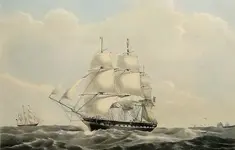
The 1000 ton Madagascar went missing in Australian waters carrying gold coins, like the one Fraser Brown had allegedly found. Gold sovereigns, like the coin confirmed to have been found by Fraser Brown by the President of the Island's Historical Society.... and now we have writing inside the bell Fraser found that appears to confirm that whatever ship it was from had passed a Lloyd's A1 survey in "53", which means 1853 because it's a 19th century ship's bell. Lloyds Register for the year 1853 confirms that the Madagascar, recently restored, had passed an A1 survey in 1853. Pure coincidence? I don't know about that website quoted, might be a scam and really sounds like one. This other information, for what it's worth, is verified and correct.
You'd need to get permission from the Elders of the Quandamooka people for anyone to go in, also from NP&WS. Do not try to enter without permission and a guide, it's dangerous. The closest hospital with blacksnake antivenin is in Cleveland. Regardless of which ship is really there however, it's very interesting.
Now the bad news. No excavating with a digger is likely to be permitted. What's left of the wreck is only the lower section of a ship, under a few feet of swamp water and buried in the peat below that. The swamp is not exactly "hospitable" - there's razor grass, bugs, and there are those red bellied black snakes, highly poisonous but they usually slither away if you make enough noise.




 And what the gold carried by the passengers who were for some of them rich diggers coming back to their home in England?

















