Kuger wrote:
> Not sure what the markings signify, maybe Crusader or Silver Searcher can help?
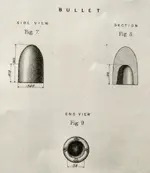
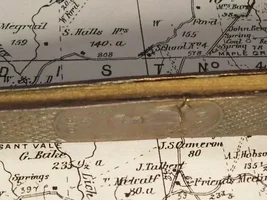
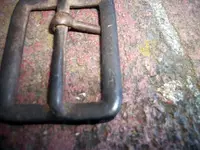
Tinpan's buckle has a distinctive shape of "arrow" mark which was put on various types of military objects to denote that they were the property of the British Government, and/or they had been officially accepted for service by an Ordnance Inspector. (That mark's purpose is similar to marking various US Army equipment with the stamped letters "US.") The distinctive mark on Tinpan's buckle is known as the "British Broad-Arrow" mark. Here's a mid-1800s diagram showing the Broad-Arrow mark on the bottom of a British-made Minie-ball. It is also found on British Army and Navy cannonballs. I don't know whether the British Army/Navy is still using the Broad-Arrow mark today.
I do not know the intended meaning of the letter "H" stamped into Tinpan's buckle. It could represent the manufacturing company. That being said, I should mention that the "font" (lettering-style) of the letter may be an indication of that particular buckle's time-period. Prior to the 1880s, most such letter-markings were done in "serifed" lettering, and after that time tended to be in "plain block" lettering. Note, that's only a rule-of-thumb (not a 100% rule) for dating lettered markings, because I've seen a few exceptions to the rule. But the plain-block letter H mark is an indication that Tinpan's buckle was manufactured in the late-1800s or early 20th-Century.
See the illustration below showing serifed letters, with the red part being the serifs on the letters.




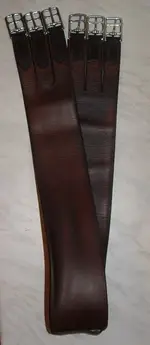
 well I'll be darned,in 35 years a horseback,and building saddles(western,and bronc)I aint never seen a cinch like that,but then again,never been around any or allowed anybody to ride "English"!!!