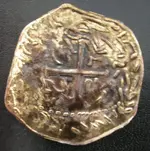
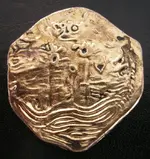
"As I look at the edge of the coin, it is thicker wherever there is an angle as shown in the head-on view. There may be a not-well-defined rim on the side where the cross is."
Hi again Monte. About that rim; as you probably know, the planchets were usually larger in area than the little blob of gold that was struck between them. The blob would expand when struck to form a non-uniform shape usually. The rim on your's seems to follow this particular non-uniform shape, which I don't think would make sense if it were a genuine cob. The edges would be flat, wouldn't they? An exception might be a cob which expanded beyond the planchets, but again, I would think such a coin would show a rounded interior rim, even if the whole coin was irregular.



 I am sure someone will chime in with the answer soon, there are a few experts for this type of coinage on here. Do you know what the weight of it is?