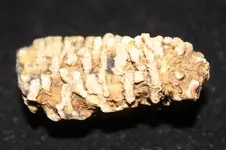
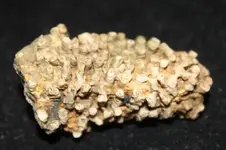
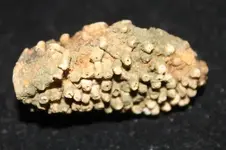
Is this colonial coral or a sponge? Found in northern Oklahoma, along Kansas border.
Thanks for any help!!
sandcreek~~
Oops, I forgot to put a ruler in the pic---this measures 1 1/2" x 3/4".
Thanks JR! Those little holes are pretty neat---I am a fossil beginner, too . I think this is some kind of coral but just as soon as I say that, it will be something else.
sandcreek~~
Honestly I would think coral too, as it is my understanding that in todays coral, the polyp lives in a very small tube, and builds up just like a tube worm does, little by little. That would match perfect with the little holes in each tube, but I'll wait patiently for the experts!
Thanks naturegirl---I had a hard time getting the camera to focus on those little holes.
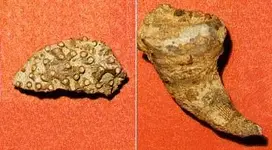
I found a similar one on the Kansas fossil website(http://www.kgs.ku.edu/Publications/ancient/f08_corals.html )called an "auloporid". Here's a picture from the website and a brief description: Another form of coral is colonial, a simple example of which is auloporid on the left in the photo above. Lacking in internal skeletal features, each successive trumpet-shaped individual or "corralite" directly builds from its parent predecessor in a manner termed budding.
See what you think.....
Yes, maybe so . It says "Syringopora grew as individuals not a true colony coral. They built their tubes close and joined together with small connecting tubes."......From the website http://www.catnapin.com/Fossil/CoralReef/ffCoral.htm .
Thanks LanceHall
sandcreek~~



 . I think this is some kind of coral but just as soon as I say that, it will be something else.


 . It says "Syringopora grew as individuals not a true colony coral. They built their tubes close and joined together with small connecting tubes."......From the website