- #1
Thread Owner

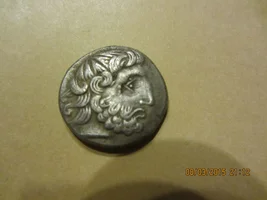
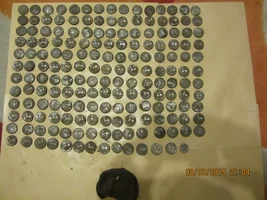
When I see the picture above with 6 coins, I can tell that they didn't come off the GD. They are round and minted and I don't think that happened in 1656 as opposed to all the P of 8 in the following picture. When I lived in Australia Allan Robinson put on a tour and talk about the Gilt Dragon. While in Adelaide he stayed with me for 3 days. He gave me the pick of a bag full of coins from the GD. He was arrested later in Sydney and decided to commit suicide while in jail. When I see the word looted I know that the article was written by an Archie. A picture of the GD coin I chose.Here is more on he story On 4 October 1655, Vergulde Draeck of the Amsterdam Chamber of the Dutch United East India Company (VOC) set sail from Texel, on what was to be its second and final voyage to Batavia (modern Jakarta) in the East Indies.
The jacht Vergulde Draeck carried a cargo of trade goods worth 106,400 florins, together with eight chests of silver coin worth 78,600 florins, and the crew consisted of 193 men. Following Brouwer’s route, the vessel made use of trade winds before making a northward turn to the East Indies. The vessel was lost on 28 April 1656 on a reef off the coast off Western Australia, north of Yanchep, near Ledge Point. The vessel began to break up immediately and two of the ship’s boats were launched. Subsequently, a boat was dispatched to Batavia to get help. Arriving on 7 June they reported that 75 people of the 193 people on board had reached the shore and the other one of the ship’s boat had been driven ashore and damaged. Several vessels were dispatched to try and find the survivors but no one was found.
When the site was discovered in 1963, it had been looted and damaged. The wreck’s original finders approached the Western Australian Government suggesting that they transfer their rights as finders of the site to the Government on the condition that the site was protected under legislation. ( that was the official stance but reality was more cut throat than that. )
In the 1950s Clive Daw was an agent for the stock firm Goldsborough Mort and purchased bulls for R M B Edwards and Sons who had properties near Moore River. The family homesteads were known as ‘Millbank’ and ‘Woodlands’ . This was the same Edwards family who found ducatons and Mamieta Gins at what became known as the ‘Money Desert’ on the coast north of Moore River in 1931. These coins are believed to be the private property of one of the shipwreck survivors.
View attachment 2230512
The Edwards were happy to share the discovery story with Clive daw and show him some of the coins.
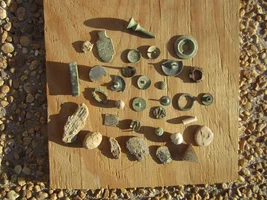
Daw was intrigued by the story and began thinking about the relationship between the coin site and the possible location of the wreck, which was unknown at the time. He visited the coin site in the late 1950s with an old army mine detector and found a corroded bronze clasp which he did not consider was necessarily related to the Vergulde Draeck but kept it as a curious find.
View attachment 2230513
In late 1963 the site was protected by law and the WA Museum’s Department of Maritime Archaeology was called in to assess and excavate the site in 1971. In 1972, the Department conducted its first major excavation. Over several months a very large collection of artefacts was systematically excavated from the site. Finds included beardman jugs, clay tobacco pipes (including a box of complete pipes), bronze and brass utensils, tools, accessories, glass bottles, various armaments, over 8,000 bricks from the Netherlands (presumably used as paying ballast on the ship) and over 8,500 silver coins, mostly Spanish reales.
View attachment 2230511
The 1972 fieldwork was the first major underwater archaeological excavation undertaken in Australia and saw the commencement of a series of major archaeological excavations by the Department in the 1970s and 1980s. Subsequent visits to the site were made in 1981 and 1983.
View attachment 2230515
The objectives in 1981 were to excavate the main wreck site areas that had been left at the end of 1971–72. This proved to be extremely difficult because of the bad weather and limited time.
View attachment 2230514
The 1983 season was a great success due to long periods of unusually calm weather. During the excavation period, on the 19 days when diving took place, a total of 332 diving hours were recorded. Finds included a Southeast Asian smoking pipe (a very unusual find for the mid-17th century), several beardman jugs and an astrolabe.
Crow
The Australian government and archeologists hounded Allan Robinson to the point he took his own life. They had blood on their hands.When I see the picture above with 6 coins, I can tell that they didn't come off the GD. They are round and minted and I don't think that happened in 1656 as opposed to all the P of 8 in the following picture. When I lived in Australia Allan Robinson put on a tour and talk about the Gilt Dragon. While in Adelaide he stayed with me for 3 days. He gave me the pick of a bag full of coins from the GD. He was arrested later in Sydney and decided to commit suicide while in jail. When I see the word looted I know that the article was written by an Archie. A picture of the GD coin I chose.View attachment 2231556

Agreed, Crow. But we're in a catch-22. Any significant wreck cannot be salvaged without the locals reporting you, or the coastal authorities checking you for drug trafficking. If you happen to come across a few coins, fine. But if you're putting together a serious project, it's next to impossible to do so without a permit. Your investors MUST know this dilemma in advance (we warn ours profusely to reconsider). If they're still willing to risk it, then it's game on.But its a time reminder to where ever you are in the world governments cannot be trusted even with signed commercial agreements.
I agree with your thoughts 100%. Catch 22 the system they created does not rewards honesty. No matter how much we wrap a project in virtue signaling. There are investors that are good investors. Other that are more trouble than its worth.Agreed, Crow. But we're in a catch-22. Any significant wreck cannot be salvaged without the locals reporting you, or the coastal authorities checking you for drug trafficking. If you happen to come across a few coins, fine. But if you're putting together a serious project, it's next to impossible to do so without a permit. Your investors MUST know this dilemma in advance (we warn ours profusely to reconsider). If they're still willing to risk it, then it's game on.
To me it seems like you need to do it for the love of it, not for solely for the monetary gain. After you have to jump through all the hurdles you mention above you still run the chance of losing your rights to it, if all your i’s are not dotted and all of your t’s crossed.At the end of the day commercial salvage is a business. There has to be profit from the effort. Regardless of a treasure land sea historic artifacts. base metals or even mining ventures.
Many treasure hunters are absolute terrible business men. A successful project has to achieve high results in key performance indicators.
1. research has to as best as possible free as of as much assumption as possible. more facts than hypothesis. to prove beyond doubt there is asset worth recovering to beginning with. Understand all legal, political implication and financial. marketing such recovered assets into liquid as assets.
2. Planning such projects take time weaving reserve into a project that has practical research, finance, search, recover, and dispose project. Each stage has to be meretricious planned but also allowing for variables that such arise during such complex projects. Most of all sticking to Budgets and getting the most efficient bang for your buck.
3. Building a team to meet key performance indicators of each stage. Very few people have the entire skill sets needed. Every one has different life experience and skill sets. Matching the right skill sets to right task at hand is crucial to have any chance of success. Making sure what roles each team member has in respect to each stage and keep them on the same page. Is no easy task. But is essential in achieving a successful outcome.
4. Enabling everyone involved in the project to reach the same goal. If one fails it can derail the whole project. That is why it is so important you distinguish between driven people and others there for a free ride. Efforts of people can vary depending of their perceived self worth in the project and their ultimate performance.
5. As a leader overseeing a project there can only be one ultimate decision maker that macro manages and micro manages the project. Its his skill and trust in the expertise of each team member in various role will ultimately play a huge role in the success of an operation. Each team member may not fully understand the roles of other only their role. As a leader of the project you must be able delegate roles and express clearly your expectations on what role has to achieve. There is a clear distinction between key personnel and hired hands.
Many time I had been a team member for one role only and bound by NDA with the corporate or company framework. You like me, we all have different skill sets. to use them to best ability to achieve the best outcomes possible each team members need to know the boundary they are working with in.
Crow