What's new

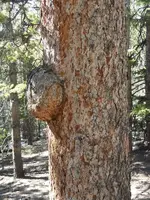
Does this need to be lanced??

colorado14ers

Bronze Member
Joined
Jul 3, 2010
Messages
1,530
Reaction score
6
Golden Thread
0
Location
Naples, Fl
Detector(s) used
whites M6, Surfmaster PI
:tongue3: :laughing9:
 

Attachments

  • Leadville 2011 (ibex ore house) 011.webp
    Leadville 2011 (ibex ore house) 011.webp
    292.6 KB · Views: 520
:laughing9: :laughing9: :laughing9: Watch out, that things liable to blow any second!!!!! :laughing9:
 
No. The tree does that naturally to try to protect itself from fungal invasion. If you look at it in cross-section, it will have a lot of pitch pockets in it. Pitch is a tree's natural immune system keeping saprophytic fungi (parasitic) away.

If you tried to knock it off, you'll only harm the tree more than it already has been harmed.

That's probably where a limb was knocked off by a nearby falling tree many years ago.
 
Tuberale said:
No. The tree does that naturally to try to protect itself from fungal invasion. If you look at it in cross-section, it will have a lot of pitch pockets in it. Pitch is a tree's natural immune system keeping saprophytic fungi (parasitic) away.

If you tried to knock it off, you'll only harm the tree more than it already has been harmed.

That's probably where a limb was knocked off by a nearby falling tree many years ago.
hmm, i was wondering what the heck it was :laughing9: i dont think anyone will harm it (its at 10,000 feet offa hiking trail)thanks for all the info! ;D
 
I learned something, have seen those before but just never gave it much thought. Now I must decide what bit of knowledge I must forget in order to have room in my brain for this new info. (maybe an old movie since I seem to be deleting those anyway as I grow older)
 
Tn Gizmo said:
I learned something, have seen those before but just never gave it much thought. Now I must decide what bit of knowledge I must forget in order to have room in my brain for this new info. (maybe an old movie since I seem to be deleting those anyway as I grow older)
LOL
 
Wow!

That looks like it would be the perfect size for a bowl - If that ever comes off there - I'd love to turn it.


Beth
 
Royal said:
Nope, It is called a Burl and is natural. Woodworkers turn them into some beautiful bowls... http://en.wikipedia.org/wiki/Burl

But being a pine burl it would not make that good of a bowl. Probally to sappy and chatter on the lathe.
 
I've turned pine - kiln it for a bit, or leave it dry for 6-9 months, first, of course.

I am turning some pine right now for wheel spokes - have to turn it a tad faster, and be real careful, though. (helps stop the bumpies), and takes more sanding - and I like to treat pine afterwards, so nothing leaks in the future (pine can weep for over a year).

Probably wouldn't want to mess it with until all the sap is out - and have to watch for splintering - the biggest pain for me for pine, is cutting too fast and screwing it up. (I don't know if that's normal, or if its just me) I'd leave that outside just like it is, and just turn the inside.

:tongue3: My dad taught me to turn when I was young - and finally got back into it when I was in my 30's, you should have SEEN the first 10+ pieces of pine I turned - my dad would NOT have been proud. :tongue3:

This guy, Mike, turns pine bowls all the time - pine burl can be beautiful.

http://mikemahoney.bowlmakerinc.com/2010/12/pine-burl-bowl.html


Beth
 
Royal said:
Nope, It is called a Burl and is natural. Woodworkers turn them into some beautiful bowls... http://en.wikipedia.org/wiki/Burl
Need to check your definition again, Royal. This has no green suckers growing from it. It is not a burl. It is, as stated before, a healed scar from where a limb was knocked off.

Burls, again by the definition cited above, are typically on hardwood (deciduous) trees. I have seen them on cherry, apple, walnut, hawthorne, birch, oak, chestnut, maple, and many more.

The photo shown is pine, which is quite rare for burl formation.
 
This is a bowl turned from a Redwood burl...no two are ever the same...
 
mrs.oroblanco said:
Here is a pine burl.

While it may be rare (which I'm not sure of, in Pa, lots of pine trees get them), it doesn't mean it is non-existent. Either way, it would make a great pattern, I bet.


http://www.flickr.com/photos/41188800@N00/172525368/in/photostream


Beth
Your example above IS a burl. See the green sucker growing from the top, plus the knobby features on the face? That is, by definition, a burl. The example given for this thread however, if not a burl. It lacks these green suckers growing from it, it lacks the knobby appearance, and therefore is not.

BTW, do you know what species of pine this is? Could it be Eastern White pine, which is one of the few coniferous trees noted for burl formation?
 
I'm not 100% sure why there is all this discussion on whether or not it is a burl - because I said I'd like to turn it?

It is a burl - plain and simple - different woodworking folks can look it up - or call it this, that or the other thing.

Websters dictionary:

Burl

a : a hard woody often flattened hemispherical outgrowth on a tree

Dictionary.com

–noun
1. a small knot or lump in wool, thread, or cloth.
2. a dome-shaped growth on the trunk of a tree; a wartlike structure sometimes 2 feet (0.6 meters) across and 1 foot (0.3 meters) or more in height, sliced to make veneer.


Bottom line here - a burl is not the "why" of something - its the growth on the trunk.

And - they can still be turned, and they are all beautiful when they are turned - or like my grandfather used to do - make it into veneers.

Beth
 

Users who are viewing this thread

Back
Top Bottom