- Joined
- Apr 24, 2010
- Messages
- 13,022
- Reaction score
- 28,187
- Golden Thread
- 1
- Location
- Upper Canada 🇨🇦
- 🥇 Banner finds
- 1
- Detector(s) used
- XP Deus, Lesche Piranha 35 Shovel & 'Garrett Carrot'
- Primary Interest:
- Relic Hunting
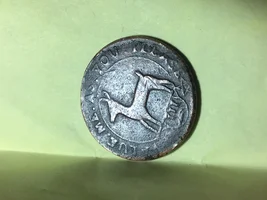
I first detected this field in 2014, at that time the soil was turned annually. The farmer switched to ‘no till’ in 2018, since then the finds have been far less in quantity and quality. But hey, beggars can’t be choosers right.  I arrived here at 5:30am on Sunday morning knowing that it was going to be another sweltering day. I lasted until 9:30 but had to call it quits due to the heat and my knee pain. My first find was the ‘holed’ Tiffen Token, then the Agriculture Token and finally the George V Canada Dime. I found the toy cap gun in the yard of a house down the road; I think there may have been a root through the trigger guard when I popped it out. The quartz rock was ‘glowing purple’ in the sunlight in the farm field, so I brought it home.
1812 Tiffin Half Penny Token.
These thin lightweight tokens were imported into Canada, c1832 by Joseph Tiffin, a Montreal grocer. They bore the date 1812 to evade the laws forbidding the importation of tokens into Canada.
1918 Canada Silver Dime.
Featuring King George V, this coin is 92.5% silver. It was minted during World War I and is a tangible example of Canadian currency from that era.
1837 Agriculture & Commerce Lower Canada Un Sou Half Penny Token.
This series of tokens were created for use primarily within Lower Canada in the mid-1830s. They were roughly equivalent in value to a Half Penny, the "bouquet sou" were so called because they displayed a group of heraldic flowers tied together with a ribbon on their obverse. They were initially issued by the banks of Lower Canada and were later imitated by speculators who produced tokens that looked similar but were underweight for their denomination. In both Lower and Upper Canada in the early 19th century, there was little in the way of circulating coinage, and merchants struggled to use what coinage there was available that came in a variety of denominations from numerous countries, including, England, the United States and Mexico. To remedy this situation, the Bank of Montreal issued the first bouquet sou token in July 1835. They were minted in New York State, and about 500,000 pieces were created.
Thanks very much for looking,
Dave


I arrived here at 5:30am on Sunday morning knowing that it was going to be another sweltering day. I lasted until 9:30 but had to call it quits due to the heat and my knee pain. My first find was the ‘holed’ Tiffen Token, then the Agriculture Token and finally the George V Canada Dime. I found the toy cap gun in the yard of a house down the road; I think there may have been a root through the trigger guard when I popped it out. The quartz rock was ‘glowing purple’ in the sunlight in the farm field, so I brought it home.1812 Tiffin Half Penny Token.
These thin lightweight tokens were imported into Canada, c1832 by Joseph Tiffin, a Montreal grocer. They bore the date 1812 to evade the laws forbidding the importation of tokens into Canada.
1918 Canada Silver Dime.
Featuring King George V, this coin is 92.5% silver. It was minted during World War I and is a tangible example of Canadian currency from that era.
1837 Agriculture & Commerce Lower Canada Un Sou Half Penny Token.
This series of tokens were created for use primarily within Lower Canada in the mid-1830s. They were roughly equivalent in value to a Half Penny, the "bouquet sou" were so called because they displayed a group of heraldic flowers tied together with a ribbon on their obverse. They were initially issued by the banks of Lower Canada and were later imitated by speculators who produced tokens that looked similar but were underweight for their denomination. In both Lower and Upper Canada in the early 19th century, there was little in the way of circulating coinage, and merchants struggled to use what coinage there was available that came in a variety of denominations from numerous countries, including, England, the United States and Mexico. To remedy this situation, the Bank of Montreal issued the first bouquet sou token in July 1835. They were minted in New York State, and about 500,000 pieces were created.
Thanks very much for looking,
Dave
Upvote
36


 Great pictures !!! Why do you think they was in the place you marked ?


 Never! Nice saves, research, and cleaning.