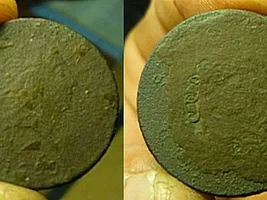
more info.
Hey guys, the issue of "someone holding on tighter to something of more value", isn't really holding water. Since when does the value of something, affect its ability to become fumble finger losses? Even a dime in the old days would buy a beer at a bar. So that might be equivalent to $2 or $3 today? Since when does any of us not stop to pick up the $2 or $3 we just dropped? Or how about all the gold rings that are found routinely on the beach by us md'rs: Do you think anyone "didn't care" or "didn't go look for" that gold ring when he/she lost it? When anyone looses something, it's never "on purpose", or were they ever calculating value to determine when it's time to loose something.
Here's the deal with gold coins: Yes, they represented a day's or a weeks pay. Thus they were not carried like regular pocket change would be. It would be analogous to any of us getting paid today, and making a deposit at the bank. You might take back out $10 and some change to carry, but no, it's not normal for any of us to "carry around $200 to $300 in cash" (although it's possible). Those larger denominations, just like now, were for when you were getting ready to make a big purchase: Like a downpayment on a house. Or buying a horse or buggy, etc.... Thus yes, people *would* have need to carry them at times, but no, not like dimes and pennies, etc...
Also if they got ready to travel, they would often carry their wealth with them, d/t those were in the days before banks and ATMs were as readily around (although "wiring" was in infancy in bigger cities, or at travel hubs).
The type sites I've found mine in were the following: travel locations (stage stops and emigrant type spots), sidewalk tearout, beach (after storm erosion is getting us down to old coins), old-town urban demolition tearouts, and one at a park.