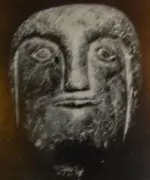
My thoughts are that it looks to calcausion(white) The nose and hair look to be an extention of eachother as if a helmet is being worn, small lips very round eyes, just looks like its from another culture other then native american.JMO.....what say you?
interesting point. The style of bowl, minus the face of course, is typical enough for a one lugged bowl from the Transitional Archaic Period, and there were many steatite quarries in operation here at that time. I'm not certain I can really speak to the racial characteristics displayed, though, because it seems stylized to a degree anyway. There is no doubt in my mind that it is a product of the Transitional Archaic culture right here in southern New England, however. The bowl was found at a major Native American site on the river. Someone else did remark on the resemblance to a helmet, BTW.
I'm just not sure how representational the maker intended to make the face. The very round eyes seem less then artistically representational, don't know anyone whose eyes would look quite like that. I understand your observation though, and it is interesting. I have seen many human head and face effigies from New England, and many of those are not representational enough to determine race either, or don't immediately suggest a native face. Well, I guess we have no real way of knowing if a Viking posed as the model! That's whole subject, Viking or earlier explorers, is a fascinating subject and one I've done research in. Interestingly, when Italian explorer Verrazano, who was sailing in the employ of the King of France, spent 2 weeks in Narragansett Bay in 1524, he described the natives as, quote, "more inclined to whiteness" then other natives he met sailing up the east coast of NA. Which proves nothing of course, but that, plus the fact he showed something he called a "Norman Villa" on his map, in the vicinity of present day Newport, which some have interpreted as evidence the Newport Tower must have been standing in 1524, nearly 100 years before the Pilgrims landed at Plymouth Rock, have been used by some as evidence Europeans were in this area much earlier then thought. The subject of debate since the mid 1800's and it will probably remain an unsettled question.
Of course, the above is all hypothetical anyway. No Vikings over here 3000-4000 years ago.