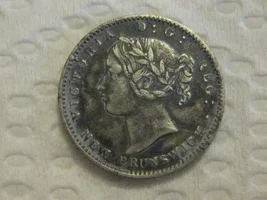
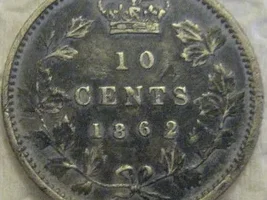
I had a Bounty Hunter Pioneer 202, and they are not bad detectors, they have ID id, and go fairly deep, I found a coin spill of a 1904 barber dime, a 1919 Buffalo Nickel, and an almost uncirculated 1915d wheat cent in my first week of detecting, that was with the Bounty Hunter Pioneer 202. Right now I have a Technetic T2 SE, I liked the hobby and even though I didn't find anything after the pocket spill I didn't quit. On around July 23 2013 it all turned around, after I quit hunting playgrounds, and had my first taste of colonial finds, it was a huge colonial button. Since then I have only metal detected at colonial sites, typically the woods where old houses and farm fields used to be. Of course, you can't go to any woods, you have to look at town records, old maps, check old documents of your town in the library. If you do your research right you will know the history of the place you are detecting, for example, did you know the area I found my first button had many cabins in the early 1700's, then in the early 1800's someone had a farm there until the 1950's. Since then I have found around 25 colonial buttons, 5 colonial shoe buckles, a beautiful 1700's whiskey barrel spigot, many more various colonial relic (just look at my signature below my main post),a 1655-1658 Louis XIV French Liard, a 1723 Wood's Hibernia Halfpenny, a dateless king II King George II young head Half Penny (1727-1740), some large cents from 1803-1838, and extremely rare 1861 New Brunswick Half Cent with less than 5,000 known. Anyways, don't think you will find something great right right away if you metal detect, chances are you won't. For me it is great just to be outside, and able to relax, knowing you may find something great. Most likely if you metal detect, at some point you find something great.
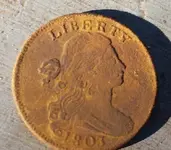
One year ago I would only dream of finding half of what I've found this year. I year ago I thought that finding a would be impossible, but this year with patience I have found a few large cents, and this beauty.
In case you are not a coin collector the value of large cents is based on their grade,
if you have a worn 1803 large cent it may be worth $30, where as if you have a large cent in the condition of the one pictured it may be worth $800+, of course that is without the corrosion.