What's new

Metal detecting in forests

It's possible to find any aged items at any depth. Every piece of ground is different for it's rate of deposition, errosion, turnover, etc.
 
Any other ideas????...
 
Out west, we have Redwood trees, groves of giant trees that are several thousand of years old. Redwoods drop lots of needles, and if these needles caused the soil to build up, I would expect the trees to have soil above their root area. But they don't. So although, the dropped needles or leaves surly cause temporary soil or ground build up, I think that the mass of organic stuff decays into the soil, and becomes nutrients. Therefore, depending on conditions, coins and heavier metal objects tend to sink into the ground. That's why you go to bed rock to find gold in streams. So rain and soil type would have more to do with depth of objects than leaf build up. Just my idea, put a dollar and a half with it, and you probably could get a cup of coffee most any joint I frequent.
 
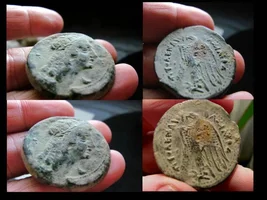
I dug a roman coin in the woods while overseas. The best thing is the coins are not hit by plows and damaged by fertilizers. Also you can often hunt the forest when the fields are frozen . :coffee2:
 
Thank you guys for all your posts...
seems it is absolutely possible to find 500-1000-2000 years old items in 10-30cm depth...
but why are the items not covered by the withered leaves and grass much during centuries is not really clear...
 
I've hunted in some of our giant redwood groves here in northern California. One of the main challenges have been the deep pine needles that tend to cover the coins. I've seen pine needles that were 10 inches deep. I tend to avoid these areas and try to find the hard pan dirt areas where the needle mating is relatively shallow. I've found that most of the silver and wheaties tend to be shallow around the redwood trees, 2 to 5 inches mostly. Find where the foot traffic was, that's where the coins are hidding!
 
Hello Friends,
I'd like to add a very good point here... Hope this will be very helpful to you...

I have searched a lot the web, different forums and discussion boards...

and found a great idea... the old goods are placed in small depths because they are "pushed" from the depth of the ground by The ROOTS of The Trees!!.... and this way 500-1000-2000 old items are placed in 10-30cm from the surface instead of 1-2 meters!! :)
 
do you have a different opinion? I'll be glad to hear it...
 
Decomposing leaves are not dirt and won't add much buildup over the years because as they decompose they are absorbed back into the ground and reused by the plants.

I've found many civil war bullets by scraping back the top layer of leaves and exposing the mineral soil. The bullet was just laying there half in the dirt layer.
 
Ever notice when a tree falls over there is an upheaval of all the roots and a big deep hole is created?
A thousand years of trees falling with craters forming could cause objects to be deeper.

Just as a root could bring something to the surface, it could also do the opposite.

If you are from Europe, then your forests could have easily been cultivated fields hundreds of years ago.
How do you know that it has always been a forest? Also the older the country, the more times that forest has been logged.
I'm sure logging would disturb things quite a bit.

Here is something for you to think about.....
A lot of forests that are near cultivated fields contain very deep objects.
Why?
During years of drought and when there are strong winds, the topsoil lifts off the fields and deposits along the bush line.

I'm sure there are many possibilities but for the most part, I find 200+ year old artifacts fairly shallow in the woods on average.

Cheers.
 
Perhaps a bit of research into the Old Copper Culture would give you some good answers to your questions. Many copper points are found on the surface, and others as deep as detectors can find them. Tnet has a good thread on the OCC, or http://www.exploringthenorth.com/cophistory/cophist.html, also try any search engine query. Some of these finds are as old as 3500 BC. They are found in forests, fields, and lakes, rivers, streams, here in Wisconsin and the Upper Peninsula of Michigan.

Many, many of the ancient mining tools were found on top of the ground at mine sites, undisturbed after thousands of years, as soon as Europeans started coming to the area. It was not uncommon to find large, handled hammers right where the ancient miners had set them down, and these finds sometimes occur yet today. Copper tools are also found as grave goods, obviously intentionally buried. Copper tools found beneath acidic soil show much deterioration, while finds in better soil are can be nearly pristine. Several museums display many of these ancient tools, and some of them show the finds online.

My dream treasure hunt would be to find Alaric's grave, he who sacked Rome and died shortly thereafter, or perhaps King John's treasure wagons. Outside of North America, there are many well known treasure yet to be found and recovered. They all come with huge problems, even without governments and lawyers turning up under every rock. Hope that helps you.

You could also start searching yourself, if you haven't done, and record what you find, and draw your own conclusions based on your experience. If you do, share with us here, many of us would just love to hear your stories. Join the Do It Team!
 
No such thing as an "undisturbed" 1000 year old forest.

How many 1000 year old trees do you see? Trees get old and die, wind blows them over, they get uprooted, etc.

There is a constant exchange going on in the surface of the soil. As was pointed out, worms, small mammals, etc. live in the top layers, constantly eating leaf mulch and mold, borrowing and tunneling, living and dying, loosening and packing soil.

Larger mammals walk the ground doing the same thing, adding their waste, packing soil down as they bed for the night or walk the same paths, which by the way are frequently the same paths man later used to get through the dense forests.

Wind, rain and erosion play a big part in where things lie on and in the earth. Again, as pointed out, one looks for areas to detect in areas where the ground is hardpacked and not under 10 inches of leaves. Wind pushes leaves and soil to areas where a natural windbreak is...maybe 200 years later the wind break has disappeared due to erosion or some other natural event and now it is the barren area.

The 1000 year old forest is not a photo copy of the forest 1000 years later. Trees and undergrowth are not in the same place. Look how the glaciers moved and formed mountains and valleys, look how streams and rivers cut gorges and formed canyons.

Just maybe that object you see laying on the surface has been buried and recently exposed due to high gales of wind, a torrential rain storm, a flood...etc.

Forrests are alive and constantly changing and not necessarily by man. And if the forest is "truly undisturbed" you're not going to find squat left by man...because he was never there. That is unless some creature swallowed something, walked into the forest and deposited it.

Al
 
deepskyal ,
Thanks, for your great post...

and a little offtopic...
"I think...therefore I am." it's from Descartes.. isn't it?...
 
I think so.. therefore it is.
 
is the ground really hard in the winter in the woods? I know its been a mild winter in the Northeast. I am ordering a new machine this week and am looking forward to trying it out. :wav: :wav: :wav: :wav:
 

Users who are viewing this thread

Back
Top Bottom