Re: Musketball babbit?
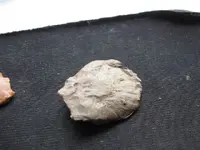
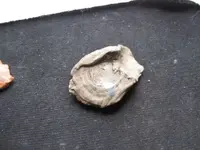
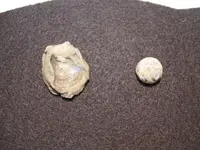
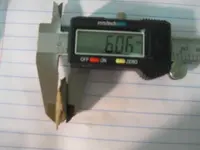
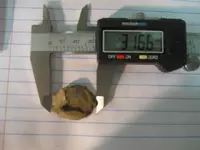
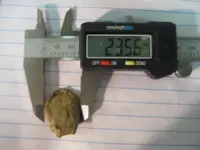
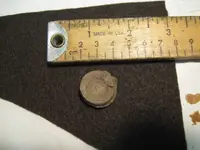
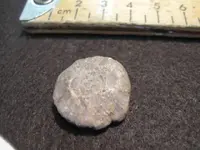
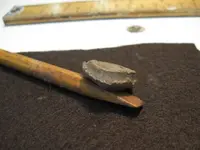
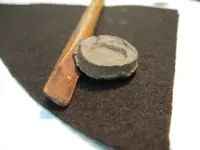
Naturegirl, thank you for providing the size-measurements, and especially, the precise weight. The precise weight is super-important in this case, because damage from impact tends to change a bullet's shape but not its weight. So, yes, the smushed ball you found is most probably a .44-caliber pistol-ball.
As Charlie P. mentioned (thanks, Charlie!), the large cavity in your bullet's base means you found a type of bullet known as a "Minie-ball" (even though it isn't actually a ball). That, and its large caliber, excludes your bullet from being a 20th-century bullet ...unless it is a Reproduction made for modernday Blackpowder hunters -- but its very thick patina strongly indicates it isn't a Repro.
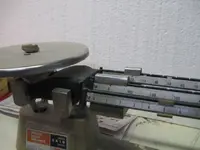
Because you gave me the precise weight of the "splat" bullet, I was able to do some checking for you. I weighed three different calibers of dug civil war Minie-balls (a .54-caliber, a .58, and a .69), to determine which caliber you found. Your bullet's precisely-measured weight (24.8 grams) is right in line with the 25.3 grams weight of my .54-caliber minie. (The .58 weighed 32.6 grams, and the .69 weighed 45.2 grams.) I also weighed a .44-caiber Colt Dragoon revolver bullet. It is 16.1 grams, so your "splat" bullet is definitely a lot heavier than any caliber of pistol-bullet.
I expect you'll be hoping to learn your "splat" Minie-ball's
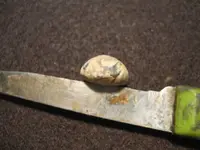
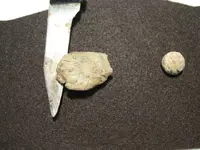
specific ID. Unfortunately, that can be difficult to determine with much certainty when a bullet is smushed/smashed/splattered. However, I seem to see 3 indented grooves encircling the base of your bullet. The third groove is visible in only one area on your bullet, the lower left edge in the photo, but I'm pretty sure it's there. Most (but not all) 3-groove minies were yankee-made, so that is very probably what you've got.
In view of your bullet's "splatter," your guess that your minie struck the very-nearby old rotted treetrunk has a good chance of being correct. Please keep hunting that site, because where there's one fired bullet, there's usually more of them. And, let us know if you have some more luck there.

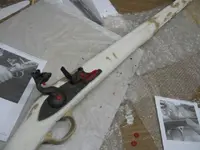
Lastly... just in case Buckshot didn't mention it, regarding your sculpted musket... it is the "Flintlock ignition" type, meaning its hammer used a piece of flint to strike a spark which would ignite the gunpowder. Flintlocks date from the 1600s into the early-1800s. Flintlocks were officially obsolete by the time of the civil war, but some did get used in it.





 I do a lot of muzzleloading with flintlocks.
 I knew about the flintlock because I have a thing for flint too. Having to sculpt one really makes me appreciate the workings of the gun. And now the evolution of firearms. I'll give this one a 'green check',
 . I'm on the bullet hunt now, and maybe I'll get lucky and find a coin while I'm at it. Thanks again-