What's new

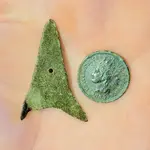
Native American Copper Kettle Arrowhead (c. 1650-1700), 1864 Indian Head Penny

  • Thread starter Thread starter Deleted member 140734
  • Start date Start date
D

Deleted member 140734

Guest
Today I loaded tick spray onto my rubber boots and got out into the woods detecting with my Manticore set to 30 sens. I was pleasantly surprised to find my fourth copper arrowhead. The other three I previously found were clustered fairly close together miles away. I donated the three previously found copper arrowheads to a regional Indian Museum as I will this one. They are quite rare finds as our contact period was mostly shortened by 1700 as an estimated 3/4's of the regional native population had tragically succumbed to smallpox. The Museum will be publishing a book "Native American Projectile Points of Eastern Long Island, NY. They asked permission to publish a page of my artict finds in the book which I readily agreed to.

I thought it ironically appropriate to find an 1864 IHP right after Memorial Day weekend. I often think of the American tragedy of the Civil War. This area has given me several IHP from the Civil War period.

The ticks weren't bad in the mature forest. Despite plenty of rain, the forest floor is desiccated from the the large trees evaporating the water out through their leaves. The ticks are mostly in town on people's irrigated lawns. I see this play out every year.
 

Attachments
  • -coppera1.webp
    -coppera1.webp
    263.9 KB · Views: 207
Upvote 69

Today I loaded tick spray onto my rubber boots and got out into the woods detecting with my Manticore set to 30 sens. I was pleasantly surprised to find my fourth copper arrowhead. The other three I previously found were clustered fairly close together miles away. I donated the three previously found copper arrowheads to a regional Indian Museum as I will this one. They are quite rare finds as our contact period was mostly shortened by 1700 as an estimated 3/4's of the regional native population had tragically succumbed to smallpox. The Museum will be publishing a book "Native American Projectile Points of Eastern Long Island, NY. They asked permission to publish a page of my artict finds in the book which I readily agreed to.

I thought it ironically appropriate to find an 1864 IHP right after Memorial Day weekend. I often think of the American tragedy of the Civil War. This area has given me several IHP from the Civil War period.

The ticks weren't bad in the mature forest. Despite plenty of rain, the forest floor is desiccated from the the large trees evaporating the water out through their leaves. The ticks are mostly in town on people's irrigated lawns. I see this play out every year.
Very nice! Where on Long Island are you located?
 
Great finds !
 
Well found on the kettle point.
The hole is interesting, not sure what the purpose was.

The Mild winter has its benefits, though the ticks benefited greatly here it seems.
Pulled 3 Dog ticks off yesterday.
Only had 1 latched so far this season.
 
Well found on the kettle point.
The hole is interesting, not sure what the purpose was.

The Mild winter has its benefits, though the ticks benefited greatly here it seems.
Pulled 3 Dog ticks off yesterday.
Only had 1 latched so far this season.
Hafting point. Typical for this type of arrowhead.
 
Today I loaded tick spray onto my rubber boots and got out into the woods detecting with my Manticore set to 30 sens. I was pleasantly surprised to find my fourth copper arrowhead. The other three I previously found were clustered fairly close together miles away. I donated the three previously found copper arrowheads to a regional Indian Museum as I will this one. They are quite rare finds as our contact period was mostly shortened by 1700 as an estimated 3/4's of the regional native population had tragically succumbed to smallpox. The Museum will be publishing a book "Native American Projectile Points of Eastern Long Island, NY. They asked permission to publish a page of my artict finds in the book which I readily agreed to.

I thought it ironically appropriate to find an 1864 IHP right after Memorial Day weekend. I often think of the American tragedy of the Civil War. This area has given me several IHP from the Civil War period.

The ticks weren't bad in the mature forest. Despite plenty of rain, the forest floor is desiccated from the the large trees evaporating the water out through their leaves. The ticks are mostly in town on people's irrigated lawns. I see this play out every year.
really cool pieces of history there, thanks for posting
 
East Hampton, south fork of the east end.
Long island is chock full of history. I just watched an interview of the lion gardener’s
 
Well done. Love them both.

That IHc looks like it was uncirculated when it was lost. I can't tell from the image whether there is an "L" on the ribbon or if the point of the bust is narrow. If it is that variety, it will bring a premium, even in this condition.
 
that is a nice find. congratulations.
An interesting viewpoint on the ticks.
 

Users who are viewing this thread

Back
Top Bottom