What's new

🔎 UNIDENTIFIED Need era of maker or information

pepperj

Diamond Member
🥇 Charter Member
Joined
Feb 3, 2009
Messages
52,242
Reaction score
207,103
Golden Thread
1
Location
Eastern Ontario Canada
🥇 Banner finds
1
Detector(s) used
Deus, Deus 2, Minelab 3030, E-Trac,
Primary Interest:
Relic Hunting
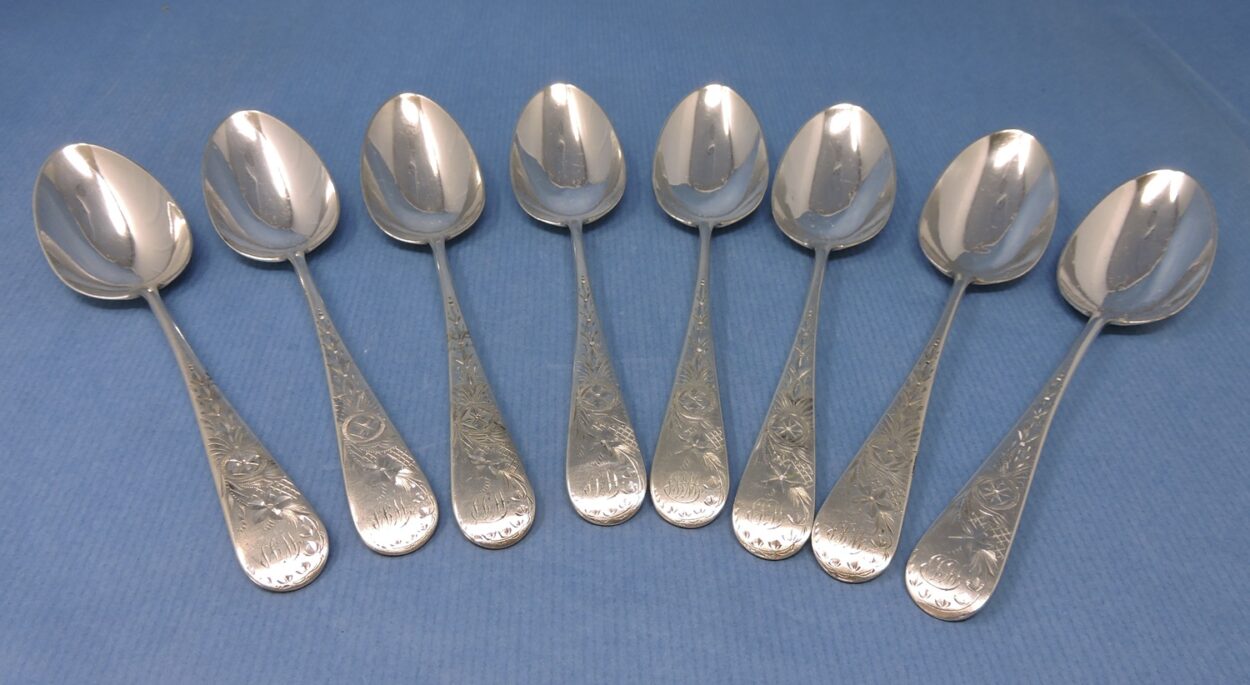
Colonial sterling tea spoons.
Need to figure out maker and era.

20251207_171259.webp
Resized_temp_share_51580684906208.webp
20251207_171334.webp
 
Nice looking, but not sterling silver I’m afraid. The ‘HB & CO’ mark is for Henry Birks & Co. of Montreal from the period when they were operating as a retail jeweller between 1879 and 1897.

The lion (note that it’s ‘rampant’, not ‘passant’ as used for sterling) and a profile head (mimicking a monarch's head duty mark) are those of the maker, Hendery & Leslie. They’re pseudo marks intended to be mistaken for English hallmarks and were used on silver plate/base metal. If not plated, they will be 'German silver' (a base metal alloy that contains no silver).

Birks acquired Hendery and Leslie in 1898 and then used the mark ‘BIRKS’ together with the former Hendery & Leslie pseudo marks plus a date letter. From 1903 onwards they did produce sterling flatware, but it was marked with the word 'STERLING'.
 
Last edited:
Upvote 0
Nice looking, but not sterling silver I’m afraid. The ‘HB & CO’ mark is for Henry Birks & Co. of Montreal from the period when they were operating as a retail jeweller between 1879 and 1897.

The lion (note that it’s ‘rampant’, not ‘passant’ as used for sterling) and a profile head (mimicking a monarch's head duty mark) are those of the maker, Hendery & Leslie. They’re pseudo marks intended to be mistaken for English hallmarks and were used on silver plate/base metal. If not plated, they will be 'German silver' (a base metal alloy that contains no silver).

Birks acquired Hendery and Leslie in 1898 and then used the mark ‘BIRKS’ together with the former Hendery & Leslie pseudo marks plus a date letter. From 1903 onwards they did produce sterling flatware, but it was marked with the word 'STERLING'.

As always an answer that never leaves any doubts on its validity.
 
Upvote 0
Nice looking, but not sterling silver I’m afraid. The ‘HB & CO’ mark is for Henry Birks & Co. of Montreal from the period when they were operating as a retail jeweller between 1879 and 1897.

The lion (note that it’s ‘rampant’, not ‘passant’ as used for sterling) and a profile head (mimicking a monarch's head duty mark) are those of the maker, Hendery & Leslie. They’re pseudo marks intended to be mistaken for English hallmarks and were used on silver plate/base metal. If not plated, they will be 'German silver' (a base metal alloy that contains no silver).

Birks acquired Hendery and Leslie in 1898 and then used the mark ‘BIRKS’ together with the former Hendery & Leslie pseudo marks plus a date letter. From 1903 onwards they did produce sterling flatware, but it was marked with the word 'STERLING'.
So who's duty mark is that then?

The lion rampant sterling mark
signifies silver from Scotland, specifically used by the Glasgow Assay Office historically (until 1964) and by the Edinburgh Assay Office as a voluntary sterling mark since 1975, replacing the thistle. It represents the Scottish Royal Arms and guarantees 92.5% silver purity (sterling standard).
 
Upvote 0
So who's duty mark is that then?

The lion rampant sterling mark
signifies silver from Scotland, specifically used by the Glasgow Assay Office historically (until 1964) and by the Edinburgh Assay Office as a voluntary sterling mark since 1975, replacing the thistle. It represents the Scottish Royal Arms and guarantees 92.5% silver purity (sterling standard).

It's not a duty mark. It's just meant to look like one. The spoons are not silver, and not English or Scottish. The maker was Canadian, using pseudo English hallmarks.

Your mark is pictured here, with the attribution, dating and non-silver composition that I stated above:

https://justinteeantiques.com/pages...fegkQxQZZycylXHk8zReSKvIBzYvNXuG6kceosnKhr_fg
 
Upvote 0
I did a 5+ minute acid test. It's testing out as .925 sterling. Not German Silver as you claim.
Henry Birks didn't operate in the time era of the duty stamp.

Resized_temp_share_57767570911035.webp
 
Upvote 0
Upvote 0
It's not a duty mark. It's just meant to look like one. The spoons are not silver, and not English or Scottish. The maker was Canadian, using pseudo English hallmarks.

Your mark is pictured here, with the attribution, dating and non-silver composition that I stated above:

https://justinteeantiques.com/pages...fegkQxQZZycylXHk8zReSKvIBzYvNXuG6kceosnKhr_fg
Ok it's been a long day so entertain me for a while.
Where do you get German Silver from a sterling mark as noted above?
Show me the link to that please.
 
Upvote 0
I did a 5+ minute acid test. It's testing out as .925 sterling. Not German Silver as you claim.
Henry Birks didn't operate in the time era of the duty stamp.

View attachment 2236551

Read again what I said, and also read the reference information I linked to where your mark is illustrated and described.

I did NOT say the spoons were German silver. I said if they weren't plated, they would be German silver. I suspect your silver test is picking up the plating, but it is possible they could actually be silver. The marks are however not standard sterling marks and when Birks later made sterling pieces they were marked as such.

Birks most certainly DID operate during the duty mark period, but as a retailer, not a manufacturer (between 1879-1897). The actual maker was Hendery and Leslie, as I said. Duty marks ceased in 1890, but that's irrelevant since the mark on your spoons is NOT an authentic duty mark. It's a poor imitation thereof.

If you want to believe something else, feel free.
 
Upvote 0
Same marks, same design, Sterling silver. Note: these are soup/dessert not tea spoons


Screenshot 2025-12-07 at 8.06.57 PM.webp
Screenshot 2025-12-07 at 8.08.28 PM.webp
 
Upvote 0
Read again what I said, and also read the reference information I linked to where your mark is illustrated and described.

I did NOT say the spoons were German silver. I said if they weren't plated, they would be German silver. I suspect your silver test is picking up the plating, but it is possible they could actually be silver. The marks are however not standard sterling marks and when Birks later made sterling pieces they were marked as such.

Birks most certainly DID operate during the duty mark period, but as a retailer, not a manufacturer (between 1879-1897). The actual maker was Hendery and Leslie, as I said. Duty marks ceased in 1890, but that's irrelevant since the mark on your spoons is NOT an authentic duty mark. It's a poor imitation thereof.

If you want to believe something else, feel free.
Your suspension is noted but the rub mark took it well past any plating from that era.
I certainly not going to file it to dispose any of your suspicions.
Plated German silver doesn't hold up to an acid test of that length.
How much experience have you in acid testing silver to state those claims?
 
Upvote 0
.... Plated German silver doesn't hold up to an acid test of that length.
How much experience have you in acid testing silver to state those claims?

A lot of experience actually. Nevertheless, I have conceded the possibility that they spoons may be silver, without being marked as 'STERLING'.

The marks however are not actual hallmarks, but pseudo hallmarks used as maker marks. In general, it's unusual for those to be applied to actual silver since the main rationale for the deceptive practice of using pseudo hallmarks was to create the impression to customers that they were getting silver when they actually weren't..

Every rule has its exceptions and, if they are silver, well done on the score.
 
Upvote 0
A lot of experience actually. Nevertheless, I have conceded the possibility that they spoons may be silver, without being marked as 'STERLING'.

The marks however are not actual hallmarks, but pseudo hallmarks used as maker marks. In general, it's unusual for those to be applied to actual silver since the main rationale for the deceptive practice of using pseudo hallmarks was to create the impression to customers that they were getting silver when they actually weren't..

Every rule has its exceptions and, if they are silver, well done on the score.
Henry Birks wouldn't lower their standards to deceive buyers. They're probably the hallmark of authentic sterling in Canada.
A lot of experience actually. Nevertheless, I have conceded the possibility that they spoons may be silver, without being marked as 'STERLING'.

The marks however are not actual hallmarks, but pseudo hallmarks used as maker marks. In general, it's unusual for those to be applied to actual silver since the main rationale for the deceptive practice of using pseudo hallmarks was to create the impression to customers that they were getting silver when they actually weren't..

Every rule has its exceptions and, if they are silver, well done on the score.
You directed me to the maker and that's what counts. Thank you 😊
 
Upvote 0

Users who are viewing this thread

Back
Top Bottom