

Professor of Engineering
Ruby Member
- Joined
- Oct 5, 2014
- Messages
- 31,916
- Reaction score
- 35,440
- Golden Thread
- 1
- Location
- Massachusetts
- 🥇 Banner finds
- 1
- Detector(s) used
- Garrett: AT Pro, AT Gold & Infinium; Minelab: Explorer SE, II; Simplex; Tesoro: Tejon & Outlaw; White's: V3i
- Primary Interest:
- Relic Hunting
Hello everyone,
After speaking to many Tnet and club members they have convinced me to post a few of my hunts. So I will post todays and some of my future hunts. Still feel a bit funny about posting, but the last post wasn’t painful and the Tnet support was overwhelming.
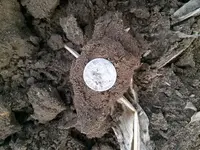
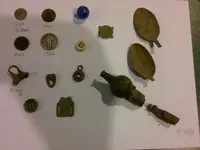
Today, I was in RI and driving down a old farm filled area and seen a farmer in his field just sitting there in a tractor; he was obviously turning over the farm field soil. So I walked over and asked if I could detect his fields, he said “you are not going to find anything; I have let people detect these fields for years.” He then said, “Go ahead and have fun”. I began working in the right hand corner of a large square field, and gridded about 100’ x 100’ area trying to not bother the farmer. As I made pass after pass, moving very slowly and working the coil to barely touch the freshly turned soil. After a few passes, I realized this place has much to offer in terms of coins and relics. The first coin of the day was a 1925 SLQ about two inches down! The next a 1779 Spanish ½ reale (9”), then a 1921 wheat cent (6”) and finally an unknown to me foreign coin (6”) that has a 2 in the front with a date of 1890 and what looks like a German seal on the back (the 2 is not in the correct place for a German 2 Pfenning). I briefly tried to locate the origin of the coin, as of this writing have had no luck. The coin has seen better days, but if I can take a few close-up photos, I may post; someone here will know its origin. The rest of the relics and jewelry were found while completing the gridding pattern, with the marble being a surface find. I hope to hit the field sometime again before it gets to cold.
The two photos are of the cleaned (soft toothbrush) Reale and complete hunt.
Thanks for reading and GL & HH
Regards,
Doc
After speaking to many Tnet and club members they have convinced me to post a few of my hunts. So I will post todays and some of my future hunts. Still feel a bit funny about posting, but the last post wasn’t painful and the Tnet support was overwhelming.
Today, I was in RI and driving down a old farm filled area and seen a farmer in his field just sitting there in a tractor; he was obviously turning over the farm field soil. So I walked over and asked if I could detect his fields, he said “you are not going to find anything; I have let people detect these fields for years.” He then said, “Go ahead and have fun”. I began working in the right hand corner of a large square field, and gridded about 100’ x 100’ area trying to not bother the farmer. As I made pass after pass, moving very slowly and working the coil to barely touch the freshly turned soil. After a few passes, I realized this place has much to offer in terms of coins and relics. The first coin of the day was a 1925 SLQ about two inches down! The next a 1779 Spanish ½ reale (9”), then a 1921 wheat cent (6”) and finally an unknown to me foreign coin (6”) that has a 2 in the front with a date of 1890 and what looks like a German seal on the back (the 2 is not in the correct place for a German 2 Pfenning). I briefly tried to locate the origin of the coin, as of this writing have had no luck. The coin has seen better days, but if I can take a few close-up photos, I may post; someone here will know its origin. The rest of the relics and jewelry were found while completing the gridding pattern, with the marble being a surface find. I hope to hit the field sometime again before it gets to cold.
The two photos are of the cleaned (soft toothbrush) Reale and complete hunt.
Thanks for reading and GL & HH
Regards,
Doc
Upvote
82





 I think living in Massachusetts has some advantages when it comes to metal detecting. Many of the farms have been around since the late 1600's to early 1700's, this sure helps when looking for old Spanish silver and other interesting relics.

 I love just thinking of how the coin ended up at this location. As for SLQ, I have only found a few of them, but Spanish Reale coins a nice hand full...go figure.
















